
When we talk about transportation infrastructure, we often talk about funding鈥攈ow much is available, how it gets spent. But often the fundamental constraint is more basic: space.
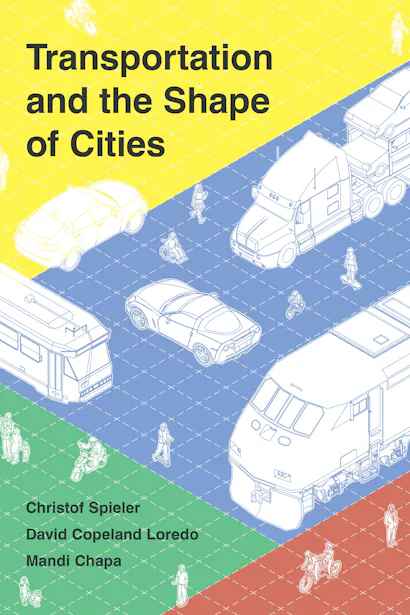
In our book Transportation and the Shape of Cities, Mandi Chapa, David Copeland Loredo, and I map that out. Every form of transportation takes space even sitting still: a person is roughly 2 feet wide, a car is 6 陆 feet, a locomotive is 10 feet. Moving takes more space: that car needs 25 feet to turn 90 degrees, and the train needs 350 feet. The faster something goes, the more space it takes. By the time the car is going 65 mph, it needs a 1,500 foot radius, and a 200 mph high speed train needs 13,000 feet.
These dimensional requirements are set by sizes and by physics. They drive the shape of our cities.
Every element of the street has a minimum size. A traffic lane needs to be at least 10 feet wide, a parking lane 8 feet wide, a one-way bike lane protected with concrete curbs is 8 feet, and a sidewalk is at least 10 feet. A 60-foot-wide street can fit four lanes of traffic, two lanes of traffic with parking on both sides or two lanes of cars with bike lanes on both sides. No matter how much we want to fit all of that into a smaller space, we can鈥檛.
Parking is famously space intensive. A parking space is 18 feet long; one with a drive aisle and two spaces consumes 60 feet. A parking garage ramp from one floor to another is 160 feet long. Therefore, the minimum footprint for a garage is 120 by 244 feet. A lot smaller than that can鈥檛 fit efficient structured parking, and if city ordinances require parking that lot might simply not be developable.
Steel wheels on steel rails make trains energy-efficient but also make it harder to climb slopes. An overpass over a railroad track takes 560 feet to slope up to clear a double stacked container train, then the same distance on the other side to slope back down. If we add an overpass to an existing street, we let people cross without being blocked by passing trains. But we also cut off access to businesses for two city blocks on both sides and disconnect any cross streets.
Different modes of transportation have wildly different spatial requirements. A 10-foot-wide space can carry 6,800 people an hour on foot, 7,200 people in buses, and 1,200 in single occupant cars. If we鈥檙e trying to get people to a game, a festival, or a concert, it takes a quarter as much space if people arrive on transit than if people drive. That鈥檚 not an ideological statement; it鈥檚 a fact.
It is critical to understand all this if we want to build great cities. No amount of creativity, engineering, or community outreach will change it. Transportation is, at its heart, geometry.
But geometry is also political.
In every street design project I have ever been involved in, everyone has ideas for what they want to fit in a street. When we add up the space for everything on the wish list, it never fits. Something has to give, and we have to make a choice about what we value.
These dimensions set up choices, and those choices shape our cities. Something like a quarter of our cities is devoted to public right of way. The way we use that space determines what kind of city we will have. And it turns out that different people have different ideas of what kind of place they want to live in.
There鈥檚 a long tradition of saying transportation is not political. The profession of traffic engineering was built on the premise that street design is a technical exercise based on measurable criteria. Politicians love bipartisan infrastructure bills. Reporters often write about wider highways as the inevitable outcome of traffic growth.
But the geometry of transportation requires decisions about how to use our precious shared public space, and in making those decisions we are determining what our cities will be like to live in. Politics is the process of making those choices. Streets are contested space. If we pretend transportation is not political, it simply means someone is making the decisions for us.
Transportation is geometry. The geometry of public space is politics. And we鈥檒l get better cities if we all engage with the fundamental facts of the space it takes to get us where we want to go.
Christof Spieler, PE, AICP, LEED AP is a planner who has worked with cities and agencies across the United States, a former lecturer at Rice University, and author of two editions of Trains, Buses, People, published in 2018 and 2021 by Island Press. He is now the Director of Transportation for Madison, Wisconsin.