
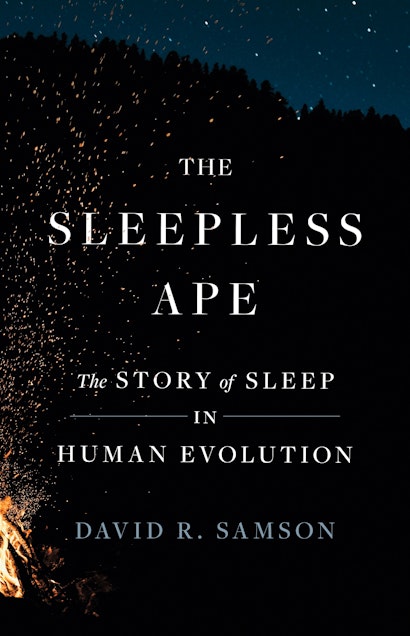
Night should have been one of the greatest dangers our ancestors ever faced.
For most animals, sleep is a risky necessity. It leaves the body still, the senses dulled, and the mind temporarily cut off from the world. Today, the perceived threats that keep many in the Global North awake at night range from midterm exams to board room powerpoint presentations. But for an early human sleeping on the ground in Pleistocene Africa, darkness would have brought real threats: predators, hostile rivals, cold, and the simple vulnerability of unconsciousness. From an evolutionary point of view, sleep presents a problem. It is essential, yet it also makes an animal defenseless.
And yet humans became one of the most successful species on Earth while doing something especially odd: we appear to sleep less than we should. Like鈥 lot less.
Compared with other primates, humans are unusual, if not bizarre, sleepers. We spend less time asleep than expected for a primate of our body and brain size, and yet we function remarkably well. This is one of the great paradoxes of human evolution. If sleep is so important, why would natural selection permit us to get by on less of it? Why did our lineage not move toward longer, safer, more protected sleep, rather than the shorter and more flexible sleep that characterizes our species today?
Part of the answer may be that humans did not solve the problem of sleep as isolated individuals. We solved it socially.
At some point in our deep past, our ancestors began shifting from sleeping in the trees, as other great apes do, toward sleeping on the ground. That transition should have been dangerous. Tree nests offer elevation, concealment, and a degree of separation from predators. Ground sleeping, by contrast, seems like a reckless move for a primate. It exposed our ancestors to new risks just as they were becoming increasingly dependent on terrestrial life.
But humans were not simply exposed animals lying helpless in the dark. We were becoming a species that altered its sleeping environment. Fire likely played a crucial role. So did shelters, chosen sleeping sites, and the protective presence of others nearby. The human night began to change. Instead of each individual bearing the full burden of vigilance alone, the costs of vulnerability could be spread across a group.
This may have had profound consequences.
In many traditional societies, sleep is not an entirely sealed-off state in which everyone becomes unconscious at once for a perfect eight-hour block. In fact, that 鈥渆ight-hours of sleep鈥� is likely not even close to the relative amount needed by humans, and is probably an artifact of 19th century union reps negotiating for a certain amount of downtime. Wild, free range human sleep鈥攆ar from a 鈥渓ie down and die鈥� model of labor negotiated sleep鈥攊s often lighter, more flexible, and more socially embedded than modern ideals suggest. In group settings, some people stir while others sleep. Different chronotypes mean that not everyone grows tired or wakes at the same time. Across the night, there may be a kind of natural relay of partial wakefulness. For our ancestors, that would have mattered. A sleeping group in which someone is usually awake, or close to waking, is a much safer group than one in which every member drops into identical synchronized unconsciousness.
This is the deeper point: humans may have evolved not to eliminate the dangers of sleep, but to buffer them through social life.
That buffering may have allowed our species to do something rare and powerful. Once the dangers of sleep were reduced by social protection and environmental control, humans may have been able to sleep more efficiently. We did not necessarily need to spend as long asleep because we had begun to make sleep safer, deeper, and more reliable. In that sense, human sleep may be part of a larger evolutionary strategy: not just better brains or better tools, but better nights.
And those nights were not only for sleeping.
When darkness became less terrifying, evening could become socially productive. Firelight extended the day. The hours after sunset could now be used for storytelling, teaching, planning, bonding, flirting, comforting children, and reinforcing group identity. Night was no longer just a time to endure until dawn. It became a new arena for human social life. Around fires and in shared sleeping spaces, our ancestors may have done some of the quiet work of becoming human.
This possibility changes how we think about sleep. We often treat it today as an individual biological problem: a personal matter of duration, discipline, and optimization. Did you get enough? Was your room dark enough? Did you follow the right routine? Those questions matter. But they can obscure something deeper: our ancestors survived, not in spite of, but because they learned how to sleep together.
That social achievement may have helped free humans from one of the oldest constraints in animal life. Most creatures remain bound to the night as a zone of danger. Humans, by contrast, gradually transformed it. We made darkness more navigable, rest less perilous, and sleep less of an individual gamble. In doing so, we may have gained something extraordinary: not just protection in the night, but time within it鈥攖ime for culture, connection, and the fragile forms of cooperation on which our species would come to depend.
Our sleep still bears the marks of that history. It is shorter than we might expect, more flexible than we often admit, and deeply entangled with social life. The story of human sleep is therefore not just a story about rest. It is a story about how a vulnerable primate learned to turn the most dangerous hours of the day into a foundation for survival.
David R. Samson is associate professor of evolutionary anthropology at the University of Toronto and the author of Our Tribal Future: How to Channel Our Foundational Human Instincts into a Force for Good. His pioneering research has been featured in National Geographic, Time, and The New York Times and on NPR and the BBC.