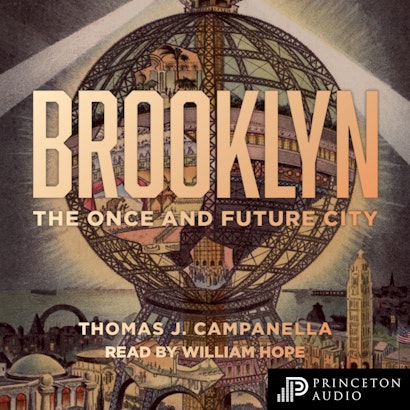
America’s most storied urban underdog, Brooklyn has become an internationally recognized brand in recent decades鈥攃elebrated and scorned as one of the hippest destinations in the world. In Brooklyn: The Once and Future City, Thomas J. Campanella unearths long-lost threads of the urban past, telling the rich history of the rise, fall, and reinvention of one of the world鈥檚 most resurgent cities.
Spanning centuries and neighborhoods, Brooklyn-born Campanella recounts the creation of places familiar and long forgotten, both built and never realized, bringing to life the individuals whose dreams, visions, rackets, and schemes forged the city we know today. He takes us through Brooklyn鈥檚 history as homeland of the Leni Lenape and its transformation by Dutch colonists into a dense slaveholding region. We learn about English 茅migr茅 Deborah Moody, whose town of Gravesend was the first founded by a woman in America. We see how wanderlusting Yale dropout Frederick Law Olmsted used Prospect Park to anchor an open space system that was to reach back to Manhattan. And we witness Brooklyn鈥檚 emergence as a playland of racetracks and amusement parks celebrated around the world.
Campanella also describes Brooklyn鈥檚 outsized failures, from Samuel Friede鈥檚 bid to erect the world鈥檚 tallest building to the long struggle to make Jamaica Bay the world鈥檚 largest deepwater seaport, and the star-crossed urban renewal, public housing, and highway projects that battered the borough in the postwar era. Campanella reveals how this immigrant Promised Land drew millions, fell victim to its own social anxieties, and yet proved resilient enough to reawaken as a multicultural powerhouse and global symbol of urban vitality.
Awards and Recognition
- Winner of the PROSE Award in Architecture and Urban Planning, Association of American Publishers
- Finalist with Special Recognition for the Brendan Gill Prize, Municipal Art Society of New York
- One of Kirkus鈥� Most Anticipated Nonfiction 快色直播 for Fall 2019
- Named a Publishers Weekly Big Indie Book of Fall 2019
- Finalist for the On the Brinck Book Awards, The University of New Mexico
"Mr. Campanella . . . aims to give an account of 鈥榯he Brooklyn unknown, overlooked and unheralded鈥攖he quotidian city taken for granted or long ago blotted out by time and tide.鈥� He succeeds admirably . . . Brooklyn: The Once and Future City is a nuanced portrait of a diverse group of communities. Genteel farmland, then a byword for urban blight, and now the apotheosis of hipsterdom and gentrification鈥擝rooklyn has seen it all. Mr. Campanella, a native Brooklynite himself, brings both love and scholarship to his writing, revealing the true spirt of this fractured land."鈥�The Economist
"Say the name Brooklyn these days, and many people think of Jay-Z or Barclays Center or, most often, skyrocketing real estate prices fueled by gentrification. But for 500 years now, Brooklyn has charted a rich history unique in the American experience. In Brooklyn: The Once and Future City, Thomas J. Campanella . . . has produced a meticulously researched and information-filled chronicle of a place that, in its own way, defines New York City."鈥擯aul Alexander, Washington Post
"An ambitious and accomplished book . . . . For lovers of history and of the city, this book is a dream. It feels like a book that Campanella was born to write."鈥擭ick Ripatrazone, The Millions
"Campanella鈥檚 book does a masterful job of showing how individual egos or ill-planned decisions of long ago set the stage for the city we know today."鈥擫arry Getlen, New York Post
"A lively biography of New York's second borough. . . . Teeming with information, this is a must-read for fans of urban history."鈥�Kirkus Reviews
"A fascinating and well-written exploration."鈥擭orman Oder, Curbed
"Brooklyn鈥檚 history . . . is as specific and varied as its inhabitants. A single block can contain centuries鈥� worth of information, memories and relics left by heroes and villains alike. The prospect of writing a history of such a multilayered city must have been daunting even for as qualified a fourth-generation Brooklynite as Thomas J. Campanella. . . . Thankfully, Campanella takes a practical approach: Instead of attempting a chronology that traces themes or communities through the decades and centuries, he treats each chapter as a self-contained deep dive into a particular part of the borough, describing how that place came to be. . . . Illuminating."鈥擡mily Gould, New York Times Book Review
"Campanella . . . limns Brooklyn鈥檚 multiple identities and the tensions over what the borough was, and to whom . . . a fascinating chronicle."鈥擪atrina Gulliver, New Criterion
"Campanella's magisterial history . . . [is] always approachable and takes readers to the heart and soul of 鈥渢he King鈥檚 County鈥�."鈥擫iz Thomson, Arts Desk
"Every writer knows that there's inherent drama in an underdog story. Brooklyn is the ultimate urban underdog. Brooklyn native Campanella celebrates the onetime city, now-borough's astonishingly rich history, characterized by diversity, immigration, industrialization, decline, and now rebirth . . . vibrant and relevant."鈥擩osh Stephens & James Brasuell, Planetizen
"Campanella is always enlightening and remains critical throughout, with class and racial politics never far from the surface."鈥擠arran Anderson, History Today
"[Thomas Campanella鈥檚 Brooklyn is] not only the best history of Brooklyn, it鈥檚 one of the most entertaining works published this year, suffuse with fantastic tales of the achievements, iniquities, and dreams of its famous neighbor."鈥擜nthony Paletta, American Conservative
"Thomas Campanella鈥檚 Brooklyn is a sheer delight. A cornucopia of mysteries, secrets, meticulous research, and fun facts, it will prove essential reading for anyone with an appetite for New York history."鈥擩ennifer Egan, author of A Visit from the Goon Squad
"Brooklyn is a terrific piece of work, easily the best book on the history of Brooklyn. The tales are winningly told, the writing is vivid, and the authorial presence engaging. Brooklyn has long been historically underserved, but no longer."鈥擬ike Wallace, author of Greater Gotham: A History of New York City from 1898 to 1919 and coauthor of Gotham: A History of New York City to 1898
"A marvelous book that finally does justice to its majestic subject. Nevermore can it be said, as Thomas Wolfe wrote,鈥榦nly the dead know Brooklyn.鈥� Thomas Campanella knows Brooklyn, inside and out."鈥擯hillip Lopate, editor of Writing New York
"Thomas Campanella provides a superb and comprehensive antidote to the perennial plague of Brooklynmnesia."鈥擩onathan Lethem, author of Motherless Brooklyn
"This lucid and thorough history of Brooklyn's origins and progress is just the work we need to understand this sprawling and complex place, long in the shadow of glamorous Manhattan."鈥擜nnette Gordon-Reed, author of The Hemingses of Monticello: An American Family
"Brooklyn is brilliantly written and uncovers the anatomy and soul of this gritty and charming place. If you grew up in Brooklyn, you will cherish this book. If you didn鈥檛 grow up in Brooklyn, you will wish you had."鈥擬itchell Silver, former president of the American Planning Association
"An exceptional and detailed history of Brooklyn. From ancient geology to tungsten-filament lamps, Thomas Campanella鈥檚 insights are virtuosic. Never hoodwinked by nostalgia nor satisfied with conventional explanations, he gives Brooklyn the clear-eyed narrative it deserves."鈥擬ark Chiusano, author of Marine Park: Stories
"This impressive, fresh, and stimulating book investigates the social, economic, and cultural history of Brooklyn. Its use of images is excellent and a point of true distinction. Brooklyn adds to our understanding of the city鈥檚 ethnicity, urban development, and planning."鈥擟lifton Hood, author of 722 Miles: The Building of the Subways and How They Transformed New York
"In this rich book, Thomas Campanella masterfully uncovers and tells fascinating stories and moments from Brooklyn鈥檚 history. Brooklyn is riveting, carefully crafted, and wonderfully written. It will be cited for years to come."鈥擮wen Gutfreund, author of Twentieth-Century Sprawl: Highways and the Reshaping of the American Landscape