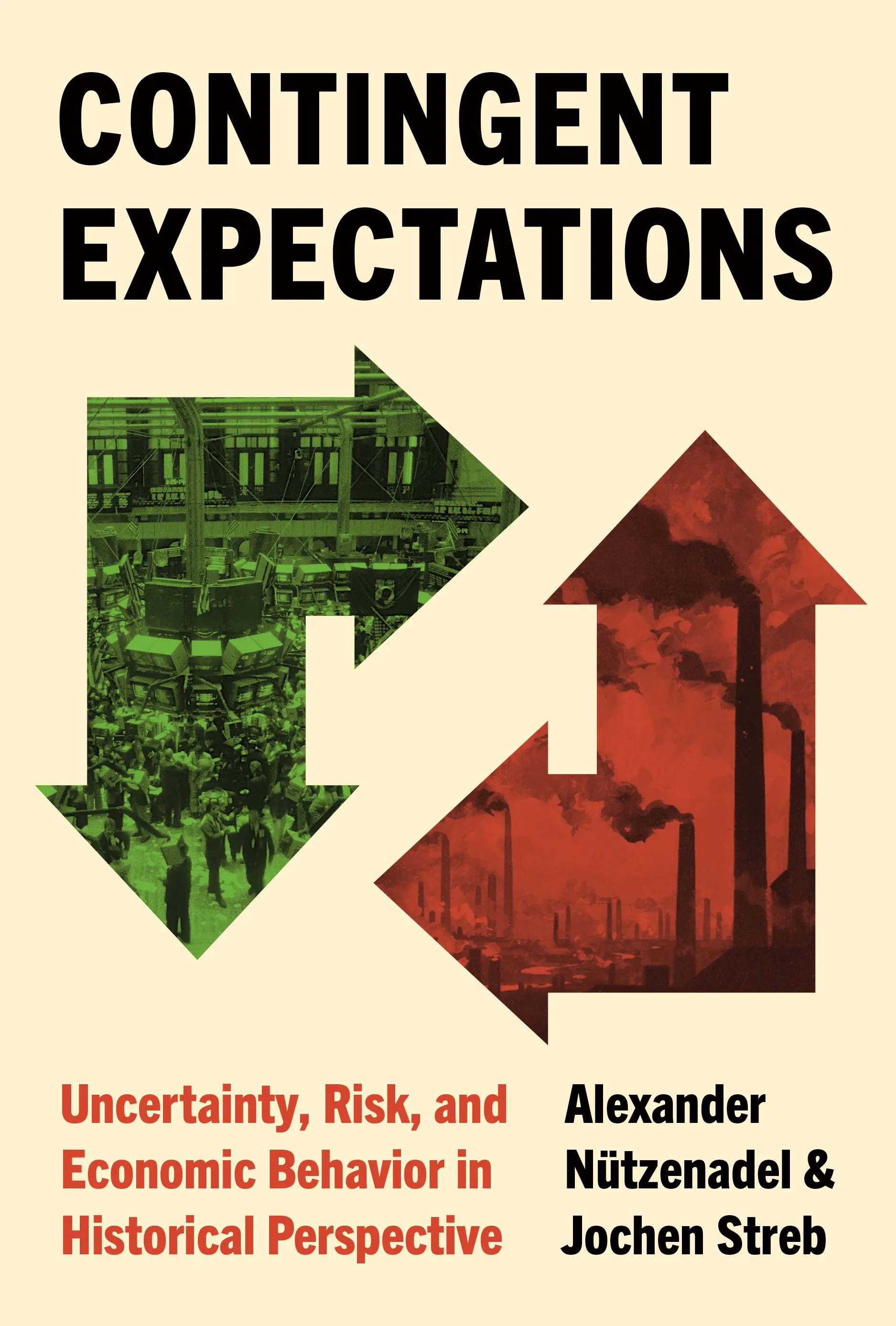
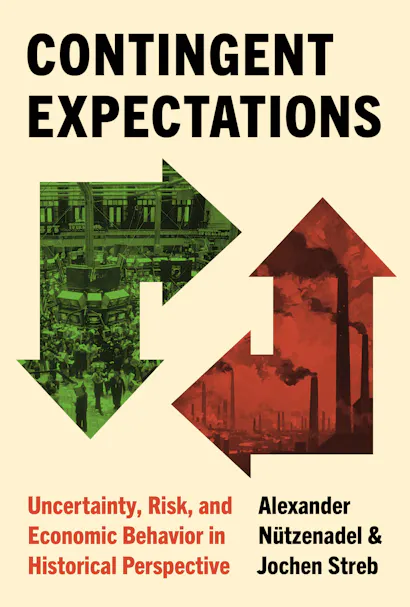
Expectations play a crucial role in shaping economic behavior. But how are expectations actually formed, and how has this changed over time? The financial crisis of 2007鈥�08 cast doubt on traditional theories of expectation formation, particularly the rational expectations framework. In Contingent Expectations, Alexander N眉tzenadel and Jochen Streb examine the ways that past experiences influence the economic expectations and decision-making of households, investors, and policymakers through history, and offer an alternative perspective. Combining a comprehensive empirical analysis of expectation formation from the eighteenth century to the present day with an assessment of the relevant economic theory, N眉tzenadel and Streb present a new theoretical framework, contingent expectations, for understanding economic expectation.
N眉tzenadel and Streb show how economic actors developed new forecasting methods in response to rising uncertainty brought on by the Industrial Revolution, the expansion of global trade, financial market integration, and environmental crises. Tracing the evolution of economic theories on expectations, they find that when growing market volatility made forecasting more complex, economic agents often adapted with remarkable flexibility to changing circumstances. Challenging prevailing concepts of expectations, including rational choice and adaptive expectations, N眉tzenadel and Streb emphasize the heterogeneity of economic agents鈥� cognitive practices鈥攊n particular, the need to consider variation in information costs and historical experience. Expectation formation, they argue, is contingent on each individual鈥檚 current decision-making situation. Their account of the history of economic expectations has significant implications for current debates in economics.
Alexander N眉tzenadel is professor of economic and social history at Humboldt University of Berlin and a coauthor of Deutsche Bank: The Global Hausbank. Jochen Streb is professor of economic history at the University of Mannheim and the author most recently of Trumpf: The Story of a Family Business, about the German family-owned engineering company.
“A tremendously rich and stimulating read. I know of no other recent book that brings history and economics into such a lively and constructive conversation.”—Frank Trentmann, Birkbeck, University of London
“The great strength of the authors’ theory of contingent expectations is that it takes into account the fact that expectations change according to historical context, personal experience, and the information available at a given moment. The book is fascinating because of its ambitious general thesis and the wide range of scientific references from a variety of disciplines.”—Eric Monnet, Paris School of Economics and EHESS
“This excellent book provides long-needed substance to the common idea that economic events are the outcome of expectations and how they coordinate. Examining a variety of original sources, mostly from the last one hundred and fifty years (but with one from medieval times), the authors show conclusively that a universal model of expectation that accurately describes the behaviors of managers, investors, and households across time is inconceivable. Their concept of contingent expectations in which human actors draw on multiple sensemaking skills in their social environment captures a way to use this finding to progress and opens the subject to much more sensible study than hitherto.”—David Tuckett, University College London
“Contingent Expectations delivers a powerful and historically rich reinterpretation of how economic actors form beliefs, overturning the notion that a single mode of expectations formation can account for behavior across time and context. N眉tzenadel and Streb develop the concept of ‘contingent expectations’ with exceptional clarity, illuminating how experiential learning, information acquisition, and the narratives individuals invoke are shaped by the informational and institutional environments they confront. This book stands as a major contribution to the study of beliefs, establishing historically grounded heterogeneity in expectation formation as a central—and indispensable—feature of economic behavior.”—Michael Weber, Daniels School of Business, Purdue University
“Alexander N眉tzenadel and Jochen Streb have combined economics and history to design a new model of ‘contingent expectations’ that is simple enough to be workable and flexible enough to account for historical complexity. This is no mean challenge. The result is an important book, offering food for thought to both academics and decision-makers.”—Youssef Cassis, European University Institute
“Part economic history, part intellectual history, part theory, this intriguing book invites us to consider historical and social context as the foundation for the way people form their expectations about the economic future. A thought-provoking, informative, and thoroughly novel approach to a core issue in economics.”—Timothy W. Guinnane, Yale University
Accessibility Features
-
Inaccessible, or known limited accessibility
-
No known hazards or warnings