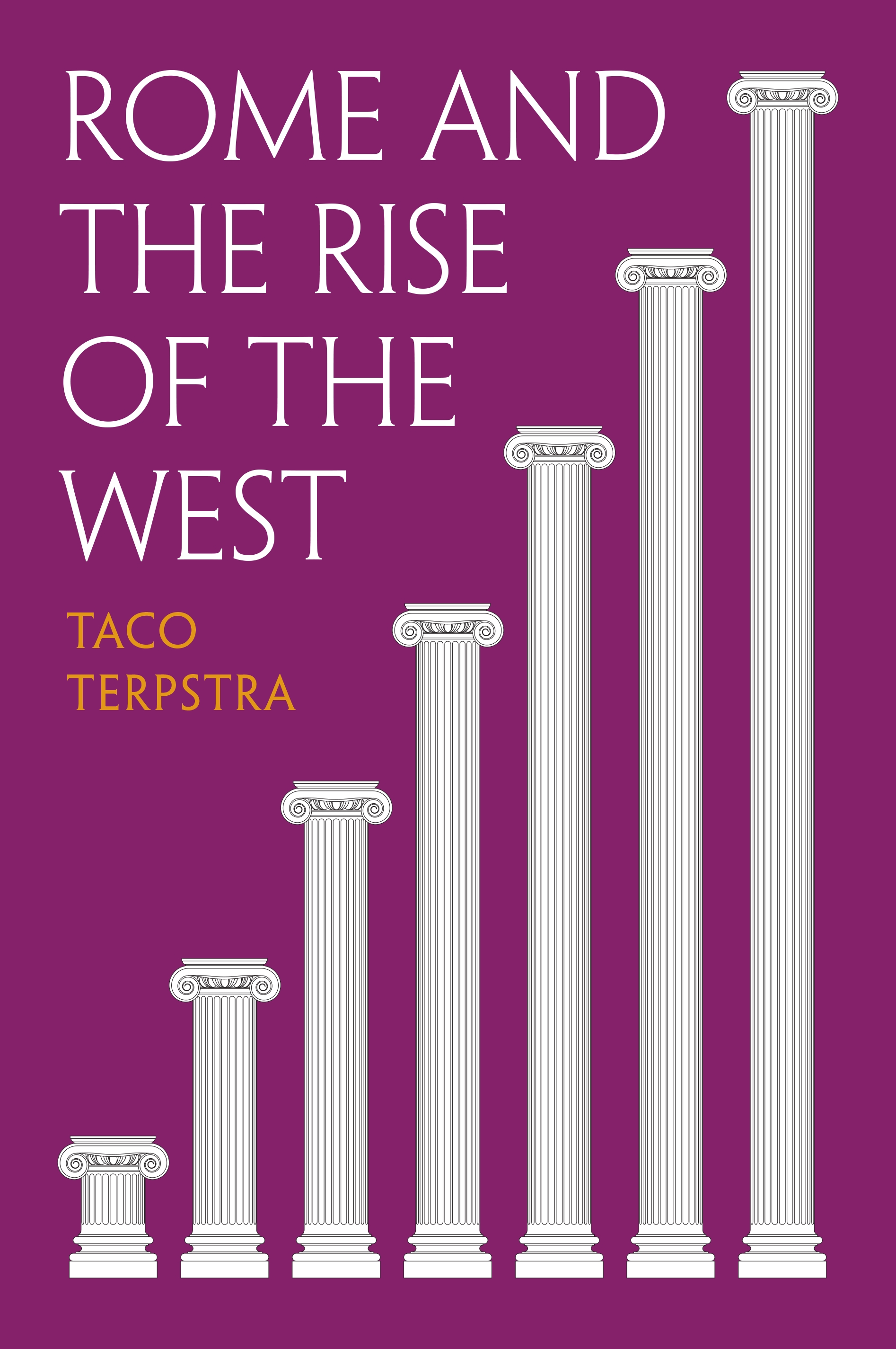
Most historians recounting the rise of the West begin their narratives somewhere in the Middle Ages. In this groundbreaking account, historian Taco Terpstra argues that if we want to understand how the rise of the West unfolded, we need to look further back鈥攁ll the way to the Neolithic, when an upward trend in social development began.
For millennia after the Neolithic Revolution, the fastest rising part of the West was the area of Mesopotamia, Egypt, the Levant and the Aegean. Yet around 1400 CE, the highest levels of social development shifted from the southeastern corner of the Mediterranean to the northwestern parts of Europe鈥攏orthern Italy, France, Germany, the Low Countries, and Britain. As Terpstra shows, it was the shock of the Roman occupation that created the unprecedented and anomalous shift. The post-Roman northwest built on the gains it had made during the imperial era to catch up in social development and achieve Western supremacy. Thus, it was imperial Rome that determined where the modern economy emerged.
Taco Terpstra is professor of classics and history at Northwestern University. He is the author of Trade in the Ancient Mediterranean: Private Order and Public Institutions (快色直播) and Trading Communities in the Roman World.
"Eloquent. . . . Pulling evidentiary support from law, coinage, writing and literacy, astronomy, monumental architecture, epigraphy, weaponry, pre-Roman archaeology, political, military, and religious history, and more, Terpstra constructs a surprising but plausible case, making this book essential reading for historians."鈥�Kirkus Reviews
“This book shows how the Roman Empire was crucial in the long-term rise of the West, thanks to its conquest of much of northwest Europe, its dramatic increase of the region’s social advancement, and the subsequent ratchet effect of economic and technological flourishing. Without these developments, Terpstra reveals, there could have been no eighteenth-century breakthrough. His argument is clear and convincing and has the great merit of being one of those claims that, once you think about it, seems entirely obvious.”—Ian Morris, author of Geography Is Destiny: Britain and the World, A 10,000-Year History
“Foregrounding institutional and infrastructural contributions of the Roman Empire itself, Terpstra demonstrates that Rome laid the groundwork for the eventual rise of Europe. This novel argument reenvisions the importance of Rome for world economic history through the widest lens and convincingly shows the long-range reach of Roman influence where it has often been overlooked.”—Kyle Harper, author of The Fate of Rome: Climate, Disease, and the End of an Empire
“Bold and relentlessly erudite, this book is for those who believe that understanding the past—and unlocking the future—requires breaking the tools we thought we knew. Closely engaging long-standing orthodoxies as well as the most provocative recent theories and analytical tools, Terpstra builds a new global framework in which the Roman Empire served as an exogenous shock that rerouted the trajectories of the four quadrants of the West.”—Jinyu Liu, Emory University
This publication has been produced to meet accepted Accessibility standards and contains various accessibility features including concise image descriptions, a table of contents, a page list to navigate to pages corresponding to the print source version, and elements such as headings for structured navigation. Appearance of the text and page layout can be modified according to the capabilities of the reading system.
Accessibility Features
-
WCAG v2.2
-
WCAG level AA
-
Table of contents navigation
-
Single logical reading order
-
Short alternative textual descriptions
-
Print-equivalent page numbering
-
Landmark navigation
-
Index navigation
-
Epub Accessibility Specification 1.1
-
ARIA roles provided
-
All non-decorative content supports reading without sight
-
No known hazards or warnings