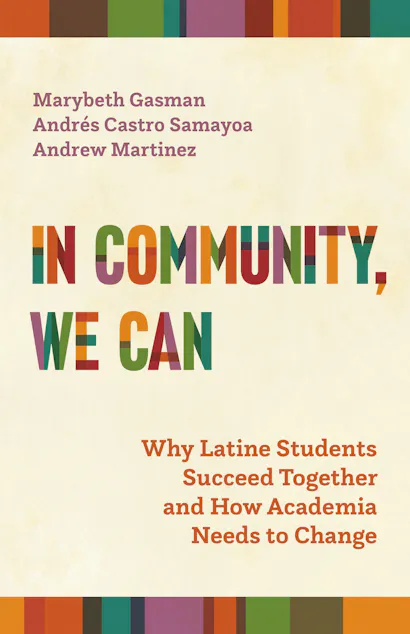
Contrary to conventional narratives, successful transitions from college to graduate school to a university professorship emerge not from isolated instances of knowledge, skill, determination, and grit but from networks of mutual support, shared vulnerability, and communal resilience. In Community, We Can draws on the stories of nearly one hundred undergraduates to explore how Latine students depend on relationships with peers, mentors, families, and communities to navigate college and prepare for graduate school. The authors provide evidence-based data and analysis to show that a focus on individual effort ignores not only how inequities shape opportunity but also how much students lean on one another. It also places the burden of success entirely on the individual rather than asking institutions to share responsibility for students鈥� academic futures.
In Community, We Can shows that shared resources, mutual accountability, and collaborative problem-solving, as practiced by these students, can transform higher education, benefiting academia as a whole rather than just exceptional individuals.
Marybeth Gasman is the Samuel DeWitt Proctor Endowed Chair and a distinguished professor in the Graduate School of Education at Rutgers University. She is the author of Doing the Right Thing: How Colleges and Universities Can Undo Systemic Racism in Faculty Hiring (快色直播), HBCU: The Power of Historically Black Colleges and Universities, and many other books. Andr茅s Castro Samayoa is an associate professor in the Lynch School of Education at Boston College and the author of For the Love of Teaching: How Minority Serving Institutions are Diversifying and Transforming the Profession. Andrew Martinez is the director of college success for KIPPNYC and an adjunct instructor in the Graduate School of Education at Rutgers University.
“This book makes significant contributions to the field. The focus on community rather than individual student achievements is innovative. As a new department chair, I read this with care, and it has forced me to think about ways to improve the graduate school experience for all my students.”—Sylvia Martinez, coauthor of Understanding the Latinx Experience: Developmental and Contextual Influences
“A compelling and urgently needed reimagining of Latine students’ pathways, from undergrad through graduate education and into the professoriate, at a moment when the commitment to diversifying academia appears increasingly fragile. This timely and necessary book reminds colleges and universities of their responsibility to build more equitable, humane, and sustainable academic pathways.”—Victor B. Saenz, coediitor of Ensuring the Success of Latino Males in Higher Education
“A timely and important volume to help faculty, staff, and administrators better support Latine undergraduate students on their journeys to and through graduate school while advancing systemic reforms that foster collective community success. This book is an essential read for higher education practitioners and leaders to honor their obligation to meet students where they are and uphold community and cultural ties.”—Richard J. Reddick, author of Restorative Resistance in Higher Education: Leading in an Era of Racial Awakening and Reckoning
“Navigating the path to a PhD often feels like traveling without a map—especially for Latine students, who rarely receive one. This book is that map, grounded in real student voices: it argues that institutions must be transformed to make success relational, that community drives outcomes, not just morale, and that support is a responsibility, not a favor. It's essential reading for students charting the path and the institutions responsible for building it in the first place.”—Catherine Millett, coauthor of Three Magic Letters: Getting to Ph.D.
This publication has been produced to meet accepted Accessibility standards and contains various accessibility features including a table of contents, a page list to navigate to pages corresponding to the print source version, and elements such as headings for structured navigation. Appearance of the text and page layout can be modified according to the capabilities of the reading system.
Accessibility Features
-
WCAG v2.2
-
WCAG level AA
-
Table of contents navigation
-
Print-equivalent page numbering
-
Next / Previous structural navigation
-
Landmark navigation
-
Index navigation
-
Epub Accessibility Specification 1.1
-
ARIA roles provided
-
All non-decorative content supports reading without sight
-
No known hazards or warnings