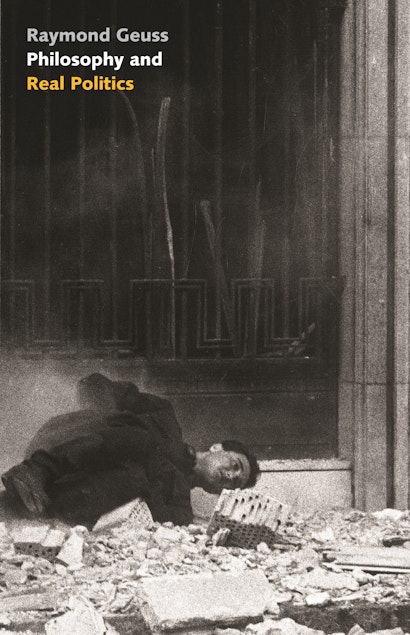
Many contemporary political thinkers are gripped by the belief that their task is to develop an ideal theory of rights or justice for guiding and judging political actions. But in Philosophy and Real Politics, Raymond Geuss argues that philosophers should first try to understand why real political actors behave as they actually do. Far from being applied ethics, politics is a skill that allows people to survive and pursue their goals. To understand politics is to understand the powers, motives, and concepts that people have and that shape how they deal with the problems they face in their particular historical situations.
Philosophy and Real Politics both outlines a historically oriented, realistic political philosophy and criticizes liberal political philosophies based on abstract conceptions of rights and justice. The book is a trenchant critique of established ways of thought and a provocative call for change.
"A discipline-altering book."鈥擥len Newey, London Review of 快色直播
"[Geuss's] intention in Philosophy and Real Politics, his short, sharp new book, is . . . to introduce a note of realism into contemporary philosophical debates about justice, by force if necessary."鈥擜dam Kirsch, City Journal
"A manifesto for a new political philosophy. . . . Geuss's realist proposal brings forcefully to the contemporary political discussion the idea that philosophy is an engaged discipline, both in the sense of engagee, of directly speaking to the political issues of the day, and in the sense of having its own historical cultural commitments firmly in view."鈥擪aterina Deligiorgi, The Philosopher's Magazine
"Philosophy and Real Politics is an impressive and provocative essay on contemporary Anglo-American political philosophy theory."鈥擟hristoph Konrath, Law and Politics Book Review
"[G]iven the current trends in political philosophy, Geuss's book is both timely and extremely important. One of Geuss's many virtues as a political philosopher is his ability to effectively confront philosophical complacency, and this superb book is surely successful in this regard."鈥擠avid Sherman, Social Theory and Practice
"A slim, devastating critique of the flight towards abstraction and pristine idealism in contemporary liberal political thought鈥攁 path led by the late John Rawls. Geuss's work deserves to be far better known."鈥擲unil Khilnani, Outlook India
"In this new study, Raymond Geuss mobilizes the strength of analytical philosophy to subvert the theoretical premises of contemporary political philosophy. He replaces its fixation on ideal norms and its abstraction from real confrontations with an orientation toward contexts of action and a rigorous concentration on the importance of political power. It is fascinating to see the result: a political philosophy that is once again a kind of intellectual craft, historically situated and locally engaged."鈥擜xel Honneth, J. W. Goethe University, Frankfurt
Raymond Geuss is the most sophisticated and subtle philosopher who takes seriously the tradition of critical theory. His critique of formal political philosophy鈥攊ncluding in neo-Kantian philosophy like that of the late John Rawls鈥攖hat shuns the crucial roles of power, historical context, and political action is powerful and persuasive. This grand text is an intellectual breath of fresh air."鈥擟ornel West, 快色直播 University
"Raymond Geuss's short, brilliant, and provocative book forces on political philosophers questions that we often prefer not to raise, let alone answer. Geuss takes seriously the disturbingly untidy character of many political transactions and the dangers of idealized abstractions. His ruthlessness toward Nozick and Rawls is in striking contrast to the attitudes of most of their critics. And Geuss lives dangerously, prescribing remedies drawn from Lenin, Nietzsche, and Weber that may have unpredictable side effects."鈥擜lasdair MacIntyre, University of Notre Dame
"This is a small gem of a book. With his other recent work, it establishes Geuss as a unique voice in political theory. Not everyone will find his arguments persuasive, and some will doubtless take offense, but there is something interesting, perceptive, and thought provoking on every page. It will stir debate."鈥擥lyn Morgan, Harvard University
"There is much to learn from and disagree with here. This book is vigorous in its arguments, displays an impressive historical sweep, and on several occasions gets in the perfect skewering criticism."鈥擫eif Wenar, University of Sheffield
This publication has been produced to meet accepted Accessibility standards and contains various accessibility features including a table of contents, a page list to navigate to pages corresponding to the print source version, and elements such as headings for structured navigation. Appearance of the text and page layout can be modified according to the capabilities of the reading system.
Accessibility Features
-
Inaccessible, or known limited accessibility
-
No known hazards or warnings