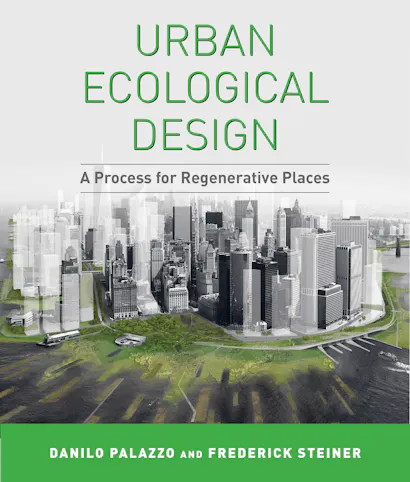
This trailblazing book outlines an interdisciplinary 鈥減rocess model鈥� for urban design that has been developed and tested over time. Its goal is not to explain how to design a specific city precinct or public space, but to describe useful steps to approach the transformation of urban spaces. Urban Ecological Design illustrates the different stages in which the process is organized, using theories, techniques, images, and case studies. In essence, it presents a 鈥渉ow-to鈥� method to transform the urban landscape that is thoroughly informed by theory and practice.
The authors note that urban design is viewed as an interface between different disciplines. They describe the field as 鈥減eacefully overrun, invaded, and occupied鈥� by city planners, architects, engineers, and landscape architects (with developers and politicians frequently joining in). They suggest that environmental concerns demand the consideration of ecology and sustainability issues in urban design. It is, after all, the urban designer who helps to orchestrate human relationships with other living organisms in the built environment.
The overall objective of the book is to reinforce the role of the urban designer as an honest broker and promoter of design processes and as an active agent of social creativity in the production of the public realm.
"In this landmark book, Palazzo and Steiner outline a straightforward process for incorporating urban ecology into the design of cities, towns and regions. They present clear principles and practices that the next generation of urban designers can use to build greener, more livable cities and regions."鈥擱obert D. Yaro, President, Regional Plan Association, and Professor of Practice, U. Penn.
"In this major contribution to urban design, Palazzo and Steiner emphasize not only the intricacies and promises of the process, but also the ecological imperatives of urban design. A wonderful compendium of methods, techniques, best practices—clearly written and amply illustrated—this book is essential for urban design students and practitioners."鈥擳ridib Banerjee, James Irvine Chair in Urban and Regional Planning, University of Southern CA
"Palazzo and Steiner bring together fresh perspectives from urban design and urban ecology, offering valuable lessons on how to face environmental challenges in building future cities. Their proposed process, which argues against limiting design to single solutions, rightly places ecological thinking at the heart of urban design."鈥擜li Madanipour, Prof. of Urban Design, School of Architecture, Planning & Landscape, Newcastle U
"Urban Ecological Design: A Process for Regenerative Places is a comprehensive and accessible guidebook on urban design with an emphasis on ecology and sustainability."鈥�ASLA's The Dirt blog
"Danilo Palazzo and Frederick Steiner have produced a textbook with soul."鈥�Planning
"I found Urban Ecological Design to be an absolutely wonderful resource if you are interested in finding out what urban design is and how it's done."鈥�Spacing
"...a richly provocative, yet practical compendium of problem-solving ideas."鈥�Reference & Research Book News
"Each chapter provides extensive information, frequently in the form of bulleted lists; this shapes the book as a form of reference work for consultation, rather than as a narrative that can be read cover to cover."鈥�CHOICE
"a welcome addition to course reading for planning and urban design students...accessible and logical."鈥�Journal of Planning Education and Research
"...the authors offer a clear view of professional practice, which embraces environmental concerns..."鈥�Urban Design
"Intended for students, practitioners, developers, and public officials, this book offers many interesting and informative insights for those who are both new to the field and seasoned professionals alike. As one of the more comprehensive texts outlining the processes and thought that contributes to this evolving field, Urban Ecological Design: A Process for Regenerative Places is an excellent resource in helping those involved better understand and appreciate this highly interdisciplinary approach to transforming the land and landscape."鈥�Ecological Restoration