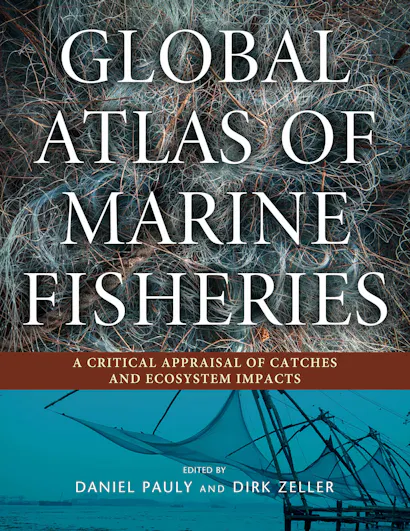
Global Atlas of Marine Fisheries: A Critical Appraisal of Catches and Ecosystem Impacts

Hardcover
Paperback
ebook (EPUB via app)
- Sale Price:
- $66.50/拢56.00
- Price:
-
$95.00/拢80.00 - ISBN:
- Published:
- Oct 6, 2016
- Copyright:
- 2016
- Size:
- 8.5 x 11 in.
- full color, 612 illustrations
30% off with code PUP30
ebook (PDF via app)
- Sale Price:
- $66.50/拢56.00
- Price:
-
$95.00/拢80.00 - ISBN:
- Published:
- Oct 6, 2016
- Copyright:
- 2016
- Size:
- 8.5 x 11 in.
- full color, 612 illustrations
30% off with code PUP30
-
Audio and ebooks (EPUB and PDF) purchased from this site must be accessed on the
快色直播 app. After purchasing, you will receive an email with
instructions to access your purchase.
About audio and ebooks - Request Exam Copy
Until now, there has been only one source of data on global fishery catches: information reported to the Food and Agriculture Organization of the United Nations by member countries. An extensive, ten-year study conducted by The Sea Around Us Project of the University of British Columbia shows that this catch data is fundamentally misleading. Many countries underreport the amount of fish caught (some by as much as 500%), while others such as China significantly overreport their catches.
The Global Atlas of Marine Fisheries is the first and only book to provide accurate, country-by-country fishery data. This groundbreaking information has been gathered from independent sources by the world鈥檚 foremost fisheries experts, and edited by Daniel Pauly and Dirk Zeller of the Sea Around Us Project. The Atlas includes one-page reports on 273 countries and their territories, plus fourteen topical global chapters. National reports describe the state of the country’s fishery, by sector; the policies, politics, and social factors affecting it; and potential solutions. The global chapters address cross-cutting issues, from the economics of fisheries to the impacts of mariculture. Extensive maps and graphics offer attractive and accessible visual representations.
While it has long been clear that the world鈥檚 oceans are in trouble, the lack of reliable data on fishery catches has obscured the scale, and nuances, of the crisis. The atlas shows that, globally, catches have declined rapidly since the 1980s, signaling an even more critical situation than previously understood. The Global Atlas of Marine Fisheries provides a comprehensive picture of our current predicament and steps that can be taken to ease it. For researchers, students, fishery managers, professionals in the fishing industry, and all others concerned with the status of the world鈥檚 fisheries, the Atlas will be an indispensable resource.