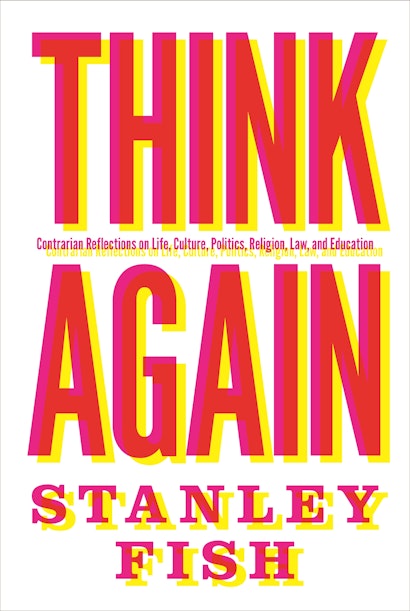
From 1995 to 2013, Stanley Fish’s provocative New York Times columns consistently generated passionate discussion and debate. In Think Again, he has assembled almost one hundred of his best columns into a thematically arranged collection with a substantial new introduction that explains his intention in writing these pieces and offers an analysis of why they provoked so much reaction.
Some readers reported being frustrated when they couldn鈥檛 figure out where Fish, one of America鈥檚 most influential thinkers, stood on the controversies he addressed in the essays鈥攆rom atheism and affirmative action to plagiarism and postmodernism. But, as Fish says, that is the point. Opinions are cheap; you can get them anywhere. Instead of offering just another set of them, Fish analyzes and dissects the arguments put forth by different sides鈥攊n debates over free speech, identity politics, the gun lobby, and other hot-button topics鈥攊n order to explain how their arguments work or don鈥檛 work. In short, these are essays that teach you not what to think but how to think more clearly.
Brief and accessible yet challenging, these essays provide all the hard-edged intellectual, cultural, and political analysis one expects from Fish. At the same time, the collection includes a number of revealing and even poignant autobiographical essays in which, as Fish says, 鈥渞eaders will learn about my anxieties, my aspirations, my eccentricities, my foibles, my father, and my obsessions鈥擣rank Sinatra, Ted Williams, basketball, and Jews.鈥� Reflecting the wide-ranging interests of one of today’s leading critics, this is Fish鈥檚 broadest and most engaging book to date.
Stanley Fish is the author of numerous books, including How to Write a Sentence, There's No Such Thing as Free Speech, and Is There a Text in This Class? His most recent book is Versions of Academic Freedom. He is the Davidson-Kahn Distinguished University Professor and Professor of Law at Florida International University and the Visiting Floersheimer Professor of Law at Cardozo Law School. He previously taught at Berkeley, Johns Hopkins, Duke, and the University of Illinois, Chicago.
"You are not obligated to agree with him and you are not obligated to like him, but if you care about the enlarging necessity of contest in cultural discourse, then you are obligated to read him, not with some magical 鈥榦pen mind'鈥擣ish has no patience for that concept鈥攂ut with the full force of the mind you have."鈥�New Republic
"Lucid, sinewy sentences lash, tickle, and caress."鈥�Kirkus
"[Fish] covers so much ground so thoughtfully. Whether he is writing about French theory, religion, poetry, law, liberal education, or politics in upstate New York鈥攚here he tries hard to be just an ordinary guy (in his country home)鈥擣ish is both stimulating and precise."鈥�Chronicle of Higher Education
"Engaging, provocative, maddening, humorous, and insightful."鈥�Arts Fuse
"Think Again is a memorable achievement, offering a standard of argument rarely published in media."鈥�The Australian
"厂迟颈尘耻濒补迟颈苍驳."鈥�Weekly Standard
"We are rarely in doubt about what Fish intends; there is small danger of his ever saying nothing; and his thoughts continually encourage us to think again as the implications of what he has written expand variously."鈥擝rooke Horvath, Rain Taxi
"Stanley Fish makes you think. No matter what you thought, or thought you thought, on a given subject鈥擨srael, academia, pickup basketball, American law鈥擣ish will flip it and spin it and dip it and turn it around for you. (And he can be a terrific comedian to boot.) A brilliant book."鈥擬ark Edmundson, author of Why Read?
"This collection of Stanley Fish's New York Times essays amounts to an intellectual autobiography of one of America's most interesting writers. As Fish says, his purpose isn't, as in most op-eds, to tell the reader what to think; rather, it's to illuminate Fish's view of how to think鈥攁nd to shake readers out of their complacent assumptions about free speech, religion, academia, and other subjects."鈥擫inda Greenhouse, author of The U.S. Supreme Court: A Very Short Introduction