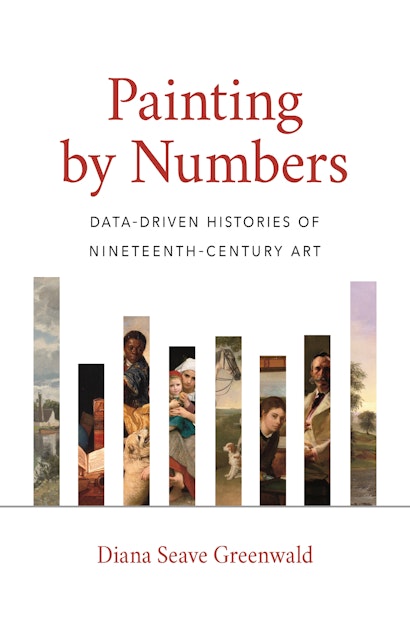
Painting by Numbers presents a groundbreaking blend of art historical and social scientific methods to chart, for the first time, the sheer scale of nineteenth-century artistic production. With new quantitative evidence for more than five hundred thousand works of art, Diana Seave Greenwald provides fresh insights into the nineteenth century, and the extent to which art historians have focused on a limited鈥攁nd potentially biased鈥攕ample of artwork from that time. She addresses long-standing questions about the effects of industrialization, gender, and empire on the art world, and she models more expansive approaches for studying art history in the age of the digital humanities.
Examining art in France, the United States, and the United Kingdom, Greenwald features datasets created from indices and exhibition catalogs that鈥攖o date鈥攈ave been used primarily as finding aids. From this body of information, she reveals the importance of access to the countryside for painters showing images of nature at the Paris Salon, the ways in which time-consuming domestic responsibilities pushed women artists in the United States to work in lower-prestige genres, and how images of empire were largely absent from the walls of London鈥檚 Royal Academy at the height of British imperial power. Ultimately, Greenwald considers how many works may have been excluded from art historical inquiry and shows how data can help reintegrate them into the history of art, even after such pieces have disappeared or faded into obscurity.
Upending traditional perspectives on the art historical canon, Painting by Numbers offers an innovative look at the nineteenth-century art world and its legacy.
Awards and Recognition
- Winner of a Millard Meiss Publication Fund Grant, College Art Association
"Painting by Numbers鈥is] careful and systematic鈥t is a solid demonstration that 鈥渃ounting things鈥� matters. It leaves audiences to wonder what work the book will inspire as other researchers draw from the quantitative foundation Greenwald has established鈥� [I]t鈥檚 clear that the author鈥檚 expertise in art and data pair brilliantly鈥� 鈥揕ydia Pyne, Hyperallergic"
"The real power of [Painting by Numbers] is. . . . prompting art historians to ask questions about the values underpinning their definition of their objects of study. . . . [Diana Greenwald] has done a valuable service to the field in asking us to rethink our fundamental categories of disciplinary concern and our responsibilities to the vast range of visual and material culture that might fall within their purview."鈥�CAA Reviews
"Diana Seave Greenwald鈥檚 Painting by Numbers: Data-Driven Histories of Nineteenth-Century Art is an ambitious study that synthesizes two disparate approaches of scholarship: art history and economic analysis. . . . Greenwald is a pioneer in the field who is willing to explore new perspectives and challenge past presumptions. The book paves the way for similar interdisciplinary studies to follow. . . . Painting by Numbers shows the promise of what can be achieved when an abundance of information is wedded with insightful scholarship."鈥擬att Garklavs, ARLIS/NA Reviews
"[Diana Greenwald] presents novel evidence on the artistic production of the nineteenth-century in France, the USA, and England and focusses on crucial topics in the art history of that period, namely, industrialization, gender, and the history of empire, providing new points of view. . . . [Painting by Numbers] represents a concrete application of the benefits of an interdisciplinary approach in humanities and social sciences."鈥擫aura Paganl, Journal of Cultural Economics
"[A] great benefit to art historians unpracticed in economic theory."鈥擡lizabeth L. Block, Panorama
"Painting By Numbers offers methods and interpretations that may revise art historians鈥� assumptions about what we do and how we do it."鈥擩ulie Codell, Winterthur Portfolio
"Using hard, quantitative data in order to test, critique or support conventional wisdom is very unusual in art-historical research. Painting by Numbers succeeds in making a convincing case for that kind of study, which makes it a model of methodological innovation, and a very welcome one."鈥擩orge Sebasti谩n Lozano, Art History
"Painting by Numbers beautifully deploys economic history and quantitative analysis to gain new insight into nineteenth-century art. Greenwald鈥檚 groundbreaking, generous book shows the power of data to expand art history鈥檚 interpretive possibilities."鈥擲teven Nelson, dean of the Center for Advanced Study in the Visual Arts, National Gallery of Art
"This groundbreaking, thought-provoking book employs datasets and socioeconomic analytical tools to tell superbly documented and compelling stories about the artists, artworks, patrons, and markets that drove artistic production and consumption in England, France, and the United States during the long nineteenth century. The ease with which Greenwald deploys her statistics should encourage broader use of these investigative techniques."鈥擡leanor Jones Harvey, author of Alexander von Humboldt and the United States: Art, Nature, and Culture
"Paintings are motionless, but Painting by Numbers shows that nineteenth-century art was shaped by the dynamics of distance and time. Domestic duties constrained women鈥檚 art in the United States, cheap railway travel influenced bucolic painting in France, and the British Empire was depicted as picturesque, sometimes by artists who had never even been there. All of this and more is measured quite precisely in this innovative and engaging book."鈥擜vner Offer, coauthor of The Nobel Factor: The Prize in Economics, Social Democracy, and the Market Turn
"Painting by Numbers brings together digital research and econometric tools to identify patterns that have not been previously visible in the exhibition of nineteenth-century artworks. Greenwald鈥檚 data is fascinating and her argument, which reconsiders peasant painting, women artists, and imperialism, is an important one."鈥擶endy Katz, author of Humbug!: The Politics of Art Criticism in New York City鈥檚 Penny Press
"Satisfying and eminently readable, Painting by Numbers offers new insights on the broad contours of U.S., French, and British nineteenth-century art history and new possibilities for digital humanities in art history more generally. Greenwald鈥檚 book is a provocative shake-up of the canon and successfully makes the case that both the quantitative and qualitative are fundamental to a truly critical social history of art."鈥擯aul B. Jaskot, director of Duke University鈥檚 Wired! Lab for Digital Art History and Visual Culture
In Painting by Numbers, Diana Seave Greenwald accepts the challenge posed by theorist Griselda Pollock to investigate 鈥渢he process of exclusion and neglect鈥� by which 鈥渢radition cultivates its own inevitability,鈥� drawing on economic and statistical data to illuminate art historical questions, some of which appeared settled and some of which had barely been asked. . . . [The book] draw[s] on economic and statistical data to illuminate art historical questions鈥reenwald鈥檚 book covers a narrow topic and is intended for a specialized audience, but it poses questions of interest to the general reader. 鈥揂drian Nathan West, Washington Examiner