Discrete choice models are essential tools for understanding decision-making when individuals must choose among alternatives. They have applications across the social sciences, notably in economics, marketing, and political science. This book offers a foundational treatment of discrete choice models, introducing the logit model and its generalizations, logistic and Poisson regressions, and generalized linear models, and demonstrates their use in analyzing important econometric models. These include international trade gravity, demand estimation, matching with and without transfers, hedonic markets, and dynamic discrete choice. Bridging theoretical clarity and practical applicability, the book is suitable for use in graduate-level coursework and will be an essential resource for researchers and practitioners.
鈥� Extensive coverage of computational issues, focusing on optimization and the reformulation as generalized linear models
鈥� Emphasis on econometric questions, including simulation, estimation, and inference methods, with estimation techniques based on both simulated and actual datasets
鈥� A substantial set of exercises and problems at the end of each chapter
鈥� Two appendixes, with one covering the mathematical tools needed to understand the material, and the other the Python code examples
Alfred Galichon is professor of economics and of mathematics at New York University. A pioneer of the use of optimal transport theory in econometrics, he is the author of a monograph on the topic, Optimal Transport Methods in Economics (快色直播).
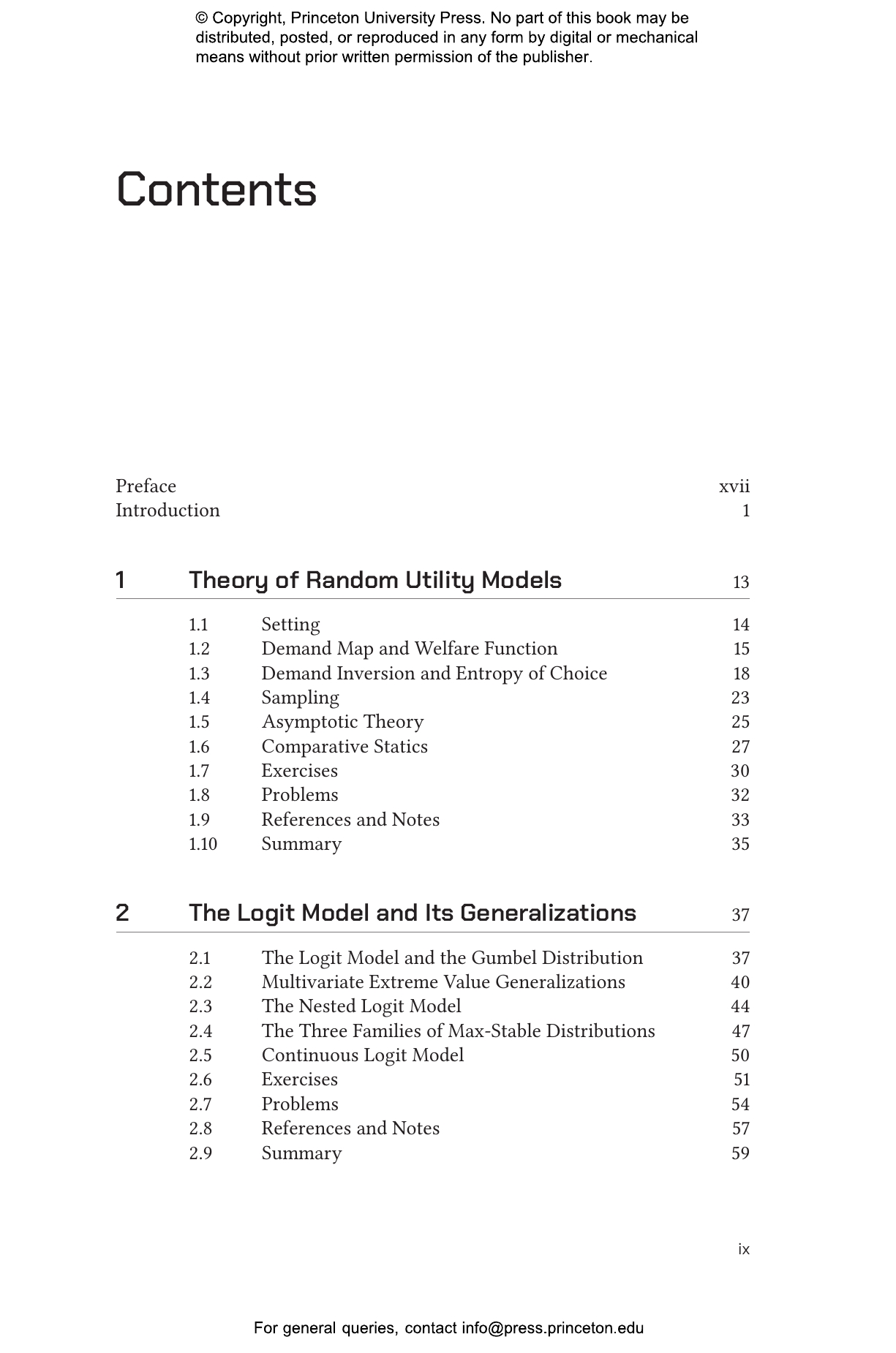
- 1 Theory of Random Utility Models
- 1.1 Setting
- 1.2 Demand Map and Welfare Function
- 1.3 Demand Inversion and Entropy of Choice
- 1.4 Sampling
- 1.5 Asymptotic Theory
- 1.6 Comparative Statics
- 1.7 Exercises
- 1.8 Problems
- 1.9 References and Notes
- 1.10 Summary
- 2 The Logit Model and Its Generalizations
- 2.1 The Logit Model and the Gumbel Distribution
- 2.2 Multivariate Extreme Value Generalizations
- 2.3 The Nested Logit Model
- 2.4 The Three Families of Max-Stable Distributions
- 2.5 Continuous Logit Model
- 2.6 Exercises
- 2.7 Problems
- 2.8 References and Notes
- 2.9 Summary
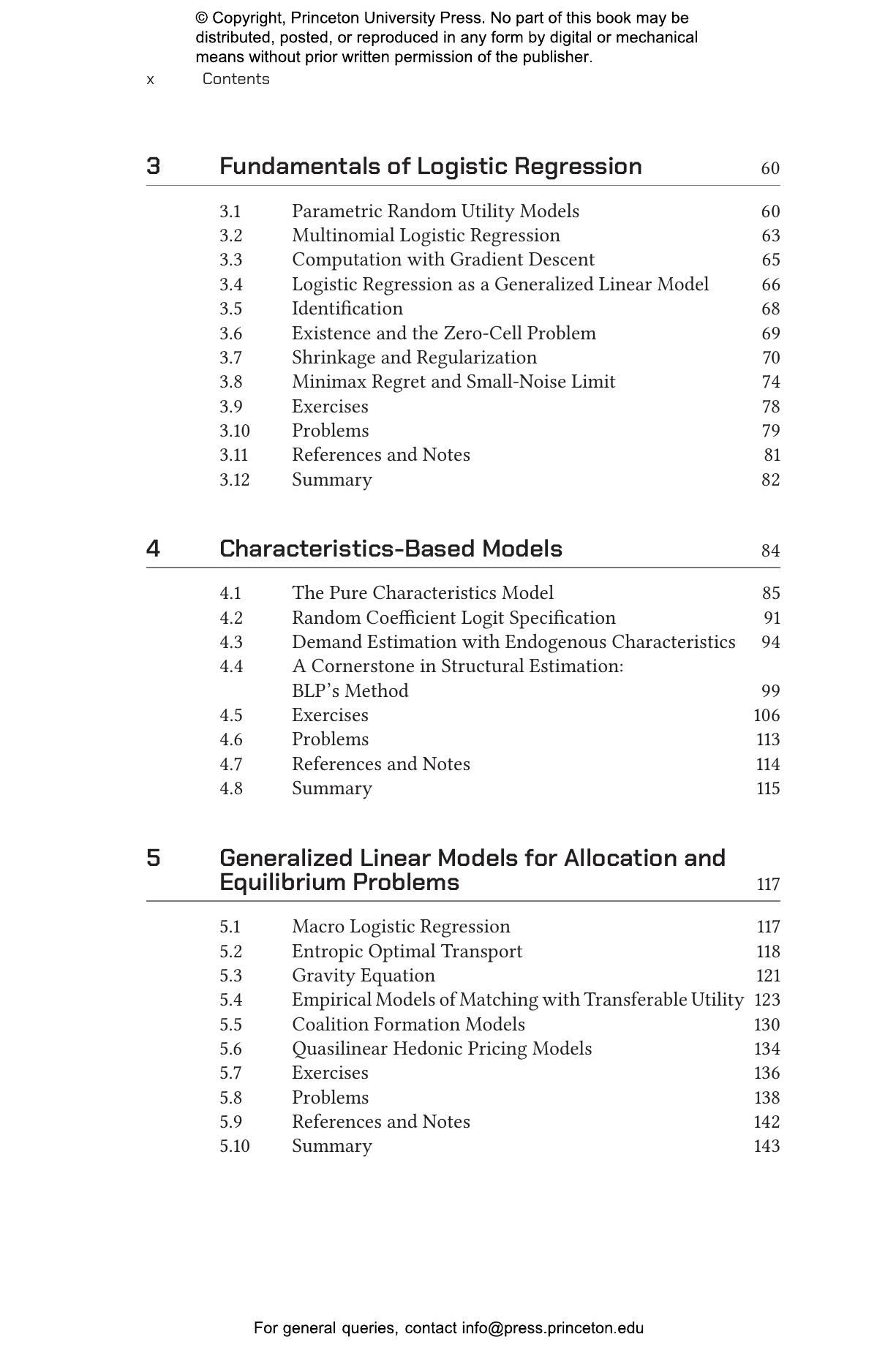
- 3 Fundamentals of Logistic Regression
- 3.1 Parametric Random Utility Models
- 3.2 Multinomial Logistic Regression
- 3.3 Computation with Gradient Descent
- 3.4 Logistic Regression as a Generalized Linear Model
- 3.5 Identi铿乧ation
- 3.6 Existence and the Zero-Cell Problem
- 3.7 Shrinkage and Regularization
- 3.8 Minimax Regret and Small-Noise Limit
- 3.9 Exercises
- 3.10 Problems
- 3.11 References and Notes
- 3.12 Summary
- 4 Characteristics-Based Models
- 4.1 The Pure Characteristics Model
- 4.2 Random Coe铿僣ient Logit Speci铿乧ation
- 4.3 Demand Estimation with Endogenous Characteristics
- 4.4 A Cornerstone in Structural Estimation: BLP鈥檚 Method
- 4.5 Exercises
- 4.6 Problems
- 4.7 References and Notes
- 4.8 Summary
- 5 Generalized Linear Models for Allocation and Equilibrium Problems
- 5.1 Macro Logistic Regression
- 5.2 Entropic Optimal Transport
- 5.3 Gravity Equation
- 5.4 Empirical Models of Matching with Transferable Utility
- 5.5 Coalition Formation Models
- 5.6 Quasilinear Hedonic Pricing Models
- 5.7 Exercises
- 5.8 Problems
- 5.9 References and Notes
- 5.10 Summary
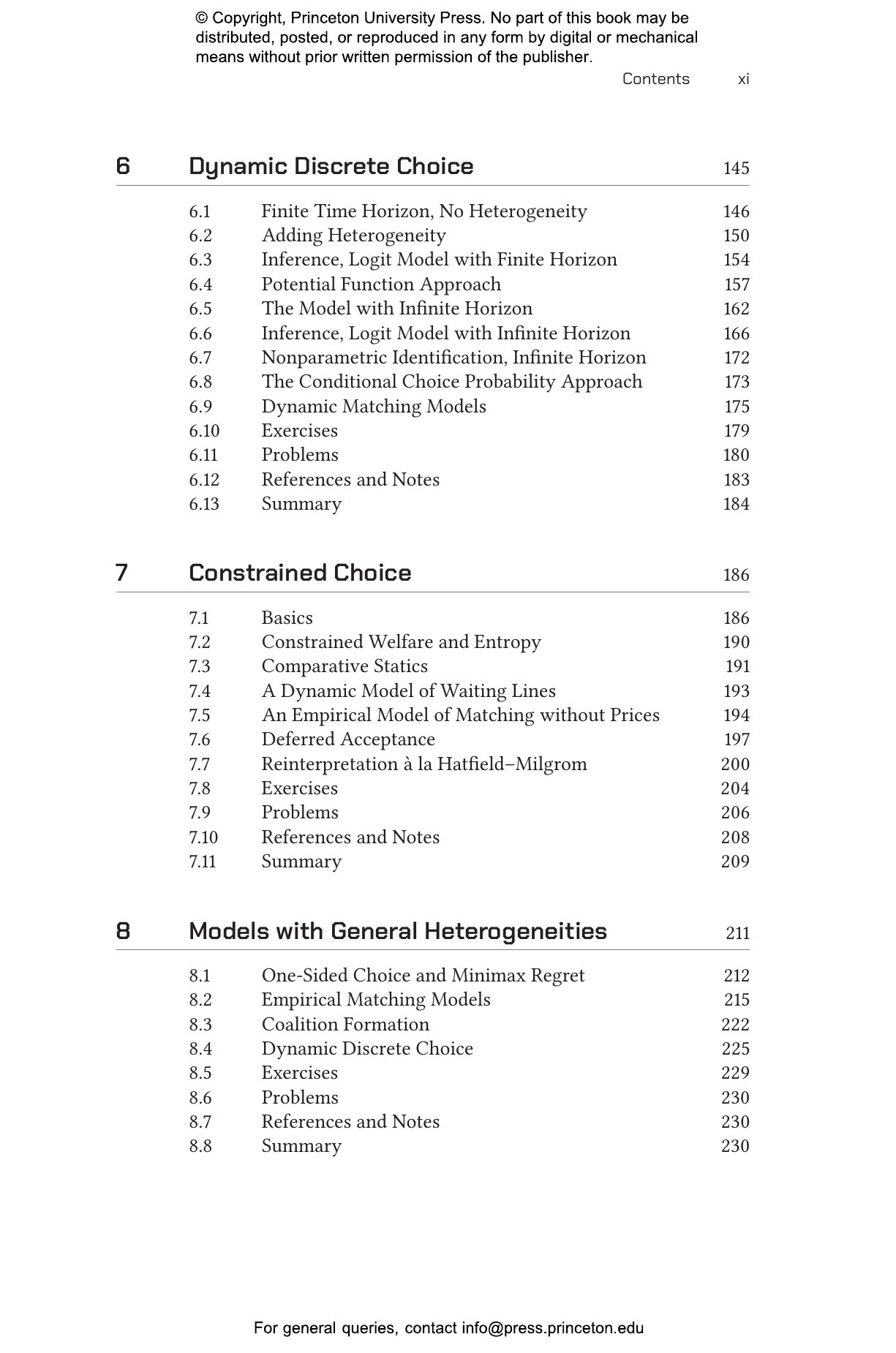
- 6 Dynamic Discrete Choice
- 6.1 Finite Time Horizon, No Heterogeneity
- 6.2 Adding Heterogeneity
- 6.3 Inference, Logit Model with Finite Horizon
- 6.4 Potential Function Approach
- 6.5 The Model with In铿乶ite Horizon
- 6.6 Inference, Logit Model with In铿乶ite Horizon
- 6.7 Nonparametric Identi铿乧ation, In铿乶ite Horizon
- 6.8 The Conditional Choice Probability Approach
- 6.9 Dynamic Matching Models
- 6.10 Exercises
- 6.11 Problems
- 6.12 References and Notes
- 6.13 Summary
- 7 Constrained Choice
- 7.1 Basics
- 7.2 Constrained Welfare and Entropy
- 7.3 Comparative Statics
- 7.4 A Dynamic Model of Waiting Lines
- 7.5 An Empirical Model of Matching without Prices
- 7.6 Deferred Acceptance
- 7.7 Reinterpretation 脿 la Hat铿乪ld鈥揗ilgrom
- 7.8 Exercises
- 7.9 Problems
- 7.10 References and Notes
- 7.11 Summary
- 8 Models with General Heterogeneities
- 8.1 One-Sided Choice and Minimax Regret
- 8.2 Empirical Matching Models
- 8.3 Coalition Formation
- 8.4 Dynamic Discrete Choice
- 8.5 Exercises
- 8.6 Problems
- 8.7 References and Notes
- 8.8 Summary
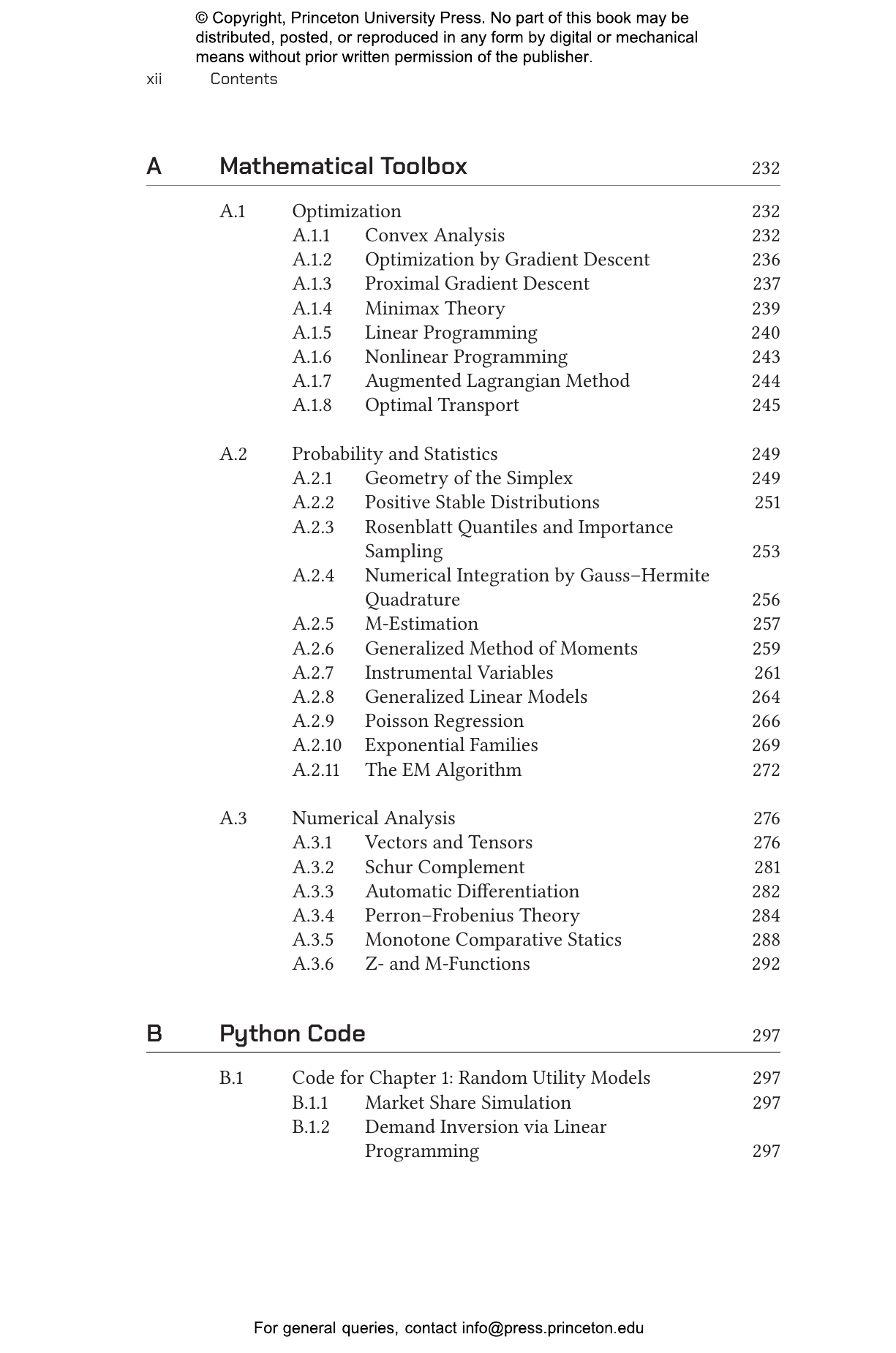
- A Mathematical Toolbox
- A.1 Optimization
- A.1.1 Convex Analysis
- A.1.2 Optimization by Gradient Descent
- A.1.3 Proximal Gradient Descent
- A.1.4 Minimax Theory
- A.1.5 Linear Programming
- A.1.6 Nonlinear Programming
- A.1.7 Augmented Lagrangian Method
- A.1.8 Optimal Transport
- A.2 Probability and Statistics
- A.2.1 Geometry of the Simplex
- A.2.2 Positive Stable Distributions
- A.2.3 Rosenblatt Quantiles and Importance Sampling
- A.2.4 Numerical Integration by Gauss鈥揌ermite Quadrature
- A.2.5 M-Estimation
- A.2.6 Generalized Method of Moments
- A.2.7 Instrumental Variables
- A.2.8 Generalized Linear Models
- A.2.9 Poisson Regression
- A.2.10 Exponential Families
- A.2.11 The EM Algorithm
- A.3 Numerical Analysis
- A.3.1 Vectors and Tensors
- A.3.2 Schur Complement
- A.3.3 Automatic Di铿�erentiation
- A.3.4 Perron鈥揊robenius Theory
- A.3.5 Monotone Comparative Statics
- A.3.6 Z- and M- Functions
- B Python Code299appendix.B
- B.1 Code for Chapter 1: Random Utility Models
- B.1.1 Market Share Simulation
- B.1.2 Demand Inversion via Linear Programming
- B.2 Code for Chapter 2: The Logit Model and Its Generalizations
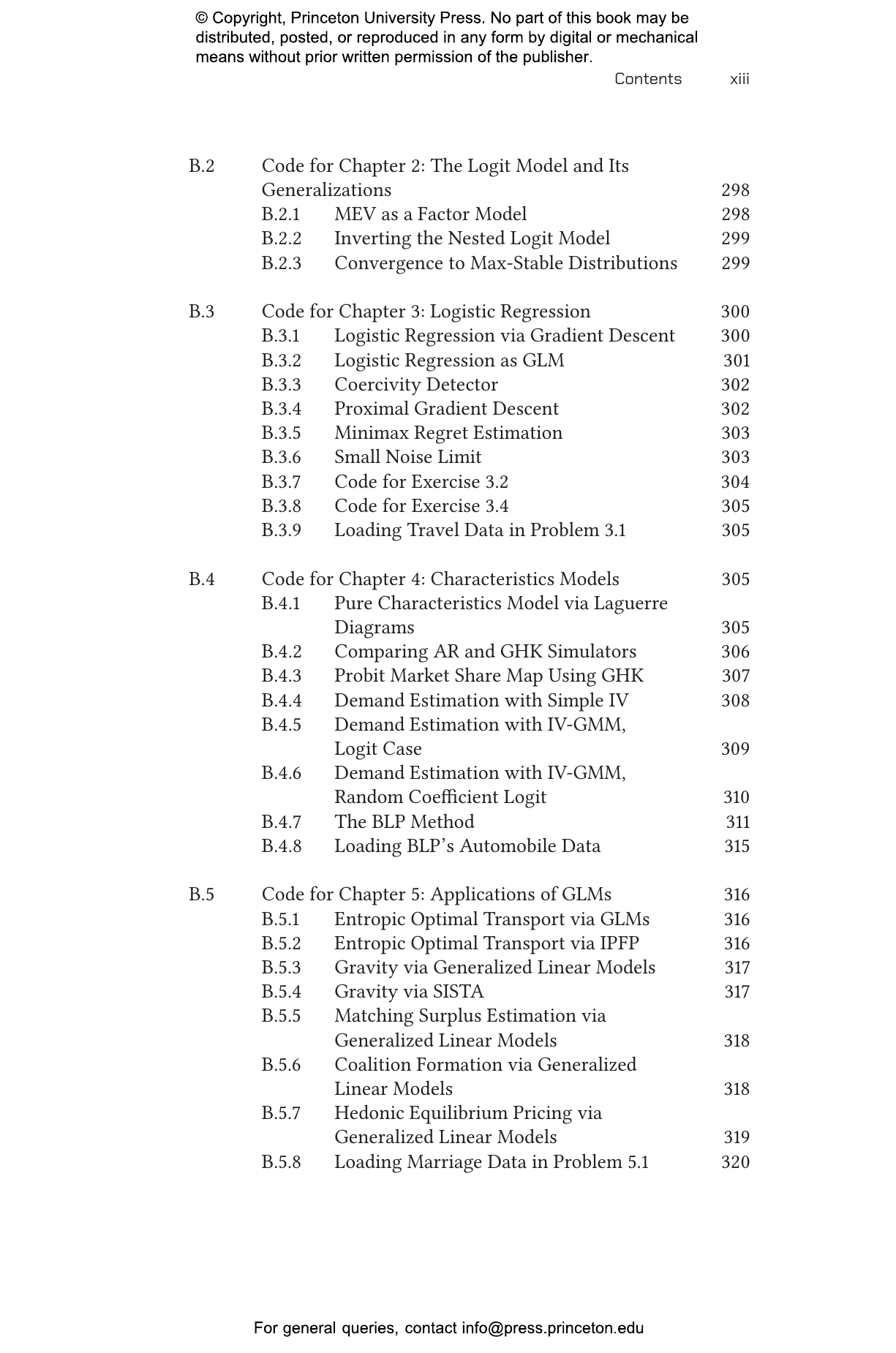
- B.2.1 MEV as a Factor Model
- B.2.2 Inverting the Nested Logit Model
- B.2.3 Convergence to Max-Stable Distributions
- B.3 Code for Chapter 3: Logistic Regression
- B.3.1 Logistic Regression via Gradient Descent
- B.3.2 Logistic Regression as GLM
- B.3.3 Coercivity Detector
- B.3.4 Proximal Gradient Descent
- B.3.5 Minimax Regret Estimation
- B.3.6 Small Noise Limit
- B.3.7 Code for Exercise 3.2
- B.3.8 Code for Exercise 3.4
- B.3.9 Loading Travel Data in Problem 3.1
- B.4 Code for Chapter 4: Characteristics Models
- B.4.1 Pure Characteristics Model via Laguerre Diagrams
- B.4.2 Comparing AR and GHK Simulators
- B.4.3 Probit Market Share Map Using GHK
- B.4.4 Demand Estimation with Simple IV
- B.4.5 Demand Estimation with IV-GMM, Logit Case
- B.4.6 Demand Estimation with IV-GMM, Random Coe铿僣ient Logit
- B.4.7 The BLP Method
- B.4.8 Loading BLP鈥檚 Automobile Data
- B.5 Code for Chapter 5: Applications of GLMs
- B.5.1 Entropic Optimal Transport via GLMs
- B.5.2 Entropic Optimal Transport via IPFP
- B.5.3 Gravity via Generalized Linear Models
- B.5.4 Gravity via SISTA
- B.5.5 Matching Surplus Estimation via Generalized Linear Models
- B.5.6 Coalition Formation via Generalized Linear Models
- B.5.7 Hedonic Equilibrium Pricing via Generalized Linear Models
- B.5.8 Loading Marriage Data in Problem 5.1
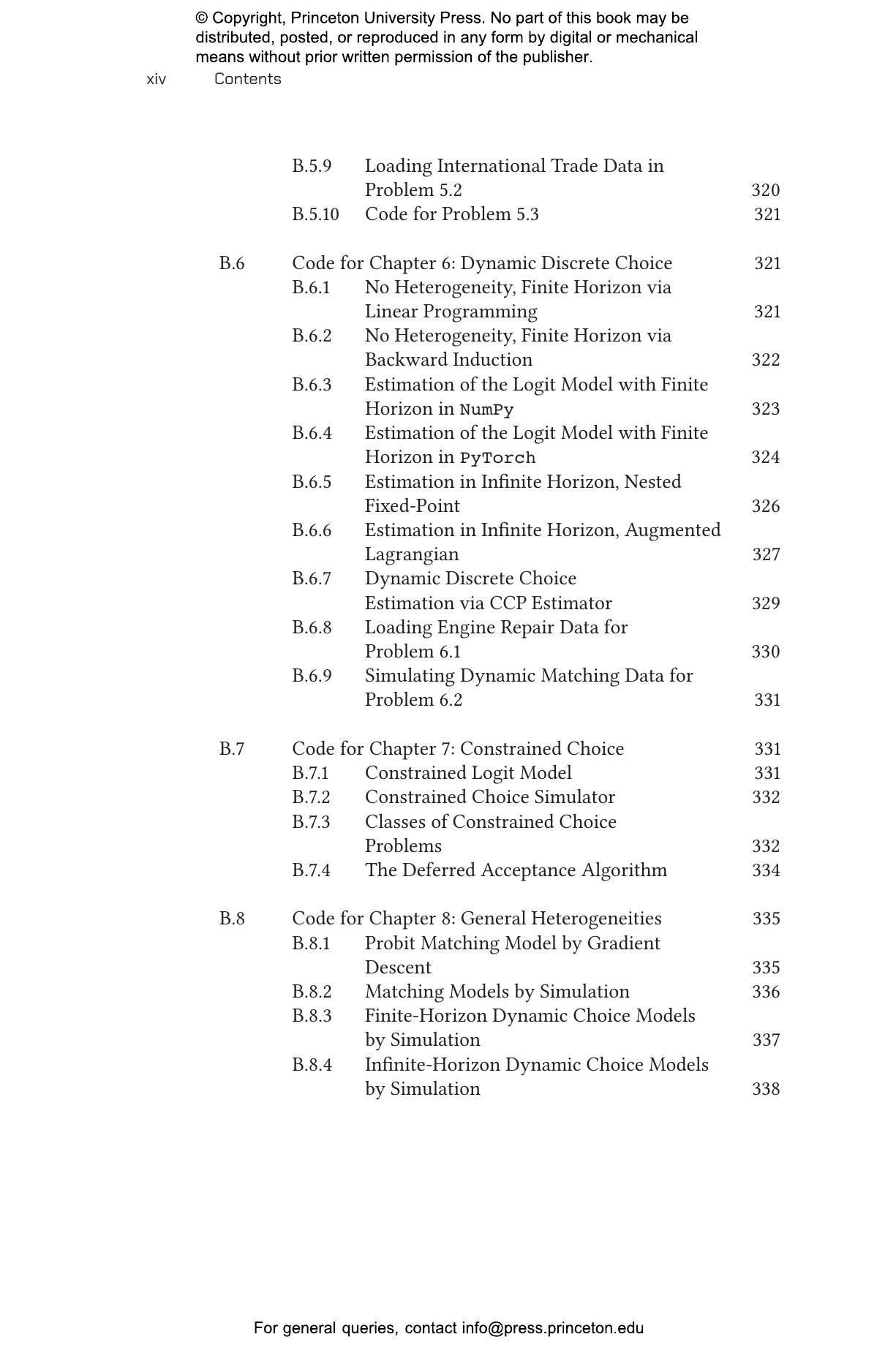
- B.5.9 Loading International Trade Data in Problem 5.2
- B.5.10 Code for Problem 5.3
- B.6 Code for Chapter 6: Dynamic Discrete Choice
- B.6.1 No Heterogeneity, Finite Horizon via Linear Programming
- B.6.2 No Heterogeneity, Finite Horizon via Backward Induction
- B.6.3 Estimation of the Logit Model with Finite Horizon in NumPy
- B.6.4 Estimation of the Logit Model with Finite Horizon in PyTorch
- B.6.5 Estimation in In铿乶ite Horizon, Nested Fixed-Point
- B.6.6 Estimation in In铿乶ite Horizon, Augmented Lagrangian
- B.6.7 Dynamic Discrete Choice Estimation via CCP Estimator
- B.6.8 Loading Engine Repair Data for Problem 6.1
- B.6.9 Simulating Dynamic Matching Data for Problem 6.2
- B.7 Code for Chapter 7: Constrained Choice
- B.7.1 Constrained Logit Model
- B.7.2 Constrained Choice Simulator
- B.7.3 Classes of Constrained Choice Problems
- B.7.4 The Deferred Acceptance Algorithm
- B.8 Code for Chapter 8: General Heterogeneities
- B.8.1 Probit Matching Model by Gradient Descent
- B.8.2 Matching Models by Simulation
- B.8.3 Finite-Horizon Dynamic Choice Models by Simulation
- B.8.4 In铿乶ite-Horizon Dynamic Choice Models by Simulation
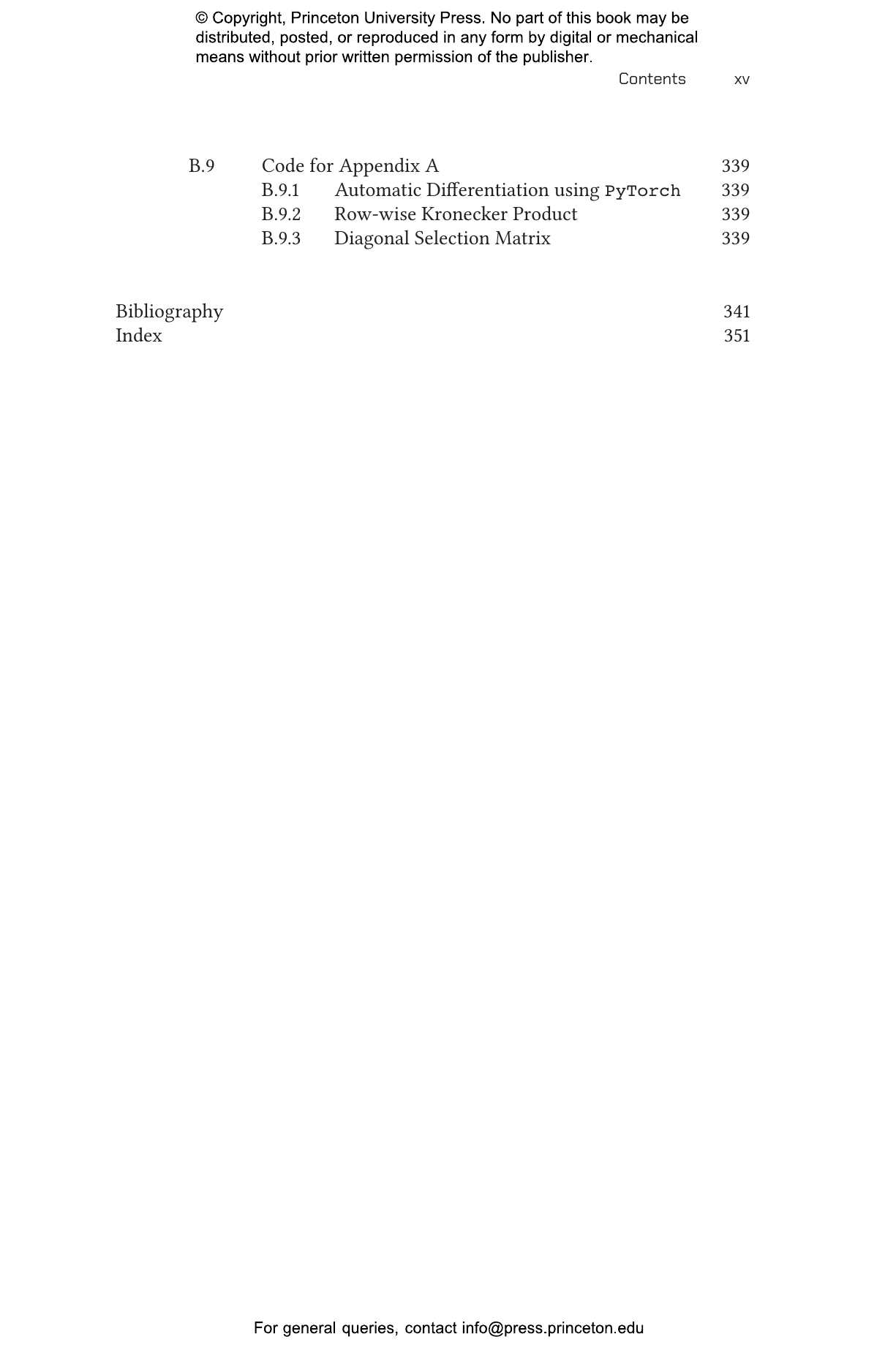
- B.9 Code for Appendix A
- B.9.1 Automatic Di铿�erentiation using PyTorch
- B.9.2 Row-wise Kronecker Product
- B.9.3 Diagonal Selection Matrix
“The author is highly recognized in the field as making strong, theoretically sound contributions with mathematical and analytical skills at the highest levels. The mathematical focus of the book offers a major advantage to students with an economics background.”—Ricardo Daziano, Cornell University
“Authored by a leading practitioner, Discrete Choice Models straddles the interface between economics and mathematics. It contains a wealth of information that has not previously been compiled in book form, augmented by valuable technical appendices and illustrated by Python routines. It will prove a welcome resource to students and scholars from both the social and the natural sciences.”—Robert McCann, University of Toronto
“This book is unique and stands apart from other works on discrete choice, making it a significant contribution to the literature. I would be thrilled to have it on my bookshelf!”—Tatiana Komarova, University of Cambridge
“This book is a rigorous, comprehensive, and up-to-date guide to discrete choice models. It develops their economic foundations, statistical frameworks, and computational requirements in depth, covering both single-agent settings and models of interacting agents in markets. It offers an indispensable introduction to the tools needed to conduct serious empirical work in economics, firmly grounded in economic theory.”—James J. Heckman, Nobel Laureate in Economics (2000), University of Chicago