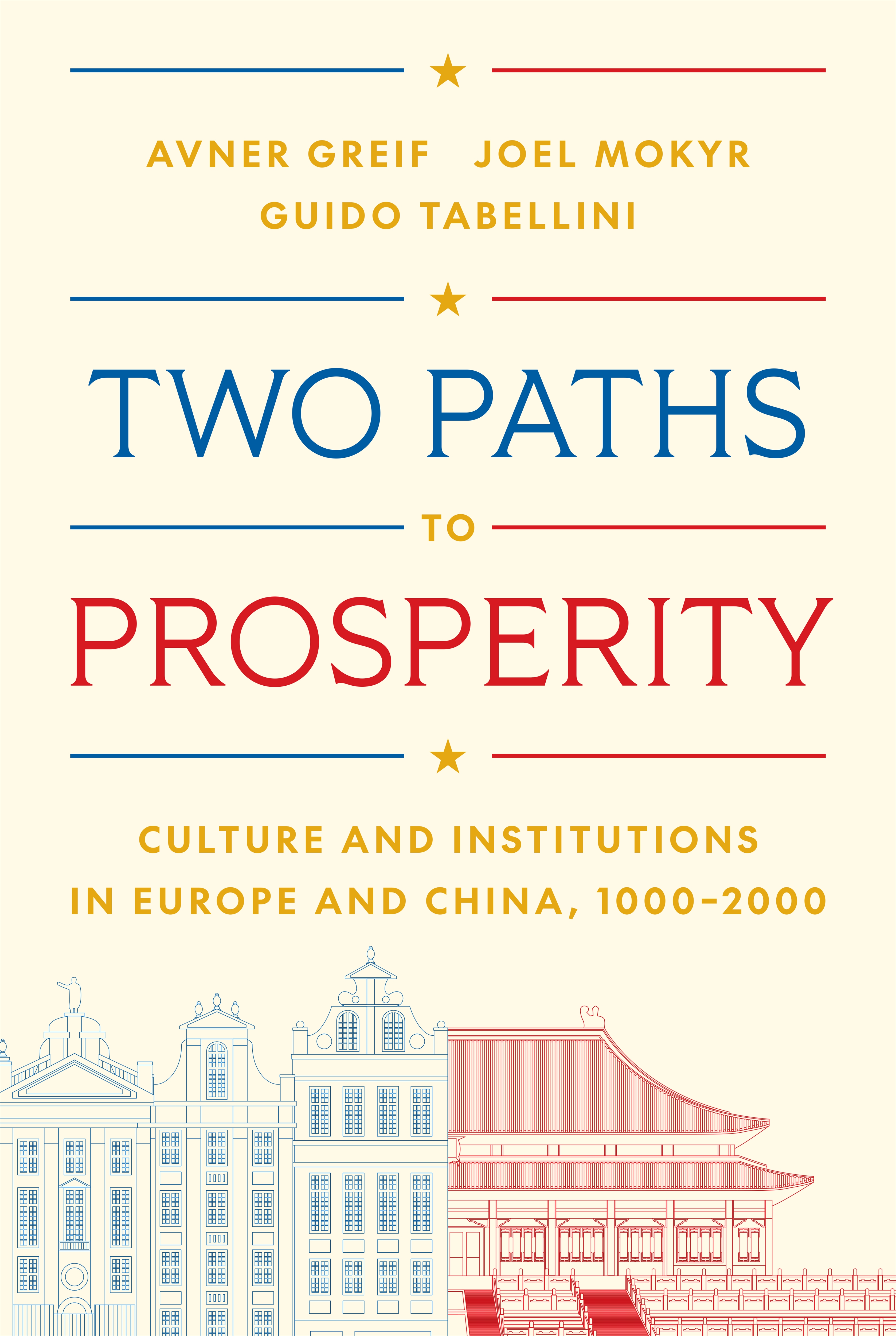
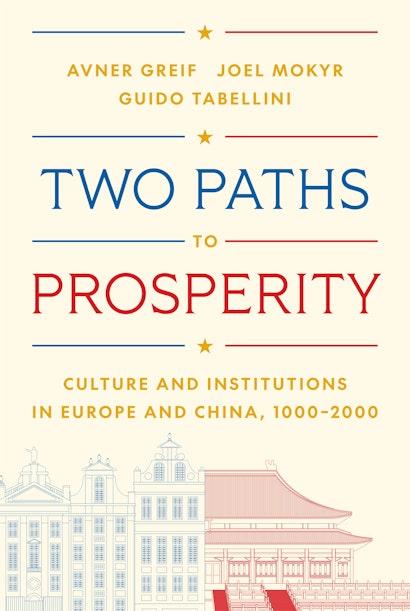
In the eleventh century, when Europe was still backward and poor, China was a rich and sophisticated civilization. Yet Europe became the birthplace of democracy and the Industrial Revolution, driving the Great Enrichment, while China stagnated until the end of the twentieth century and was always ruled by autocracies. Two Paths to Prosperity traces the emergence of two very different social organizations in premodern China and Europe鈥攖he clan and the corporation鈥攕howing how they were key factors in the economic and political divergence of these two great civilizations.
In this landmark book, three leading economists offer a bold new account of why Europe and China evolved along such different trajectories. In the early Middle Ages, public goods like risk sharing, religious worship, education, and conflict resolution were provided by nonstate organizations in both societies. China increasingly relied on kin-based cooperation within clans, while weaker kinship ties in Europe gave rise to corporations such as guilds, universities, and self-governing towns. Despite performing similar functions, clans and corporations were built on very different principles鈥攚ith lasting consequences until today.
Providing a novel answer to a fundamental question in economic and political history, Two Paths to Prosperity shows how extended kinship in Chinese society facilitated the consolidation of autocracy and hindered innovation and economic development, and how corporations in Europe influenced emerging state institutions and set the stage for the Industrial Revolution.
Awards and Recognition
- A New Yorker Best Book of the Year
- A Financial Times Summer Read
"A thousand years ago, as Europeans waded through the Middle Ages, their Chinese contemporaries were living in a civilization that was among the most sophisticated in the world. So why, in the centuries that followed, did Europe become richer and more powerful than China? In their ambitious history, Greif, Mokyr (a winner of this year’s Nobel Prize in Economics), and Tabellini suggest that cultural values and social organizations helped establish divergent paths. Confucianism held sway in China, where kinship groups managed local life. But in Europe, where family bonds were looser, strangers cooperated in organizations such as guilds and self-governing towns—institutions that gave rise to capable states, flourishing markets, and the Industrial Revolution."鈥�New Yorker
"Avner Greif, Guido Tabellini and Nobel laureate Joel Mokyr bring contemporary social science to bear on the key junctures in European and Chinese history. Along the way, they explore the most fundamental causes of growth, freedom, and innovation that led to the Industrial Revolution and still matter today."鈥擠r. James Herndon, Asian Review of 快色直播聽
"[This] book is exemplary."鈥擯aul Seabright, Times Literary Supplement聽
"[Two Paths to Prosperity] addresses the fundamental question of why Europe and then European offshoots, notably the US, managed to get so far ahead of the other great civilisations, including China’s, both technologically and economically, between the 17th and 20th centuries…. The argument is eye-opening"鈥擬artin Wolf, Financial Times
"Wonderful. . . . I'm a big fan of your new book."鈥擳yler Cowen, Conversations with Tyler
"In Two Paths to Prosperity, Greif, Mokyr, and Tabellini apply their formidable analytical powers to explaining the divergent trajectories followed by China and Western Europe."鈥擥raham Brownlow, Economic History Review
"The book is an impressive work written by three academics at the top of their field. While little of what is offered is new, it presents a remarkable synthesis of previous research by the authors as well as that of numerous scholars in the field of economic history. Indeed, it is difficult to do justice to the vast breadth of scholarship on offer, as the book enters into dialogue with myriad voices to digest the economic, social and political evolution of Eurasia over the past millennium. It is an example of interdisciplinary scholarship at its finest, using work across different fields to create a coherent and contextualised portrait of multi-regional development across time."鈥擩ames Hodgson, LSE Review of 快色直播
“A major new attempt to explain the biggest puzzle of world economic history. This book takes the debate to a new level of clarity and sophistication. Unputdownable.”—James A. Robinson, University of Chicago
“In Two Paths to Prosperity, a dream team of leading economists brilliantly addresses one of the great questions in the social sciences: Why Europe, not China? With fresh insight and compelling analysis, this book reshapes the debate and deepens our understanding of the historical roots of these two divergent economic systems.”—Jan Luiten van Zanden, coauthor of Pioneers of Capitalism: The Netherlands 1000–1800
“This profound and fascinating comparison of China and Europe makes a powerful case for how culture, religion, and social organizations shape economic outcomes. They deserve as much attention as property rights and representative institutions. A must-read for economists, sociologists, political scientists, and all social science historians.”—Philip T. Hoffman, coauthor of Dark Matter Credit: The Development of Peer-to-Peer Lending and Banking in France
“What enabled Renaissance Europe to overtake China’s economic and technological lead and become the world’s leading economy by the Industrial Revolution? Greif, Mokyr, and Tabellini make a compelling case that the Great Divergence can only be explained by the subtle interplay between culture and social organization and their cumulative impact on political institutions and economic development. A magisterial book that sheds new light on one of the most intriguing puzzles of comparative historical development, Two Paths to Prosperity is a must-read.”—James Kung, University of Melbourne