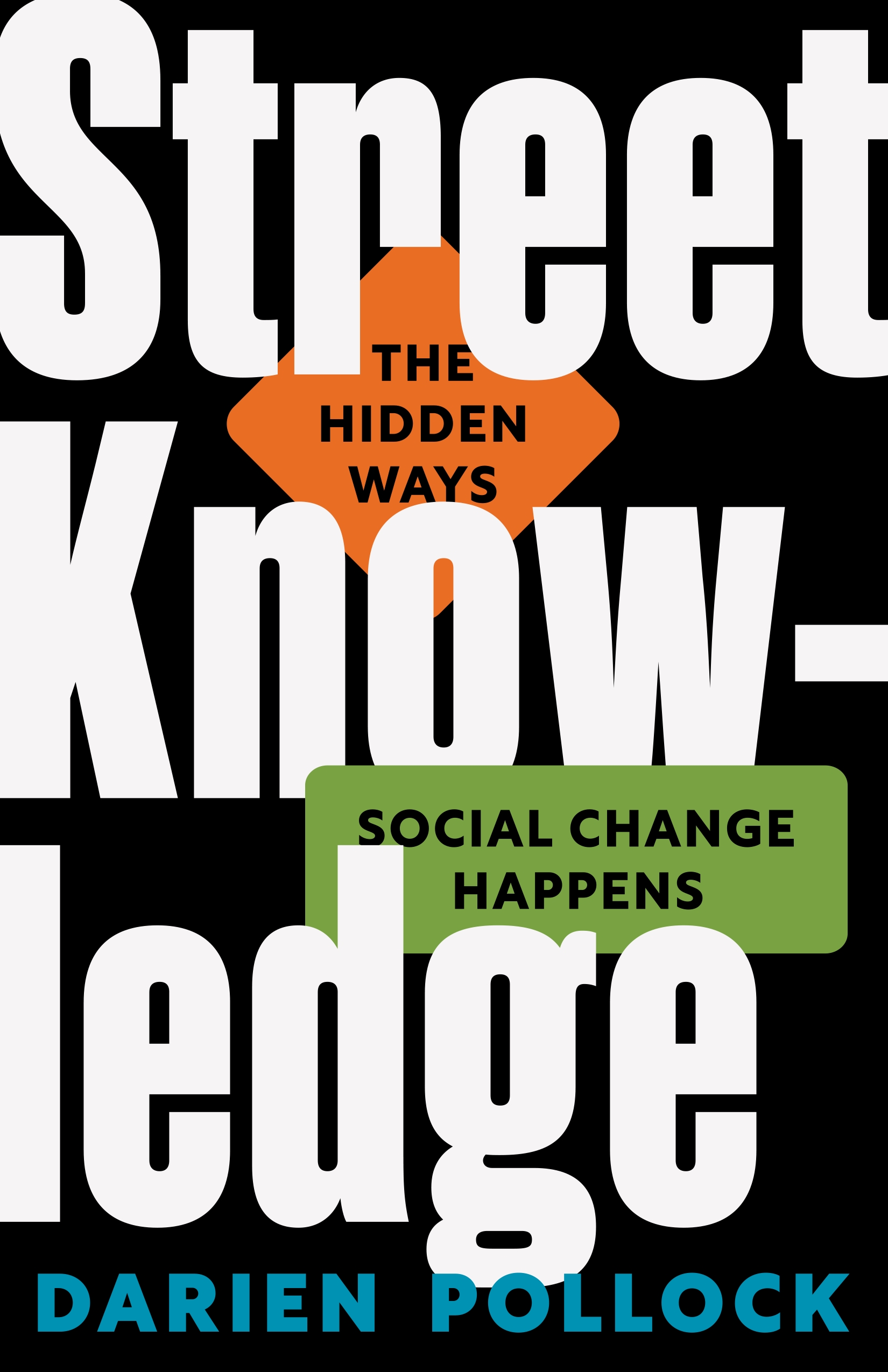
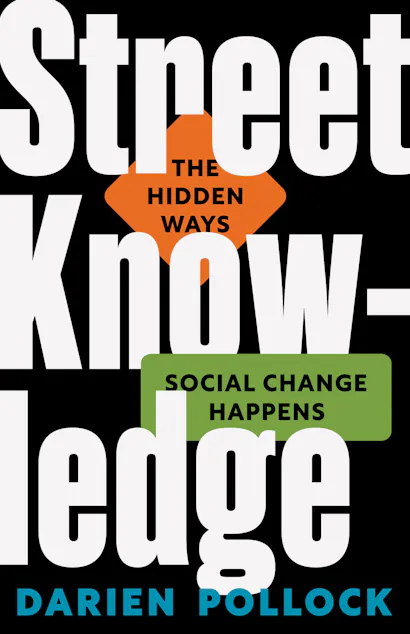
Does social change happen 鈥渢op down鈥� or 鈥渂ottom up鈥濃�攂rought about by those who hold power or by those who struggle against the powerful? In Street Knowledge, Darien Pollock argues that the most powerful change comes from the bottom up. 鈥淪treet culture鈥� supplies the creative activity that inspires not only political change but any kind of positive social change. Pollock argues that part of what prevents progressive social change is that people in power only legitimize and respond to ideas and arguments that are legible to them; marginal actors鈥攖hose with street knowledge鈥攁re forced to develop ways of making ideas that are illegible to the broader public meaningful and useful. At its best, street knowledge can be used to address civic injustice, cultural hegemony, and economic exploitation.
Reading Plato, Marx, DuBois, Derrida, and others, Pollock discovered that academic philosophy has had a street orientation all along. The core qualities he associated with the 鈥渟treet disposition鈥濃�攖he psychological and spiritual capacity to resist an unjust social arrangement鈥攚ere already represented in Plato鈥檚 Republic. Drawing on the late Congressman John Lewis鈥檚 idea of 鈥済ood trouble鈥� as well as Socrates, Pollock argues that 鈥渢he street鈥� should be understood as a universal feature of the human condition鈥攚ith the potential to emerge anywhere at any time. Street knowledge, Pollock contends, lays the foundation for a radically new way of doing philosophy and achieving social justice.
Darien Pollock is assistant professor of philosophy at Boston University. He is the founder and president of the Street Philosophy Institute, Inc., a community organization dedicated to connecting higher education resources to underserved communities, particularly in the rural South.
“A dope, dope book. Darien Pollock goes beyond clarity, creating a different and stunningly accurate way to think about the creation of literal lore that shapes policy, democracy, and the insides of Americans. Street Knowledge welcomes without pitying or pontificating. This is dynamic bookmaking at its most potent.”—Kiese Laymon, author of Heavy: An American Memoir
“Street Knowledge is a pioneering and path-blazing book grounded in the rich lifeworlds of everyday Black people and conversant with the best of the past and present philosophical voices of the West. Pollock’s own profound and poignant voice is one of the most crucial of his generation of our precious Black prophetic tradition.”—Cornel West, Union Theological Seminary
“With his capacious analyses and unflinching honesty, Pollock deftly weaves the linguistic sophistication and sociopolitical realities of Black life into a brilliant epistemological account that is rooted in his own love of wisdom and care for ‘the streets.’ Pollock is an important new figure in American intellectual life.”—Imani Perry, author of Black in Blues: How a Color Tells the Story of My People
“This is a compelling account of how social change is led by those with a rebellious ‘street disposition’ too often dismissed as ‘criminal.’ Pollock skillfully shows how ideas about language, knowledge, and ethics both arise from and shape struggles for justice in the face of overwhelming odds.”—Tommie Shelby, author of Dark Ghettos: Injustice, Dissent, and Reform
“Street Knowledge is a necessary corrective to elite approaches within philosophy. By countering dominant narratives of ‘the street,’ Pollock gives voice to traditions that have been eclipsed in the academy and provides valuable resources for anyone interested in knowledge, language, and social change.”—Sally Haslanger, coauthor of What Is Race?: Four Philosophical Views
“With great interdisciplinary breadth, Street Knowledge offers an original model for how to do public-facing philosophy and how to change scholarly debates so that they are more publicly engaged.”—Jos茅 Medina, author of The Epistemology of Protest