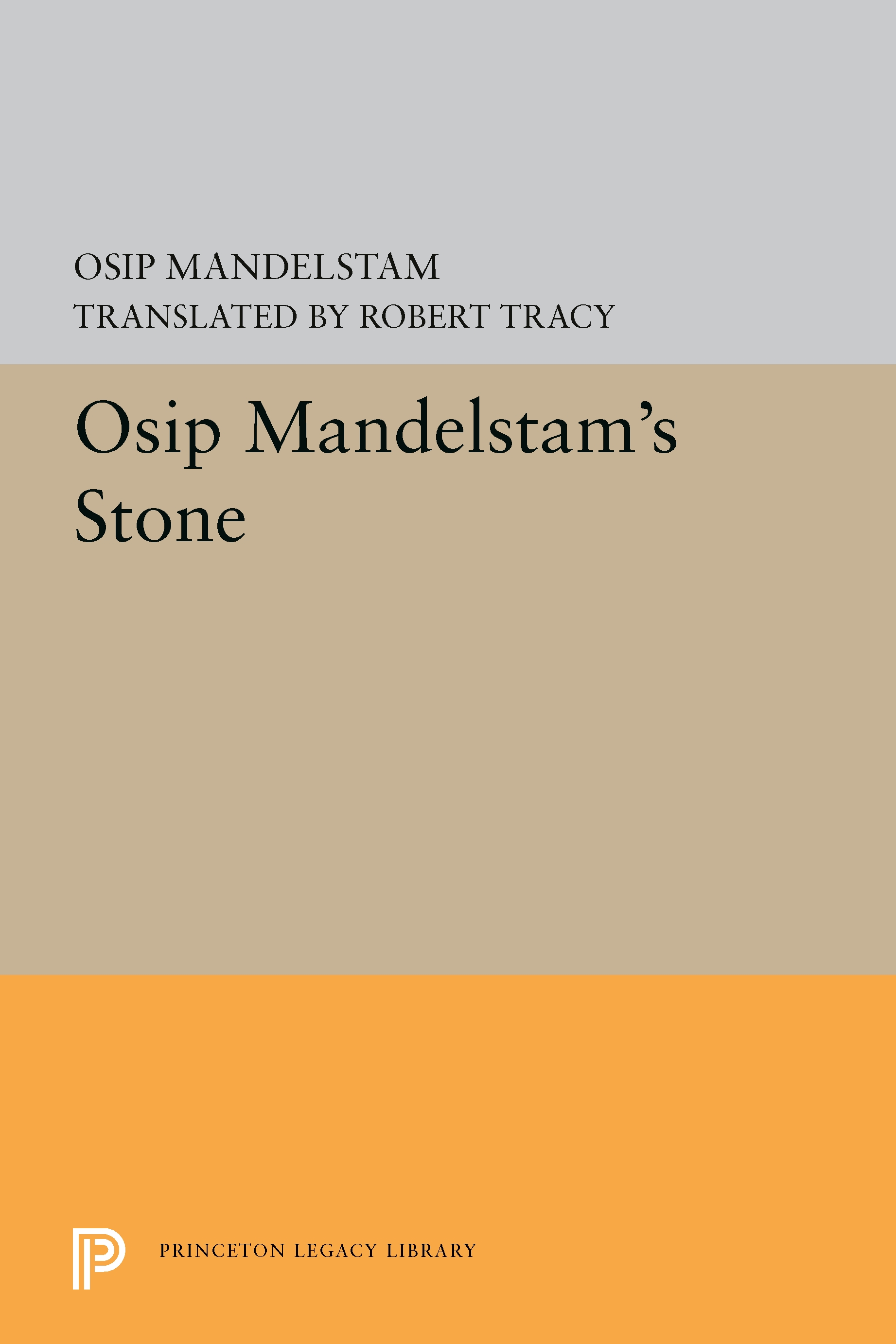
Stone鈥擮sip Mandelstam鈥檚 1913 debut鈥攎arked the arrival of perhaps the greatest Russian poet of the twentieth century, one whose refusal to bow to Soviet political and artistic dictates led to his persecution and eventual death in one of Stalin鈥檚 prison camps. Mandelstam spent his early years in St. Petersburg, and many of the poems in Stone depict the city鈥檚 vast squares, classical buildings, and Dutch canals. Other poems reflect his hunger for Western European culture, his commitment to humanistic values, and his ambition to become a master of the Russian language. This bilingual edition is based on the final version of Stone, published in 1928, and features a biographical and critical introduction and detailed annotations.
“Robert Tracy gives an account of the main influences in the air at the time of Mandelstam’s first book, Stone, here translated in toto into rhymed verse, with a parallel Russian text, an excellent introduction and very illuminating notes. . . . What makes Tracy’s book invaluable is his feeling for context. His introduction has an important section, entitled ‘Poetry and Quotation,’ where he rightly insists on the way Mandelstam’s poems are ‘as firmly rooted in both an historical and cultural context and in physical reality as Joyce’s Ulysses or Eliot’s Waste Land.’ His notes to the poems will be essential for those who seek to locate this context, especially when it turns out to be other Russian poetry or Mandelstam’s criticism. . . . Another thing that comes across in these translations is the verve and immediacy of the poems’ occasions, recalling the Acmeist programme of ‘this worldness’: there are poems about tennis and ice-cream and silent movies, poems that seem to jump into being on impulse. . . . There is a salubrious 茅lan about much of the book, and the fact that this is indeed a book, not just a selection of the significant poems, amplifies our sense of what Stone really meant to its contemporary readers.”—Seamus Heaney, London Review of 快色直播
“Wonderful. . . . Stone has been admirably translated by Robert Tracy.”—John Bayley, The Guardian
“Tracy has done a superb job. His introduction is excellent, his notes are very comprehensive . . . and his verse translations are remarkably good. All one can say is ‘Thank you.’”—S茅amus 脫 Coigligh, Irish Times
“A touchstone of twentieth-century culture.”—Christina Robb, Boston Globe