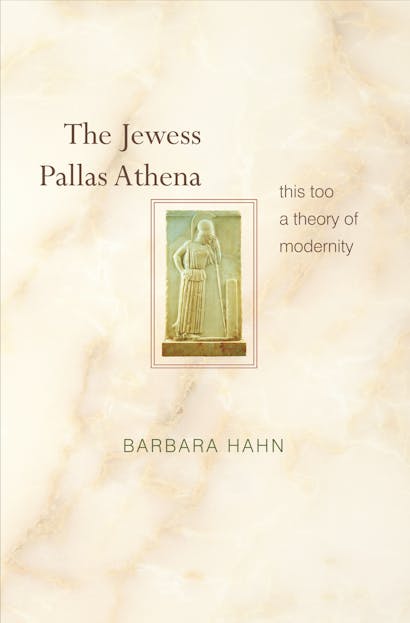
鈥淭he Jewess Pallas Athena鈥�—a line from a poem by Paul Celan. It is a provocative phrase, cutting across cultures and traditions. But it poses questions: How to reconstruct a culture that has been destroyed? How to conceive of history after the catastrophes of the twentieth century?
This book begins in the mid-eighteenth century with the first Jewish women to raise their voices in German. It ends two hundred years later, with another group of Jewish women looking back at a country from which they had been expelled and to which they would never want to return. Among the many prominent female intellectuals and literary figures Barbara Hahn discusses are Hannah Arendt, Gertrud Kantorowicz, Rosa Luxemburg, Else Lasker-Sch眉ler, Margarete Susman, and Rahel Levin Varnhagen. In examining their writing, she reflects upon the question of how German culture was constructed—with its inherent patterns of exclusion. This is a book about hope and despair, possibilities and preventions. We see attempts at dialogue between Christians and Jews, men and women, 鈥淕ermans鈥� and 鈥淛ews,鈥� attempts initiated by these women that, for the most part, remained unanswered. Finally, the book reconstructs the changing notions of the 鈥淛ewess,鈥� a key word in modern German history with its connotations of 鈥渟alons,鈥� 鈥渂eauty,鈥� and 鈥渆sprit.鈥� And yet a word that is also disastrous, in which there culminated everything the dominant culture condemned as dangerous.
Barbara Hahn is Distinguished Professor of German at Vanderbilt University. She is the author or editor of several books published in Germany on German-Jewish literature and culture. Together with Ursula Isselstein, she is editor in chief of the correspondence and diaries of Rahel Levin Varnhagen (Munich: C. H. Beck Verlag).
"Professor Hahn has masterfully assembled a representative collection of prominent German Jewish women who joined in, and contributed to, [the] exciting and productive period in the 18th, 19th and 20th centuries or who lamented its passing in the twentieth. . . . The Jewess Pallas Athena is an important contribution to the growing body of scholarly works evaluating German Jewish life as well as studies concerning theories of modernity."鈥�Jewish Book World
"This work is a major contribution to cultural history and is appropriate for graduate level students and above, as well as the widely read general reader."鈥擩ames LaForest, Association of Jewish Libraries Newsletter
"A remarkable scholarly and literary achievement, and a major work of cultural history. This is a deeply moving and sad book that reconstructs the cultural and literary history of German-Jewish women writers, poets, and philosophers from the mid-eighteenth to the late twentieth centuries. One often has the sense that one is reading scholarship produced by a distinctly literary imagination, indeed that Hahn's book could almost be part of the history it is telling."鈥擡ric L. Santner, University of Chicago, author of On the Psychotheology of Everyday Life: Reflections on Freud and Rosenzweig
"This important book is a highly intelligent and subtle analysis of the role of female intellectuals, largely Jewish, in shaping German cultural sensibilities in recent centuries. Hahn's moral concern鈥攑assion鈥攊s palpable on every page of her erudite volume. Her work is also a testimony of an earnest attempt, utterly free of sentimentalism, to claim a legacy that unfettered nationalism and bigotry sought to eradicate. Intellectually and spiritually compelling, and marked by graceful and eminently lucid prose, it should meet with enthusiastic interest not only among scholars but also among interested general readers."鈥擯aul Mendes-Flohr, University of Chicago, and Director, The Franz Rosenzweig Research Center for German-Jewish Literature and Cultural History, The Hebrew University of Jerusalem