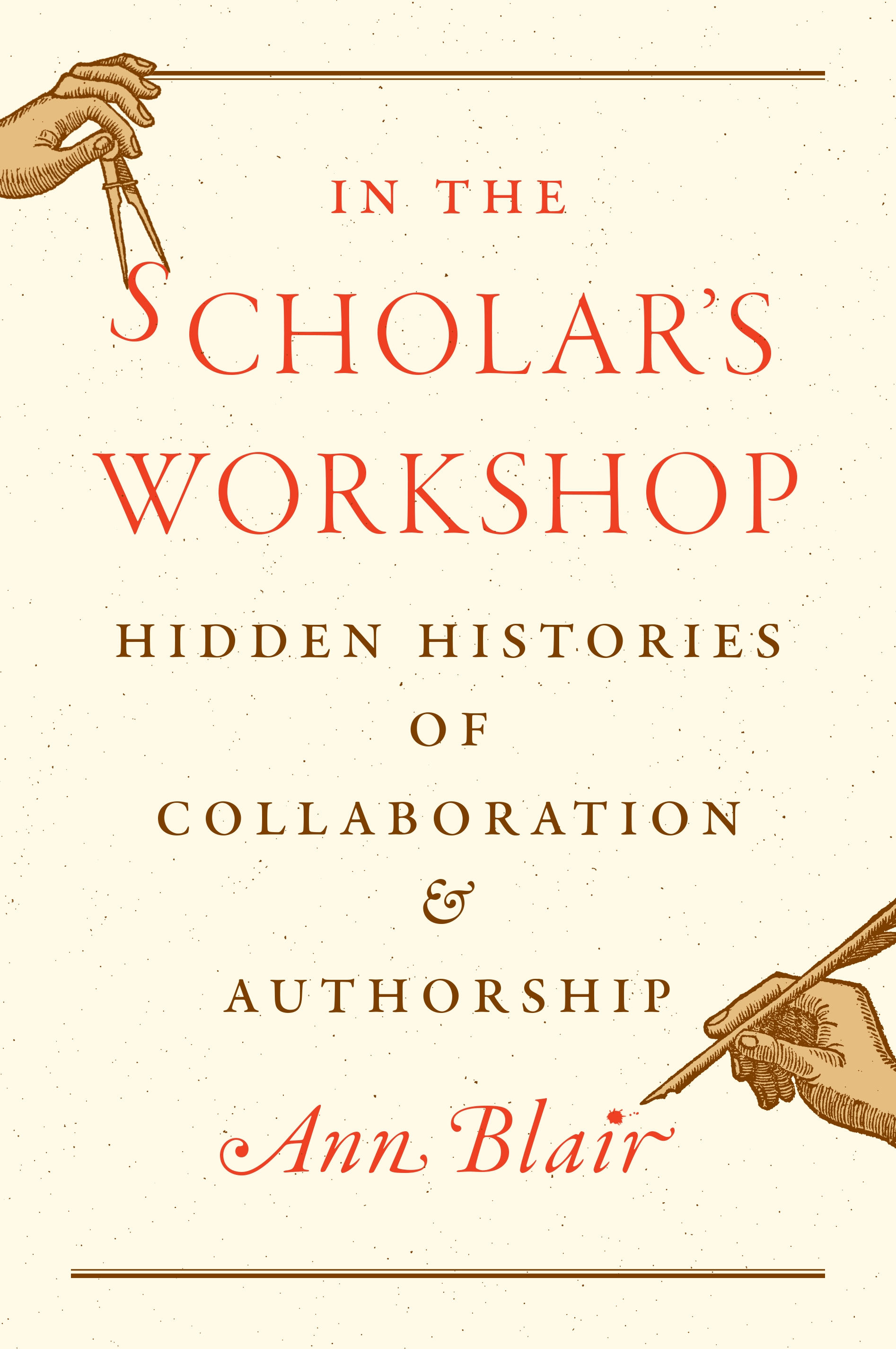
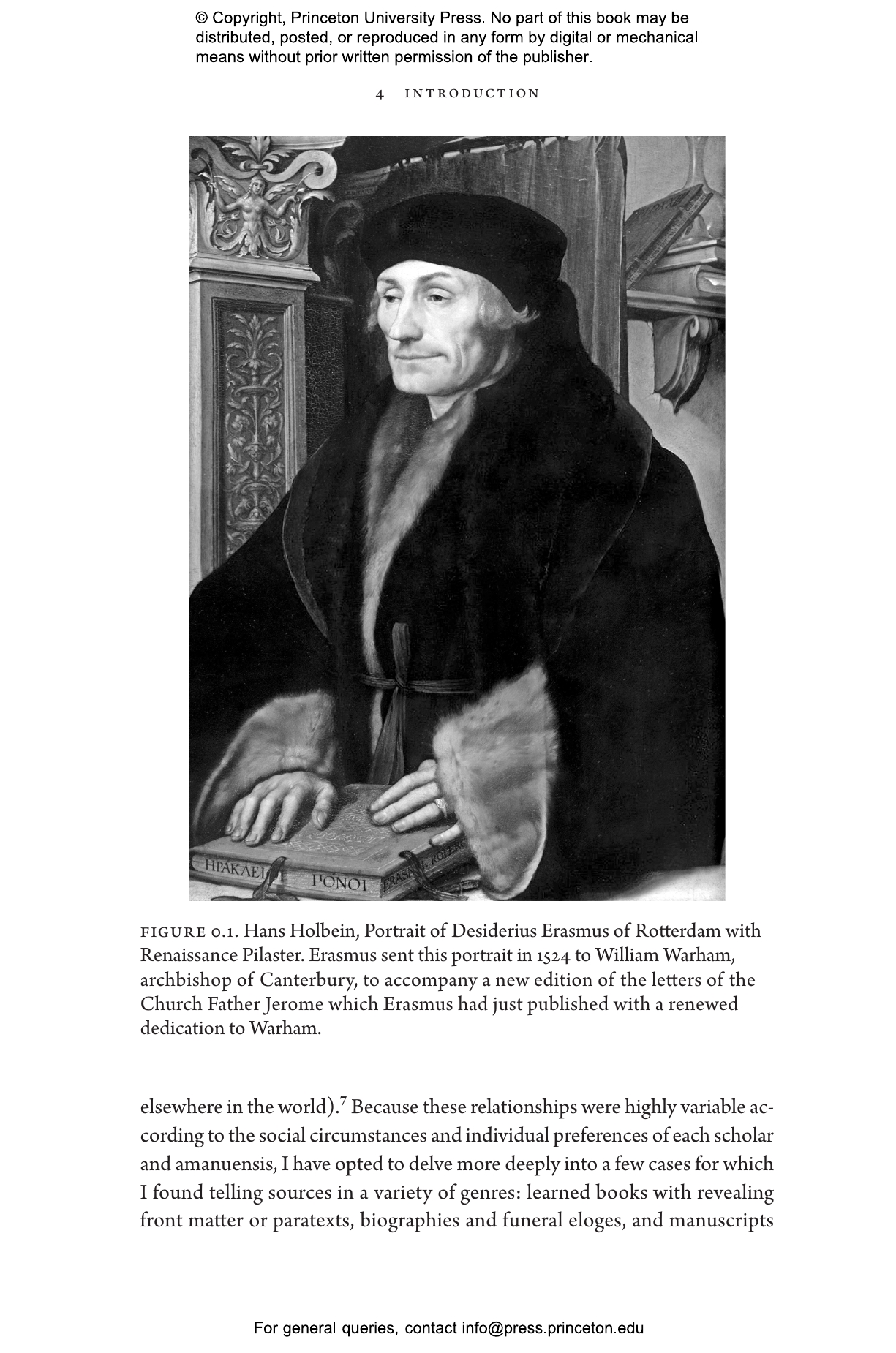
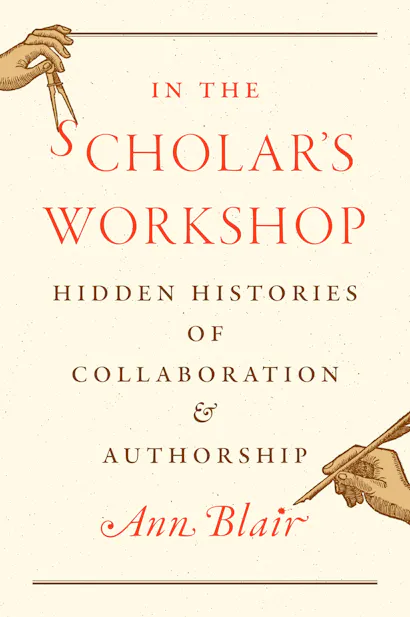
For centuries, many of the world鈥檚 most influential thinkers routinely relied on helpers who performed tasks such as taking dictation, correcting, indexing, composing, and endless copying. In the Scholar鈥檚 Workshop introduces readers to these unsung scribes, assistants, and collaborators, showing how the scholarly enterprise is rarely as solitary as we tend to think.
Ann Blair traces how the learned have relied on helpers since antiquity, discussing how and when these amanuenses became visible in manuscript and occasionally in print and explaining why they were uniquely positioned to shape the posthumous legacy of their principal. Taking an in-depth look at the later Renaissance, she reconstructs the private lives and academic pursuits of leading figures from the period such as the renowned humanist Erasmus, the reformer Martin Bucer, and Paris professors Adrien Turn猫be and Petrus Ramus. Blair paints multifaceted portraits of the servants, students, and family members who assisted in their work, drawing on sources ranging from scholarly texts in both draft and published forms to correspondence, annotations, biographical accounts, and household rules. Turning to the modern age, she identifies new kinds of digital amanuenses with the rise of chatbots and other powerful software tools.
Panoramic in scope, In the Scholar鈥檚 Workshop challenges conventional views about authorship and attribution while affirming the enduring importance of collaboration in scholarly work today.
Ann Blair is the Carl H. Pforzheimer University Professor in the Department of History at Harvard University. Her books include Too Much to Know: Managing Scholarly Information before the Modern Age and (with Paul Duguid, Anja-Silvia Goeing, and Anthony Grafton) Information: A Short History (快色直播).
"Fascinating. . . . Blair is a subtle scholar, whose deep knowledge of the techniques of Renaissance learning and command of vast bodies of contemporary research allows her to discern what others might glide over. She is adept at bringing scholarly assistants into the open, finding hidden evidence of many hands — and, more rarely, moments where amanuenses were discussed explicitly, whether to receive praise for a job well done or to take the blame for a mistake."鈥擩ulianne Werlin, The Chronicle of Higher Education
“Behind every great author of the Renaissance stood a household full of assistants who spent long hours reading and writing in his service. The greater the author, the more he depended on the work of these ‘amanuenses’—and the more that work was relegated to the shadows. Until now. Previously seen only in glimpses, the scholarly workshop comes into proper focus for the first time thanks to this extraordinary book. Based on an unparalleled range and depth of research and exquisitely attentive to every telling detail, In the Scholar’s Workshop promises to set the intellectual history of the period on a new foundation.”—Adrian Johns, author of The Science of Reading: Information, Media, and Mind in Modern America
“In the Scholar’s Workshop reconstructs the history of the largely invisible labor of scribes who made ambitious intellectual projects possible. We have long seen the artistic workshop and printshop as collaborative spaces in which masters and apprentices created a painting or a book together. Blair offers a complementary portrait of Renaissance knowledge-making in the study as the work of many different hands.”—Paula Findlen, Stanford University
“The hidden helpers of many a famous author and scholar have stepped from the shadows of history into the limelight. Ann Blair, through her rich and gripping book, has given them at last the credit that they deserve. In so doing, she provides a timely rethink, in the age of AI, of the very nature of intellectual production.”—Neil Kenny, University of Oxford
“‘Always at hand’ and ‘ready to help’ are by no means exclusively the promise of today’s handheld devices or obedient chatbots awaiting new prompts. They already characterized the writing aides of humanism and the Renaissance. In her multifaceted and monumental history, Ann Blair brings back into view the systematically erased amanuenses—a whole court of hidden hands behind the author—and reveals their decisive role in the production of scholarly texts.”—Markus Krajewski, University of Basel
Color versions of the color images: