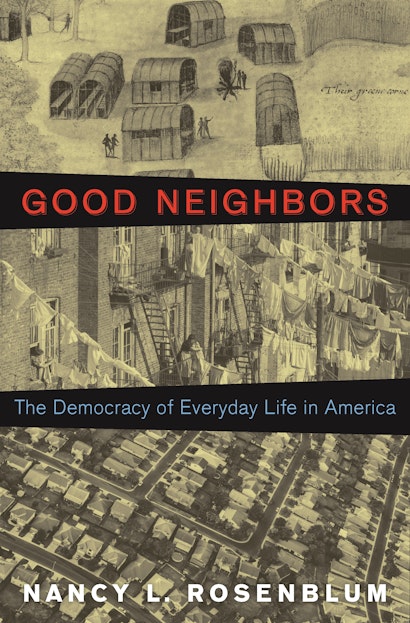
鈥淟ove thy neighbor鈥� is an impossible exhortation. Good neighbors greet us on the street and do small favors, but neighbors also startle us with sounds at night and unleash their demons on us, they monitor and reproach us, and betray us to authorities. The moral principles prescribed for friendship, civil society, and democratic public life apply imperfectly to life around home, where we interact day to day without the formal institutions, rules of conduct, and means of enforcement that guide us in other settings.
In Good Neighbors, Nancy Rosenblum explores how encounters among neighbors create a democracy of everyday life, which has been with us since the beginning of American history and is expressed in settler, immigrant, and suburban narratives and in novels, poetry, and popular culture. During disasters, like Hurricane Katrina, the democracy of everyday life is a resource for neighbors who improvise rescue and care. Degraded, this framework can give way to betrayal by neighbors, as faced by the Japanese Americans interned during World War II, or to terrible violence such as the lynching of African Americans. Under extreme conditions the barest act of neighborliness is a bulwark against total ethical breakdown. The elements of the democracy of everyday life鈥攔eciprocity, speaking out, and 鈥渓ive and let live鈥濃�攃omprise a democratic ideal not reducible to public principles of justice or civic virtue, but it is no less important. The democracy of everyday life, Rosenblum argues, is the deep substrate of democracy in America and can be its saving remnant.
Awards and Recognition
- One of Spirituality and Practice's 50 Best Spirituality 快色直播 of 2018
"[Rosenblum] draws on a wide range of historical, literary, and sociological sources鈥攆rom the stories of Raymond Carver to an ethnography of Crown Heights, Brooklyn鈥攖o produce a kaleidoscopic picture of American neighborliness."鈥擩oshua Rothman, New Yorker
"Rosenblum's book is an accessible, always interesting, narrative-filled theoretical engagement. Whether one agrees or disagrees, the journey is nuanced, insightful and original."鈥擯.E. Digeser, Perspectives on Politics
"A creative and enlightening book on neighbors, democratic public life, and the rigors and toxins of politics in America."鈥擬ary Ann Brussat, Spirituality & Practice
"Nancy Rosenblum is singular among philosophers in using her formidable analytical gifts to help us understand the gritty, personal questions we ordinary humans face every day鈥攁nd she thereby respects what is extraordinary in all of us. Good Neighbors and its elevation of 鈥榯he democracy of everyday life' is a balm and a tonic but also a challenge at a moment when our politics is the antithesis of neighborliness."鈥擡. J. Dionne Jr., author of Why the Right Went Wrong and Our Divided Political Heart
"The people next door have never been a subject for political theory. But in Good Neighbors, Nancy Rosenblum has written a very smart and wonderfully engrossing book about the importance of neighborliness in American life. From now on, neighbors will stand with citizens in our understanding of the politics of the everyday and of the human response to crisis."鈥擬ichael Walzer, Institute for Advanced Study
"In her brilliant new book, Rosenblum shows that democratic participation demands of both citizen and neighbor a precarious double act. Her innovative inquiry into neighborliness derives from her humanistic interest in literature and other narrative forms for the interpretation of everyday experience. This book has remarkable and lasting salience for humanists and social scientists alike."鈥擧omi K. Bhaba, Harvard University
"Good Neighbors is an acutely observed and deeply felt meditation on a phenomenon so familiar as to be nearly invisible most of the time. Guided by lived experience rather than top-down theoretical categories, Rosenblum resists reducing good neighbors to good citizens or friends. She shows instead that neighborliness is a distinct sphere of social life and fundamental for liberal democracy."鈥擶illiam A. Galston, Brookings Institution
"Good Neighbors explores conditions of decency and its opposite, boundaries of membership, and crucial elements of order and disorder in ways that surprise, inform, and enlighten. In so doing, this fascinating, beautifully realized consideration of neighborliness offers a fresh vantage from which to consider key strengths and vulnerabilities in American democratic life."鈥擨ra Katznelson, author of Fear Itself: The New Deal and the Origins of Our Time
"Good Neighbors makes a breakthrough contribution to both political theory and moral philosophy. Nancy Rosenblum rightly claims that moral philosophical work on the question of what it means to be a good neighbor is largely absent, and with her book she fills this space. Her writing is graceful and her imaginative power is wonderful to behold."鈥擠anielle Allen, author of Our Declaration
"In Good Neighbors, Rosenblum illuminates the world of neighborly interactions and articulates the duties, interests, habits, rights, and principles that arise in this world. She describes the dilemmas that come up for neighbors, and does not shirk from showing how neighbors can become wolves to one another. The result is a wonderful book that avoids sentimentality. Rosenblum has a distinctive voice: wise and subtle and full of quick insights."鈥擝ryan Garsten, Yale University