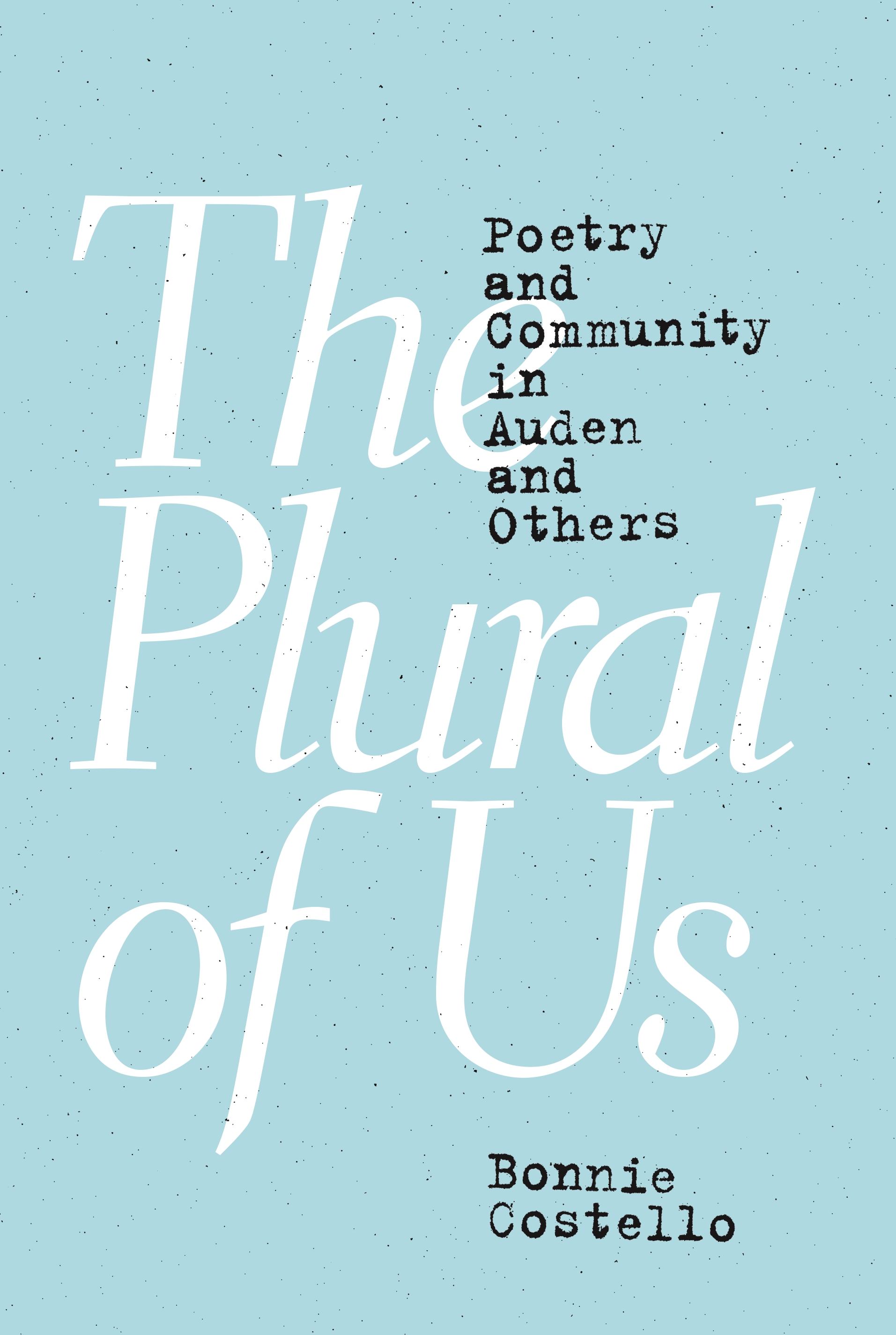
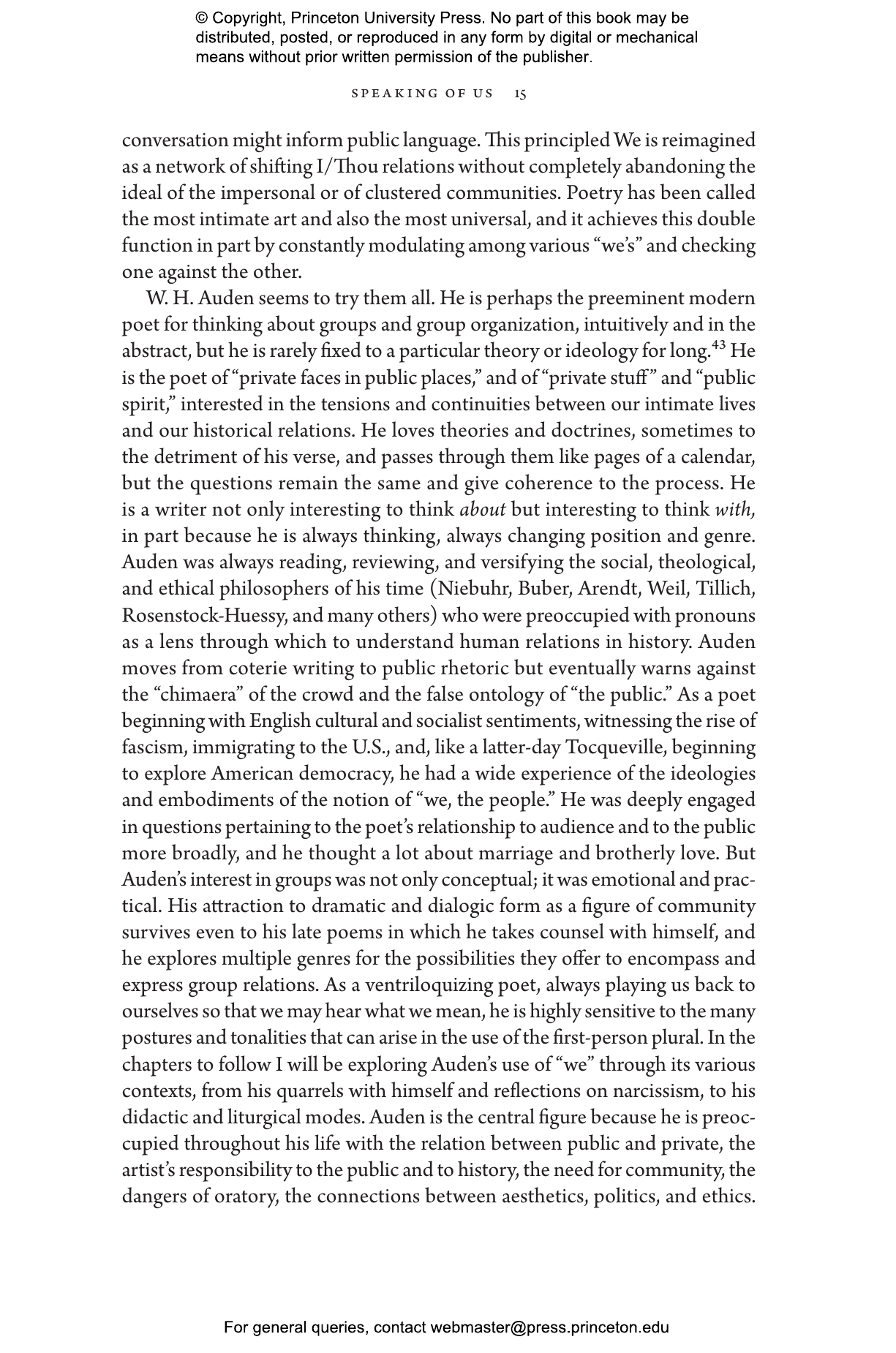
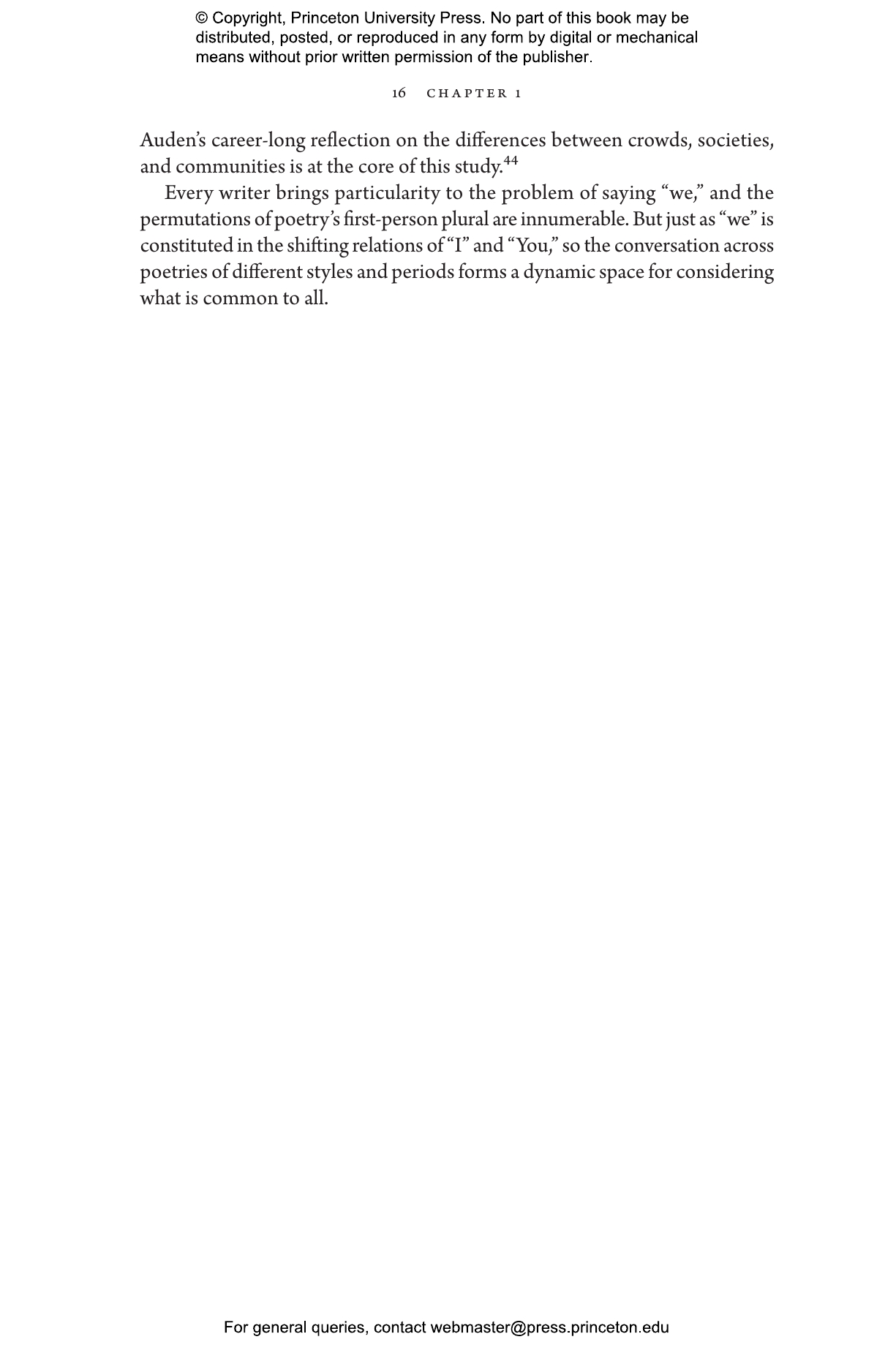
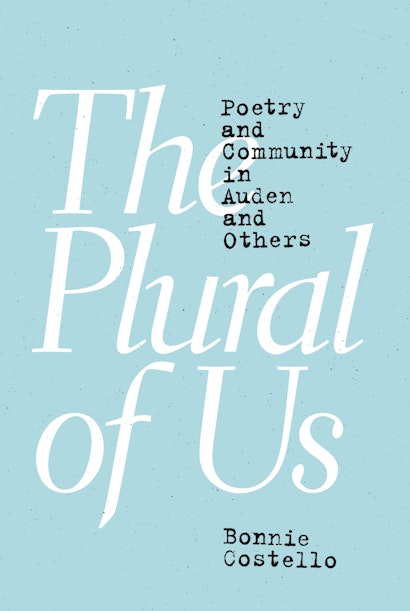
The Plural of Us is the first book to focus on the poet鈥檚 use of the first-person plural voice鈥攑oetry鈥檚 鈥渨e.鈥� Closely exploring the work of W. H. Auden, Bonnie Costello uncovers the trove of thought and feeling carried in this small word. While lyric has long been associated with inwardness and a voice saying 鈥淚,鈥� 鈥渨e鈥� has hardly been noticed, even though it has appeared throughout the history of poetry. Reading for this pronoun in its variety and ambiguity, Costello explores the communal function of poetry鈥攖he reasons, risks, and rewards of the first-person plural.
Costello adopts a taxonomic approach to her subject, considering 鈥渨e鈥� from its most constricted to its fully unbounded forms. She also takes a historical perspective, following Auden鈥檚 interest in the full range of 鈥渢he human pluralities鈥� in a time of particular pressure for and against the collective. Costello offers new readings as she tracks his changing approach to voice in democracy. Examples from many other poets鈥攊ncluding Walt Whitman, T. S. Eliot, Elizabeth Bishop, and Wallace Stevens鈥攁rise throughout the book, and the final chapter offers a consideration of how contemporary writers find form for what George Oppen called 鈥渢he meaning of being numerous.鈥�
Connecting insights to philosophy of language and to recent work in concepts of community, The Plural of Us shows how poetry raises vital questions鈥攍iterary and social鈥攁bout how we speak of our togetherness.
Awards and Recognition
- Winner of the 2017 Warren-Brooks Award for Outstanding Literary Criticism, Robert Penn Warren Center and Western Kentucky University
"As Bonnie Costello shows in her deft, knowledgable and consistently interesting study, Auden was drawn all his writing life to meditate just such questions, and to write poems with, as she puts it, 鈥榓 clear civil motive.'"鈥擲eamus Perry, London Review of 快色直播
"Although Bonnie Costello鈥檚 critical monographs have been few and far between, they always prove to be of lasting stature, invariably securing a firm position within English-language literary criticism."鈥擥rzegorz Czemiel, Explorations: A Journal of Language and Literature
"I am confident that Costello鈥檚 statement of pronouns鈥� referential ambiguity and elasticity accompanied with her relentless effort to delimit the boundaries of their references is of a great informative value, but it also provides moral support. It is so because the book will keep every critic鈥檚 head upright in all those moments when they feel they are drowning in uncertainty, confusion and despair about the poets鈥� 鈥渦s鈥� and 鈥渢hem鈥�."鈥擫adislav Vit, Svet Literatury
"Long recognized as one of our leading critics of poetry and poetics, Bonnie Costello demonstrates throughout The Plural of Us that 鈥榩oetry's "we" can be highly nuanced and variable.鈥� Her argument provides astute, original perspectives on fundamental issues like lyric subjectivity and direction of address. Focusing on Auden, her book engages with many other writers, including Shakespeare, Arnold, Dickinson, and William Carlos Williams, and will greatly interest all students of the lyric poem."鈥擧eather Dubrow, author of The Challenges of Orpheus: Lyric Poetry and Early Modern England
"Bonnie Costello has long been one of our finest readers of modern poetry, and The Plural of Us is her richest, finest book鈥攁t once stalwartly focused and provocatively wide-ranging. To read The Plural of Us is to sense a lifetime of thinking and feeling brought to bear on some of the most fundamental aspects of lyric poetry."James Longenbach, author of The Virtues of Poetry
"Bonnie Costello's exquisite book brilliantly explores how Auden and other poets use the first-person plural to conjure collectivities into being even as they also unsettle them. Her rigorous and commanding reflections on the pronoun 鈥榳e,鈥� her luminous close readings, her deep knowledge of lyric poetry, and her nuanced yet cogent arguments make this book a model of literary criticism."鈥擩ahan Ramazani, author of Poetry and Its Others: News, Prayer, Song, and the Dialogue of Genres
"The Plural of Us is an immensely ambitious look at the first person plural pronoun in Auden's poetry. Presenting a useful account of recent debates in literary scholarship on Auden, Costello traces the evolution of his thinking about the relation of the poet to audience and larger community. This book is a significant contribution to the study of modern English poetry."鈥擱osanna Warren, author of Fables of the Self: Studies in Lyric Poetry
"This persuasive book examines the way modern poets have dealt with the problem of community. Poetry, at least since the romantic period, has conceived of itself as standing apart from the greater mass of humanity鈥攕o how is the poet supposed to address the collective? Costello is a master close reader鈥攐ne of the most talented working today鈥攁nd her extended readings, focusing on the poetry of W. H. Auden, are a signal strength of this book."鈥擠avid Rosen, Trinity College