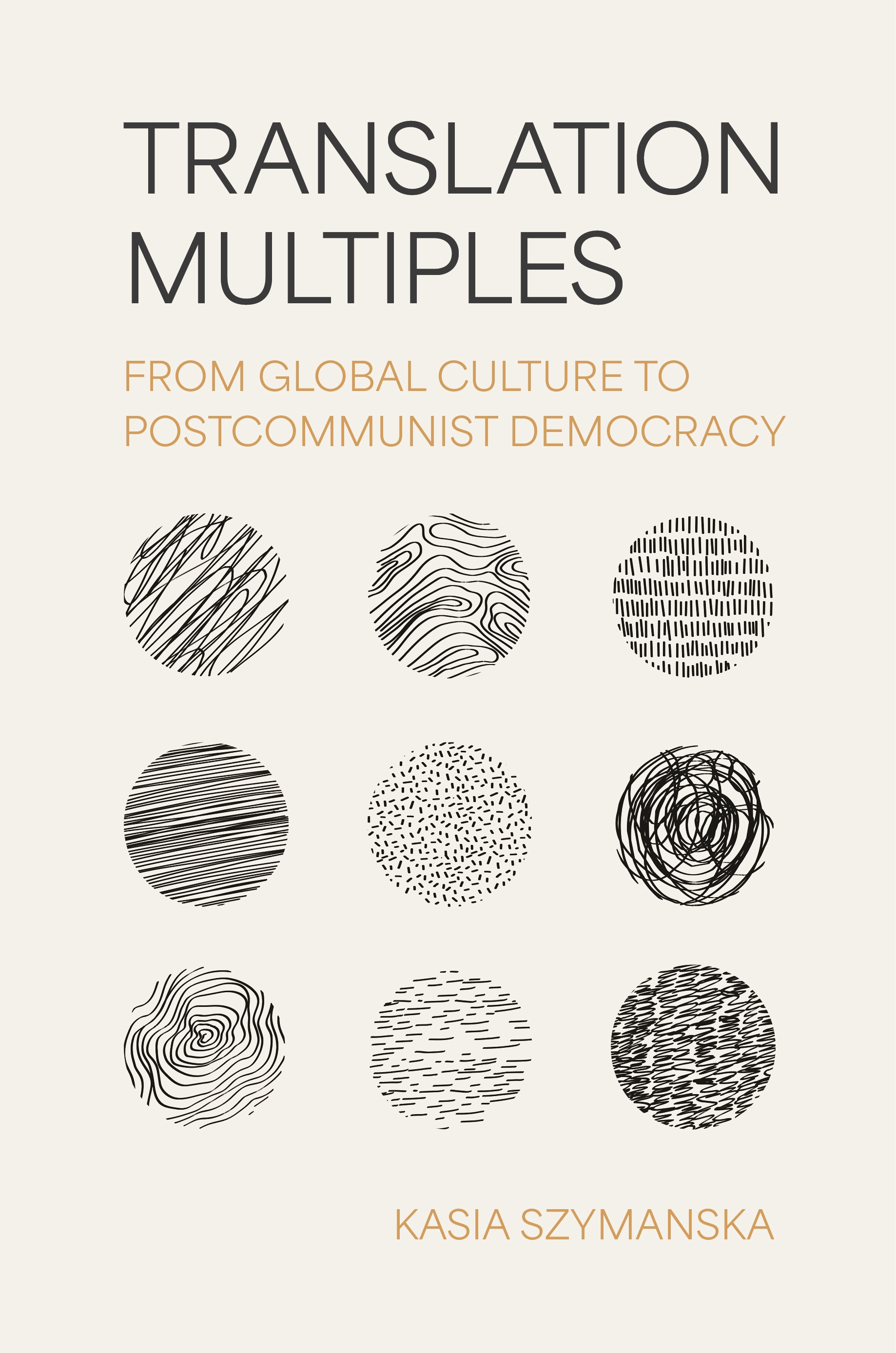
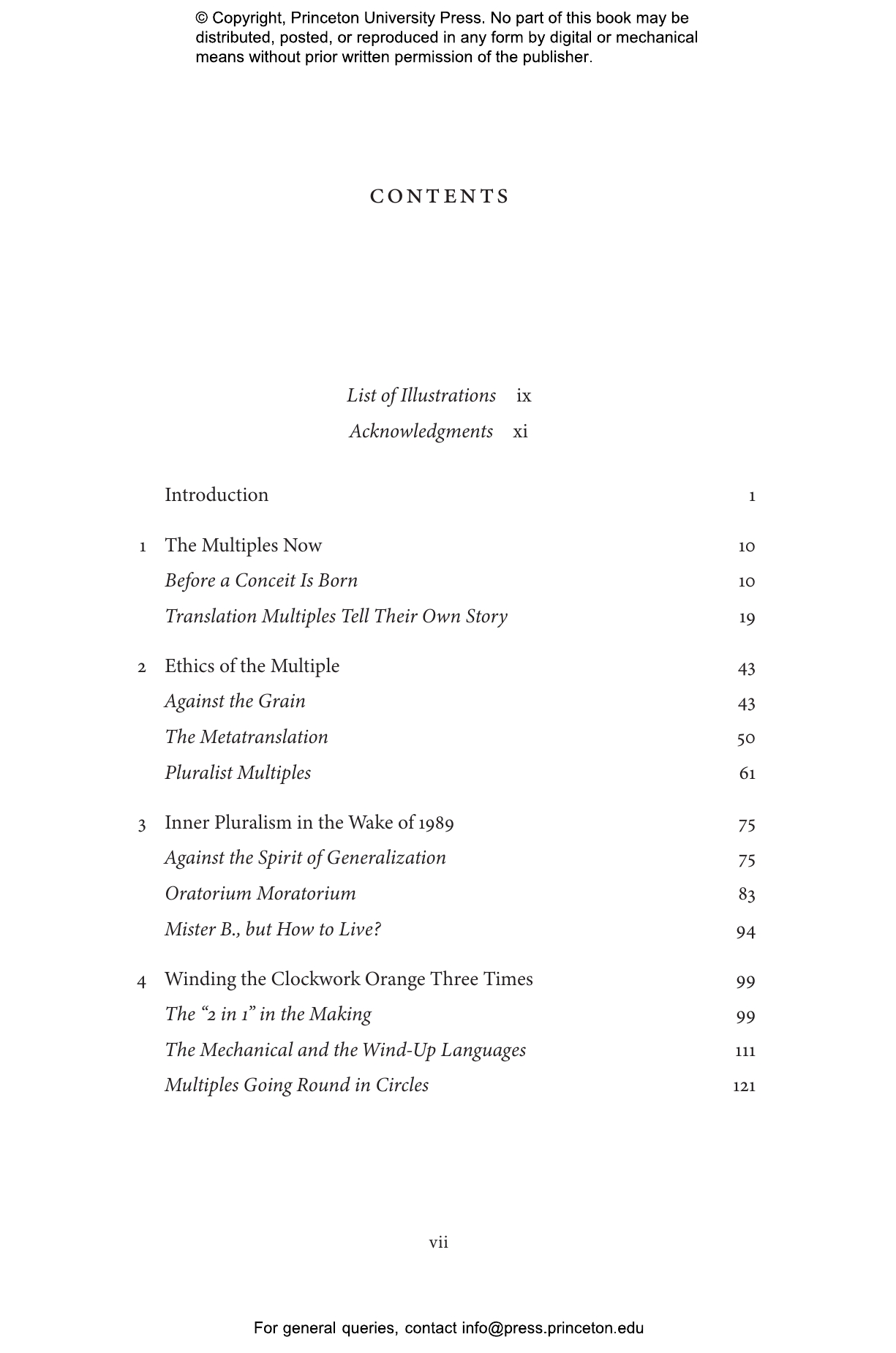
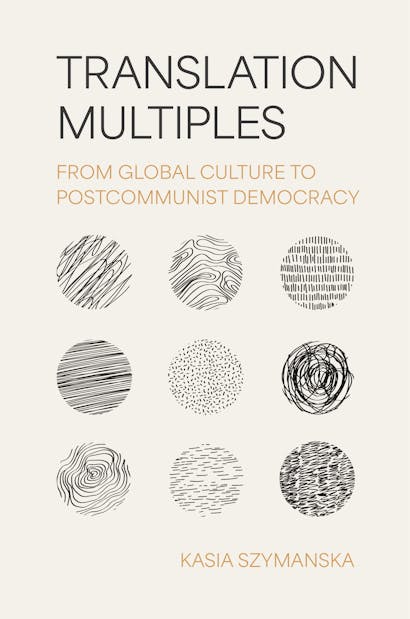
In Translation Multiples, Kasia Szymanska examines what happens when translators, poets, and artists expose the act of translation by placing parallel translation variants next to one another in a standalone work of art, presenting each as a legitimate version of the original. Analyzing such 鈥渢ranslation multiples鈥� as a new genre of writing, Szymanska explores how an original text can diverge into variants, how such multiplicity can be displayed and embraced, and how the resulting work can still be read as a coherent text. To do so, she focuses on contemporary projects in two different contexts鈥擜nglophone experimental practices and post鈥�1989 Poland鈥檚 emergence into democracy鈥攚hile viewing them against the backdrop of twentieth-century cultural and political developments.
Szymanska first takes a broad look at Anglophone global culture, debunking the myth of translation as a transparent medium and an unoriginal, secondary form of writing. She then turns to postcommunist Poland, where projects introducing multiple translation variants with different ideological readings offered an essential platform for pluralist political discussion. She examines in particular an elaborate metatranslation of 鈥淟a Marseillaise鈥�; a triple rendering of Anthony Burgess鈥檚 novel A Clockwork Orange; and a quadruple book of Bertolt Brecht鈥檚 poetry with distinct readings by four translators. She argues that the creators of such multiples want to tell their own stories鈥攑ersonal, critical, visual, or political. Showing why multiple translations matter, Szymanska calls for a redefined practice of reading translations that follows the ethics of the multiple.
"[A] celebratory, pluralist approach to translation."鈥擩ess Jensen Mitchell, Hopscotch Translation聽
"A refreshing, contemporary approach to translation. . . . This book can be read as a scholarly study but also as an introduction to a particular line of avant-garde literary practice and, as such, it may be inspiring for both literary scholars and creative practitioners. In the field of translation studies, it will become required reading."鈥擬agdalena Kay, Canadian Slavonic Papers
"A welcome reminder of the vitality of literature and literary studies in non-major languages."鈥擨na Schabert, Translation and Literature
"[A] landmark study."鈥擜lex Braslavsky, Slavonic and East European Review
"Translation Multiples is a pleasure to read, a crisply written text which thinks sensitively about contemporary, experimental literary works. The work is generous, adventurous, and open to multiple readerships: it is a rewarding addition to translation studies, contemporary Anglophone, Polish, and Slavic literary studies, while also engaging with debates in contemporary literature."鈥擯anayiotis Xenophontos, Slavic and East European Journal
"Insightful. . . . This innovative study not only defines and contextualises an important new concept within translation studies but also situates it firmly within the Polish post-communist literary landscape and analyses canonical works from a fresh perspective."鈥擠aisy Towers, Babel
"[Translation Multiple's] greatest value lies in its emphasis on how studying translation can reveal cultural mores, political attitudes, and varying degrees of social health. . . . Szymanska’s book demonstrates language’s ambiguity as an inherent element of translation. Translation brings us face to face with the excessive multidimensionality of literary texts. Perhaps for some the realization that we use language but are far from controlling it (or even understanding it) might prove unsettling. Yet this encounter helps us understand the radical potential for freedom laid within the human genome inside language itself."鈥擬att Reeck, On the Seawall
"One of the book’s major strengths lies in introducing a broader international readership to translation practices and theorisation grounded in a historical context that has been rarely explored in Translation Studies: the early years of Poland’s transition from a communist to a capitalist regime. . . . I am truly impressed by Szymanska’s ability to demonstrate, with clarity and conviction, how plural translations can strengthen democratic resilience in today’s polarised world."鈥擧anna Pieta, The Translator
"Unlike academic translation multiples, which, in their existence, are neither rare nor baffling, Szymanska’s examples are of literary bent. This is a refreshing approach, for it reminds us that to make art is to play—question, revise, complicate—and when we read the works under discussion, we immediately recognize their experimental ethos. . . . Szymanska’s study is not only deeply researched and well-argued but also written in an engaging style."鈥擯iotr Florczyk, Delos
“This book tackles an interesting contemporary phenomenon, that of multiple translations of the same text. It is very well-written, easily accessible, and jargon-free, and the arguments are convincingly expressed. Showing an excellent grasp of literary history, the author moves not only across cultures but also across time.”—Susan Bassnett, University of Glasgow
“In sparkling prose that is at once complex and accessible, Szymanska has written an exhilarating examination of what translation can do, and beyond that, what it might mean for art to collide with politics in subtle, underrecognized, quotidian ways. A bold and wonderful addition to the field of translation studies and a delightful read for any reader eager to peek behind the multilingual curtain.”—Jennifer Croft, author of The Extinction of Irena Rey
“An excellent book. The material is truly engaging, and Szymanska’s scintillating and thorough discussion makes it a genuine pleasure to read. The issues discussed will be of interest to a wide range of translation scholars.”—Adrian Wanner, Pennsylvania State University
“Szymanska presents a passionate and insightful argument for the value of translation multiples. She develops this argument through careful and frequently illuminating readings of an array of fascinating texts.”—Jacob Edmond, University of Otago