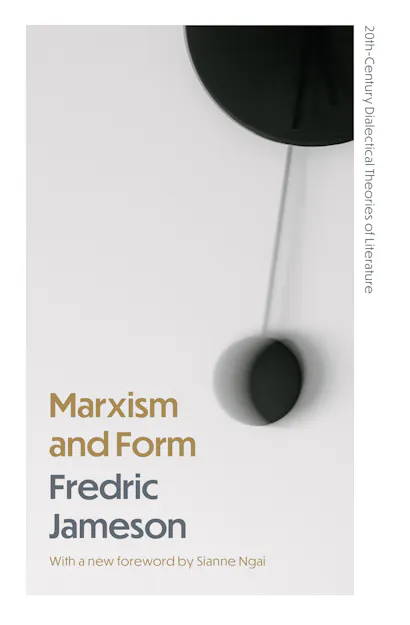
In Marxism and Form, Fredric Jameson, one of the most important literary and cultural critics of the twentieth and twenty-first centuries, offers a pioneering look at major European Marxist and Frankfurt School thinkers鈥擜dorno, Benjamin, Marcuse, Bloch, Luk谩cs, and Sartre. Through penetrating readings, Jameson develops an influential mode of critical engagement that places art and culture at the heart of Marxist theory. The result lays the foundations for the entirety of Jameson鈥檚 monumental critical project鈥攁nd remains a timely and vital work of aesthetic criticism for readers today.
“Fredric Jameson was not just an intellectual giant, but the last true genius in contemporary thought. He was the ultimate Western Marxist, fearlessly reaching across the opposites that define our ideological space. . . . One could argue that he was the last Renaissance figure.”—Slavoj 沤i啪ek
“Stunning. . . . The book’s very title throws down the gauntlet to a dreary lineage of vulgar Marxist criticism.”—Terry Eagleton
“Exploding like so many magnesium flares in the night sky, Fredric Jameson’s writings have lit up the shrouded landscape of the postmodern.”—Perry Anderson
“Jameson thinks dialectically in the strong sense, in the way we are all supposed to think but almost no one does.”—Michael Wood, London Review of 快色直播
“Jameson was arguably the most prominent Marxist literary critic in the English-speaking world. . . . Reading him could never be easy: Criticism, as he understood it, could never be, because of the complexity of its objects and its need to perpetually revise, refine and question its own procedures. To my mind, nobody did this as doggedly—or should I say as dialectically, with such a clearly articulated sense of the intellectual stakes—as Jameson.”—A. O. Scott, New York Times
“Jameson was the greatest intellectual titan of the past half-century who remained largely unknown to the general public.”—Jacob Brogan, Washington Post
“The most alluring American literary theorist.”—Angela Woodward, Los Angeles Review of 快色直播
“An intellectual titan and one of the torchbearers of Marxist thought through the tenebrous night of neoliberalism.”—Kate Wagner, The Nation
“His writings . . . accomplish a magnificent balancing act between intellectual rigor on the one hand and aesthetic perception on the other; a strong political commitment undergirds the whole, yet his devotion to dialectical thought prevents him from ever approaching dogma. . . . He was, in realms of art, a skeptical enthusiast, and thus a brilliant critic.”—Alex Ross, The Rest Is Noise
“Mr. Jameson’s exposition of their ideas is constantly exhilarating in the spirit of that tradition which extends from Plato’s Symposium through Diderot’s Conversations to Hegel’s Phenomenology. From this tradition Mr. Jameson inherits his inventive, playful, even heady style and his carefree mingling of the ‘disciplines’ (philosophy, literary criticism, sociology, economics). His best and longest chapter is devoted to Sartre, on whom he has written before and who has influenced his method most strongly. . . . Mr. Jameson’s fastidious attention to form yields some magnificent insights.”—Times Literary Supplement
“The novelty of [Jameson’s] approach lies with his emphasis on form rather than mere content as the key to the dialectical relationship of a given literary or artistic work to the determinate social moment in which it has its ground. He pursues this critical insight in a series of brilliant interpretive essays on major figures of Western Marxism whose ultimate purpose is to reassimilate the fundamental problems of Hegelian philosophy and related aspects of phenomenology and existentialism to Marxist critical theory in general and thus prepare the theoretical basis for a dialectical criticism of literature. Not just a major contribution to the theory of literary criticism, this book is an intellectual event of the first order.”—Library Journal