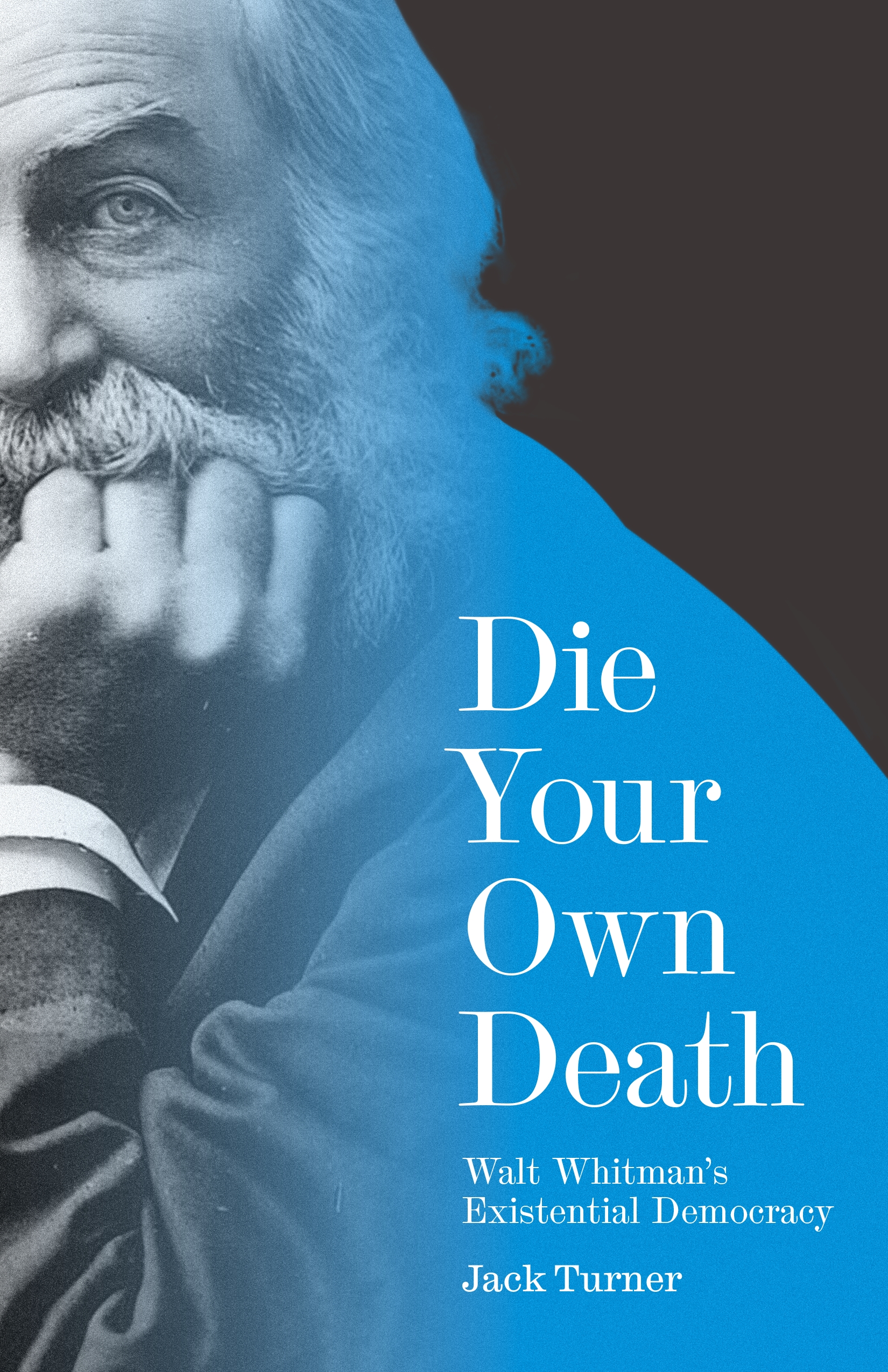
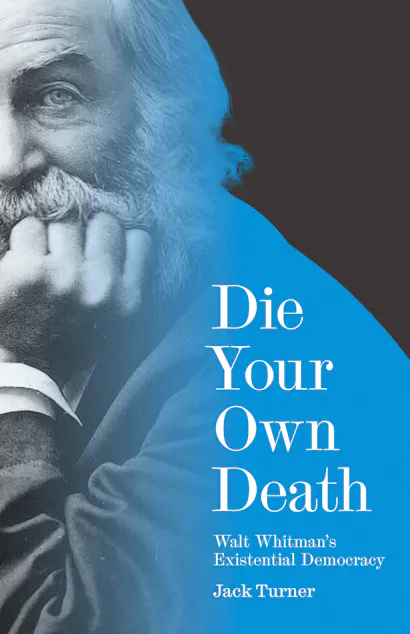
Humans fantasize about immortality. Billionaires dabble in cryonics, politicians build monuments to themselves, and writers donate their papers to libraries. In Die Your Own Death, Jack Turner argues that the quest for immortality鈥攍iteral or symbolic鈥攊s politically destructive. He does so through a meditation on the work of Walt Whitman. Whitman held that democracy prepares individuals to 鈥渄ie their own deaths鈥濃�攆ree of fear, resentment, and illusion. In Whitman鈥檚 鈥渆xistential democracy,鈥� accepting death strengthens freedom and equality. And yet, Turner finds, Whitman only half succeeded in forging a democratic philosophy of death. As Whitman鈥檚 thought evolved in response to changing ideas about nation, race, and empire, he encouraged citizens to seek immortality through racial imperialism鈥攖he expansion of white empire from North America to the Pacific Islands鈥攁s a monument to American greatness.
Turner explores the poetics of death in Leaves of Grass and its relationship to Whitman鈥檚 democratic theory (鈥淚 exist as I am, that is enough鈥�). Through a close analysis of Drum-Taps and Memoranda During the War, Turner shows that Whitman sought to redeem the mass slaughter of the Civil War by cloaking it in poetic and national glory. And in Whitman鈥檚 greatest prose work, Democratic Vistas, Turner argues, Whitman envisioned an antidemocratic national immortalism that ignored Native sovereignty and Black equality. Turner exposes the dark side of Whitman鈥檚 philosophy of death, but he also reveals how that philosophy can still be a resource in the ongoing struggle for freedom and equality.
Jack Turner is professor of political science at the University of Washington, author of Awakening to Race: Individualism and Social Consciousness in America, and coeditor of African American Political Thought: A Collected History.
“In this short book about a big topic, Jack Turner writes about politics in a personal vein and about persons in a political vein. With Walt Whitman as one muse, Turner turns a challenge we often confront alone—death—into a potent source of democratic energy. With James Baldwin as a second muse, he shows that when we shrink from our finitude, the poisons of nation, empire, and race are always near. Die Your Own Death is how epic political theory meets its world.”—Corey Robin, author of The Enigma of Clarence Thomas
“Jack Turner’s stunning revisionist interpretation of Walt Whitman’s democratic theory reveals him to be a tragically divided figure who embraces the democratic promise of a mortalist humanism, while also exemplifying the seductive allure of an antidemocratic national immortalism. These competing figurations of democracy’s relation to death illuminate the existentialist contours of our contemporary democratic crisis.”—Jason Frank, author of The Democratic Sublime: On Aesthetics and Popular Assembly
“Through a rich engagement with Walt Whitman, Turner powerfully shows why democracy needs citizens who can convert a fear of death into a passion for a life where all can flourish. This original vision of an existential democracy equips us to weather the uncertainties of freedom and to cultivate the compassion needed for equality. A beautiful book.”—Sharon Krause, author of Eco-Emancipation: An Earthly Politics of Freedom
“A fresh, exciting, and thought-provoking study of Whitman as a political thinker. The book offers close readings of Whitman’s major works that at once situate them in historical context while at the same time putting them in dialogue with the broader currents of the history of political thought, from Pericles to Heidegger. The scholarship is rigorous, the writing is elegant, the sources are comprehensive.”—Alexander Livingston, author of Damn Great Empires! William James and the Politics of Pragmatism
“Through Walt Whitman’s evolving philosophy of mortality, Die Your Own Death reveals how our understanding of life’s limits is fundamental to our visions of freedom and equality. Affirming vulnerability, finitude, and individuality, Jack Turner has written a book that exposes immortalism’s dark alliance with racial empire while calling us to reclaim mortality as democracy’s forgotten foundation.”—Cristina Beltr谩n, author of Cruelty as Citizenship: How Migrant Suffering Sustains White Democracy
“Die Your Own Death is consistently illuminating and grows steadily stronger as it unfolds. A stimulating and important book.”—Nick Bromell, author of The Powers of Dignity: The Black Political Philosophy of Frederick Douglass