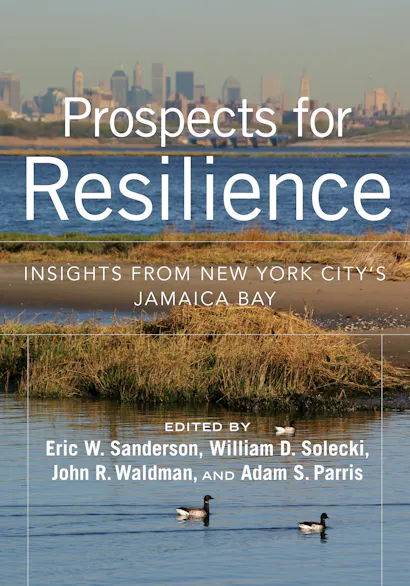
Given the realities of climate change and sea-level rise, coastal cities around the world are struggling with questions of resilience. Resilience, at its core, is about desirable states of the urban social-ecological system and understanding how to sustain those states in an uncertain and tumultuous future. How do physical conditions, ecological processes, social objectives, human politics, and history shape the prospects for resilience? Most books set out 鈥渢he answer.鈥� This book sets out a process of grappling with holistic resilience from multiple perspectives, drawing on the insights and experiences of more than fifty scholars and practitioners working together to make Jamaica Bay in New York City an example for the world.
Prospects for Resilience establishes a framework for understanding resilience practice in urban watersheds. Using Jamaica Bay鈥攖he largest contiguous natural area in New York, home to millions of New Yorkers, and a hub of global air travel with John F. Kennedy International Airport鈥攖he authors demonstrate how various components of social-ecological systems interact, ranging from climatic factors to plant populations to human demographics. They also highlight essential tools for creating resilient watersheds, including monitoring and identifying system indicators; computer modeling; green infrastructure; and decision science methods. Finally, they look at the role and importance of a 鈥渂oundary organization鈥� like the new Science and Resilience Institute at Jamaica Bay in coordinating and facilitating resilience work, and consider significant research questions and prospects for the future of urban watersheds.
Prospects for Resilience sets forth an essential foundation of information and advice for researchers, urban planners, students and others who need to create more resilient cities that work with, not against, nature.
"Prospects for Resilience centrally positions the Jamaica Bay watershed as a social-ecological system and details the interactions among wetlands, water, and people and commerce in a way that is often discussed but rare in practice. Resilience planning and practice at this broad scale is not easy, but the framework outlined in this volume should provide a solid foundation for years to come."鈥擠enise J. Reed, Chief Scientist, The Water Institute of the Gulf, Baton Rouge, Louisiana
"In Prospects for Resilience, 52 contributors from various disciplines came together to produce a dozen papers assessing how resilience can be developed in and around Jamaica Bay. The topic sounds cumbersome, and in some ways, it is, but the questions are simple and can be asked in many places: 'What does it take to make a coastal city like New York resilient? How do we understand disturbances in the context of history and nature, and how do we enhance the ability of people and nature to recover after them?'…The contributors seek to encompass everything from the quality of sediment in the bay to the nearby human communities...the result is not quick reading; the foundations are being laid."鈥�Planning
"Increasing resilience means collaborating across all levels, across interests and borders, across the world. It asks for inspiration and information with better research, data, shared knowledge, and innovation. With the world at a tipping point in its climate change approach, Prospects for Resilience provides this kind of critical information, inspiring communities and showing how to increase their capacity for resilience."鈥擧enk Ovink, Special Envoy for International Water Affairs, Kingdom of the Netherlands
"The risks of climate change are forcing a re-evaluation of the ways we live, work, and play in the twenty-first century. The groundbreaking, collaborative research being done in Jamaica Bay, insightfully presented in Prospects for Resilience, is helping us prepare for this future through our own OneNYC resilience program. For what we do in Jamaica Bay will not only help the bay but, if done right, can have a regional, national, and even global impact in the fight against climate change."鈥擠aniel A. Zarrilli, Senior Director of Climate Policy and Programs & Chief Resilience Officer, NYC Office of the Mayor
"A welcome contribution to social-ecological system restoration especially of coastal areas. It demonstrates how complex ecological restoration will become by taking into account social drivers and issues...However, it is also clear that the book is just a first step and that resilience science is, just as resilience practice, a learning process in which a lot of steps have still to be taken. The volume will surely contribute to the way forward."鈥�Restoration Ecology