
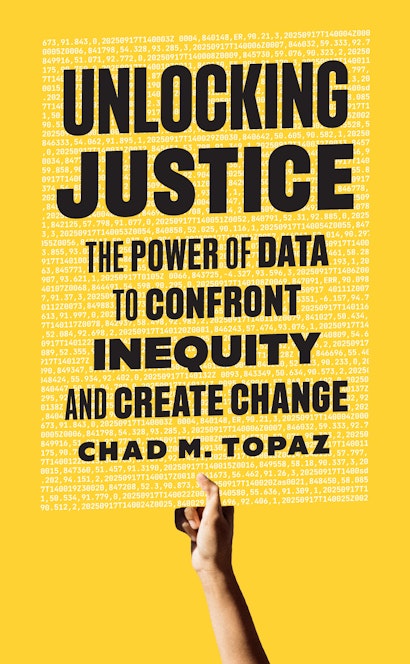
The American legal system does not offer equal justice to all; we can see obvious racial disparities in sentencing, policing, and incarceration. In Unlocking Justice, Chad Topaz offers a concrete way forward, demonstrating how a candid dialogue between social justice and data science can empower communities, spark informed debate, and inspire advocacy. In addition to big ideas, Topaz brings the receipts鈥攖he data. Drawing on unedited police call logs, chaotic city websites, fragmented judicial records, and other overlooked sources, Topaz explains how social forces shape the data we collect, influencing whose voices are heard and whose remain unheard. From a rural New England town plagued by police misconduct to New York鈥檚 notorious Rikers Island jail, the stories Topaz tells demonstrate how numbers can expose injustice鈥攁nd how data can underpin activism.
You鈥檙e an applied mathematician who once studied insect swarms. How did you end up writing a book about racial injustice in the criminal legal system?
Chad M. Topaz: For years, my profession was about applying mathematics to problems in physics, chemistry, and biology. For instance, I used math to study collective motion in animals 鈥� bird flocks, fish schools, insect swarms. I loved it. But during that same stretch, my personal and political life was changing. I was coming out as gay. I was becoming more politically aware. And I was starting to notice how the quantitative skills I used every day could be turned toward questions that felt more urgent to me than bird flocks.
The real pivot started with a few projects that showed me what data could do when pointed at questions of equity. I studied gender imbalances on the editorial boards of math journals. Then my collaborators and I looked at the demographics of artists in 18 major US art museums. That project took off and got a lot of attention in the national and international news. Those experiences led me to found QSIDE, the Institute for the Quantitative Study of Inclusion, Diversity, and Equity, where our mission is to use data science to fight injustice. From there, the work kept expanding into the criminal legal system 鈥� policing in Williamstown, Massachusetts, where I live and work, as well as bail in New York City, conditions on Rikers Island, federal sentencing, and risk-assessment algorithms used in courtrooms. Before I knew it, I had a book鈥檚 worth of stories to tell.
Applied mathematics is about using quantitative tools to solve real-world problems. I just changed which problems I was working on. And what I kept finding, in every system I looked at, was that the institutions exercising the most power over people鈥檚 lives were the ones working hardest to keep their data out of public view.
The book takes readers through policing, bail, jail, sentencing, and risk-assessment algorithms. What connects all of these?
CMT: Every chapter is a story about what happens when you shine data on a system that would rather stay in the dark. Police departments, courts, jails, the federal judiciary 鈥� these institutions hold enormous power over people鈥檚 lives, and in every case I studied, getting access to the data we needed was a fight. Public records requests went unanswered. Judges鈥� names were redacted. Jail records were riddled with errors. The institutions didn鈥檛 want to be seen clearly. And when you can鈥檛 see what鈥檚 happening inside a system, you can鈥檛 hold it accountable.
The other thread is race. At every stage of the criminal legal system I examined, racial disparities showed up in the data. Black and Latine people were disproportionately affected by aggressive policing, by high bail, by harsh sentencing, by biased algorithms. The book traces that pattern.
Your research on criminal risk-assessment algorithms produced a finding that surprised even your own students. What did you discover?
CMT: This one really threw us. In Broward County, Florida, judges use an algorithm called COMPAS to help make sentencing decisions. COMPAS takes in over a hundred questions about a defendant鈥檚 background and spits out a risk score 鈥� a number that鈥檚 supposed to predict how likely they are to reoffend. ProPublica had already shown that COMPAS was racially biased 鈥� it was roughly twice as likely to incorrectly label Black defendants as future criminals compared to white defendants. So when my students and I set out to study how COMPAS actually affected sentencing outcomes, we assumed the answer was obvious. A biased algorithm gets injected into the system, more Black people end up behind bars. Case closed.
We were wrong. What we found was that after COMPAS was introduced, confinement rates went down for both Black and white individuals. Sounds good, right? Here鈥檚 the catch. COMPAS disproportionately labels white individuals as low risk, and judges appeared more willing to forgo confinement for people deemed low risk. So white defendants reaped more of the benefit. Meanwhile, COMPAS disproportionately labels Black individuals as high risk, and those individuals repeaed less of the benefit. The net effect: the racial gap in sentencing widened. The disparity with COMPAS was 1.7 times bigger than it would have been without it.
This is an uncomfortable finding. COMPAS reduced incarceration overall, which is something I care about. But it did so in a way that increased racial inequity, which I also care about. A judge might look at declining confinement rates and feel good about the trend without realizing that the algorithm on their desk is quietly making the racial gap worse.
You write openly about your own identity 鈥� as a white, gay man from a wealthy suburb doing work centered on racial justice. Why put that front and center rather than letting the data speak for itself?
CMT: Because data doesn鈥檛 speak for itself. That鈥檚 one of the most important things I want readers to take from this book.
I grew up in Winnetka, Illinois 鈥� overwhelmingly white, extremely affluent. I went to excellent public schools. The police in my town were there to protect people like me. That background shapes everything about how I encounter the criminal legal system, and if I pretended otherwise, I鈥檇 be doing something dishonest.
There鈥檚 a concept in research called positionality 鈥� the idea that who you are affects what you see, what questions you think to ask, and how you interpret what you find. Another framework called QuantCrit forces us to examine how numbers themselves can encode the biases of the people and systems that produce them. When I tell you that I鈥檓 a white man from a privileged background studying racial inequity, I鈥檓 giving you information you need to evaluate my work.
A recurring theme is that getting access to public data was often harder than analyzing it. Can you give readers a sense of what that looked like?
CMT: In Williamstown, we filed a public records request with the police department and got back reams of physical paper that we had to digitize by hand. On Rikers Island, the city of New York categorized everyone in its jails as Asian, Black, or Unknown. Three categories for one of the most diverse cities on the planet. Hispanic and Latine people were effectively erased from the data.
Federal sentencing was maybe the most absurd. We wanted to know which judges were handing down racially disparate sentences. The data exists. But the government redacts judges鈥� names from the public sentencing files. So my collaborators and I had to build an entire database 鈥� we called it JUSTFAIR 鈥� by merging multiple sources and exploiting a workaround involving judges鈥� initials on a court website. It took years.
And then there鈥檚 Broward County, where our public records request to the Clerk of Courts went unanswered. We ended up writing a program to scrape the court鈥檚 website one case at a time, solving a CAPTCHA for each search. We hired people around the world to solve CAPTCHAs for us. I never imagined that doing data science would involve farming out robot tests to strangers in Argentina and the Czech Republic, but here we are.
We had a legal right to all of this information. But the systems designed to hold it made access as difficult as possible. When data is hard to get, accountability is hard to achieve.
You dedicate a chapter to arguing that math itself is a human creation shaped by bias. What does that have to do with justice?
CMT: Think about COMPAS, the sentencing algorithm I just described. Part of its appeal is that it looks like math 鈥� objective, neutral, above human bias. That assumption runs deep. Most people think of math as the ultimate objective enterprise. But math is built on axioms 鈥� assumptions that we accept without proof 鈥� and those axioms are chosen by people. Mathematicians even disagree about what counts as a valid proof. The whole enterprise is more human and more contested than most people realize, and that matters, because when we treat a tool like COMPAS as 鈥渏ust math,鈥� we鈥檙e hiding the human choices baked into it.
The myth of pure objectivity does real damage. If mathematicians believe their field is above human influence, they have no reason to examine who gets included and who gets pushed out. When a debate erupted in the math community over diversity statements in faculty hiring, my collaborators and I studied who signed the opposing letters. The letter against diversity statements was signed overwhelmingly by tenured white men at elite institutions. The letter in favor was signed by a much more diverse group. Where people stood on whether identity matters in math lined up fairly closely with their own identities.
The same people who resist acknowledging the human side of mathematics tend to resist incorporating data science and social justice into school curricula. They see it as diluting rigor. But what they鈥檙e protecting is a version of the field that centers their experience and excludes others 鈥� and that exclusion shapes who becomes a mathematician, what problems get studied, and whether the next generation learns to think critically about the data that increasingly governs their lives.
This book arrives at a moment when DEI programs are being dismantled and the very idea of examining racial disparities is under political attack. How do you think about doing this work right now?
CMT: I鈥檒l tell you a story. After our research on bail in New York City came out 鈥� showing that a small group of judges were imposing bail at wildly disproportionate rates 鈥� twelve judges鈥� organizations published a letter calling our work 鈥渁dvocacy masquerading as research.鈥� They disputed our right to look. That reaction tells you something about power and transparency that no amount of political commentary can.
The broader climate is real 鈥� DEI offices shutting down, restrictions on what can be taught about race in schools, legislation targeting trans people. But the resistance I鈥檝e encountered isn鈥檛 abstract. It comes from judges who don鈥檛 want to be named, courts that ignore records requests, and professional organizations that would rather not know what their own data shows. That鈥檚 exactly why the work matters. When people in power fight this hard against transparency, it鈥檚 usually because transparency is working.
I also take hope from the fact that the tools we built aren鈥檛 going anywhere. The JUSTFAIR database is public. The datasets and research behind this book are freely available online. These things persist even when the political winds shift.
Each chapter ends with concrete steps readers can take. What do you most hope someone will do after putting this book down?
CMT: Pay attention to the data in your own community. So much of what I uncovered in this book came from public records that anyone, in theory, can access. The information is there. The problem is that most people don鈥檛 know to look for it, and the systems that hold it don鈥檛 make it easy to find.
You don鈥檛 need to be a data scientist to do this work. You need curiosity and persistence. You can file a public records request with your local police department, look up your federal judges on the JUSTFAIR database, or check online to see if algorithms are being used in your area鈥檚 courts. And then share what you find. The gap between what鈥檚 happening in our public institutions and what the public actually knows about them is enormous.
Nobody鈥檚 going to make a movie about filing a public records request. But some of the most important work in this book grew out of exactly that 鈥� requests for data that nobody expected us to actually use. And we did.
Chad M. Topaz is professor of complex systems at Williams College and cofounder of the QSIDE Institute, which uses data science to promote equity and justice. An award-winning educator and researcher recognized by the National Academy of Sciences, the Association for Women in Mathematics, and the Society for Industrial and Applied Mathematics, he has written numerous studies at the intersection of data science, social justice, and public policy. His opinion pieces have appeared in The Chicago Tribune, The New York Daily News, The Philadelphia Inquirer, Inside Higher Ed, and other publications.