
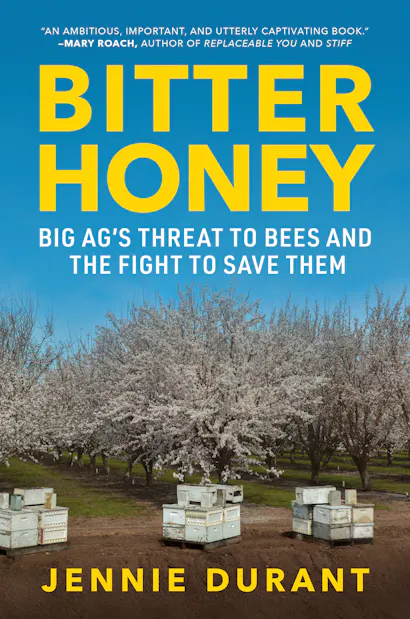
In Bitter Honey, Jennie Durant takes readers behind the scenes to reveal the human and ecological cost of industrial farming for bees, beekeepers, and all of us who depend on them. Bees today face a gauntlet of threats: parasites and disease, pesticide exposure, and climate extremes鈥攁ll magnified by Big Ag. Beekeepers, meanwhile, endure grueling practices just to survive, often losing half their hives each year.
What is Bitter Honey about, at its heart?
Jennie Durant: Bitter Honey reveals how our industrialized food system harms bees and steps we can take to help them thrive. Bee declines and colony losses have been in the news since Colony Collapse Disorder emerged in 2006. Over the past two decades, researchers have identified many threats to bees, including varroa mites, pesticides, disease, and habitat loss. What has been missing, however, is more structural lens that shows how our food system drives these stressors. That鈥檚 where Bitter Honey steps in. It鈥檚 not just a book about bee declines, but about what these declines reveal: when we build a food system designed around scale, efficiency, and constant extraction, we push the natural world we rely on to the brink.
Many people think of bees as a symbol of nature or spring. What does Bitter Honey reveal about their complex role in our modern food system?
JD: Over the past 150 years, beekeeping has shifted from a largely backyard practice to a commercial industry that trucks millions of colonies across the United States each year. Native and managed bees provide essential, often unappreciated, pollination services for more than 100 crops in the United States, including fruits, vegetables, and seeds. But our growing dependence on them has taken a toll on bee health. One of the clearest examples of this is almond pollination: each February, beekeepers bring millions of colonies to California to pollinate almonds because almonds require bee pollination to fruit. To meet that demand in the dead of winter, beekeepers must push their bees hard: they feed them supplements, breed highly productive queens, constantly manage pests, truck colonies cross-country, and expose them to agrochemicals during bloom. It highlights how bees are no longer just a symbol of nature; they鈥檙e essential workers in an agricultural system that鈥檚 asking more of them than they can bear.
Why is forage loss鈥攖he disappearance of bee flowers鈥攁n underappreciated part of the bee crisis?
JD: Forage loss is one of the biggest challenges facing beekeepers, as natural pastures are cultivated, urbanized, sprayed with pesticides, or wiped out by extreme weather. One of the most surprising examples is how forage loss in the Midwest affects bees and farms across the country. Each summer, beekeepers take more than 40 percent of all US commercial bee colonies to the Northern Great Plains to recover from the stresses of agriculture and produce a honey crop. But the prairie and conservation lands that once made the region a bee haven are disappearing as corn and soy production expand. This has real consequences for bee health and productivity. Research shows that colonies with access to abundant forage in the Midwest become stronger agricultural pollinators the following year. It鈥檚 a powerful reminder that farm practices in one region can ripple across the nation鈥攁nd that conservation programs and healthy bee forage more generally are essential to keeping bees healthy.
What are some solutions that inspired you during your research?
JD: The final third of Bitter Honey focuses on inspiring efforts to get more bee-friendly flowers on the land. At the farm level, I highlight Christine Gemperle, a California almond farmer who plants bee-friendly cover crops and hedgerows to support pollinators on her farm. She now uses less water and fewer pesticides because of the side benefits of that forage. In the Midwest, Zac Browning and Pete Berthelson co-founded the Bee and Butterfly Habitat Fund, which installs long-term, multi-acre pollinator habitat on unused land and under solar panels using their carefully designed seed mix. In Maryland, I spotlight Janet Crouch鈥檚 legal battle against her HOA, which tried to force her to remove the pollinator gardens in her yard because they didn鈥檛 align with neighborhood鈥檚 preferred aesthetic. She took that fight to the state level, helping spur a Maryland law that prevents HOAs from prohibiting native plant gardens. These are just a few examples from the book, but they all reminded me how any effort to support bees can make a difference鈥攜ou鈥檝e just got to find an approach that inspires you.
What do you hope readers will carry with them after they finish the book?
JD: I hope readers will come away with a deeper understanding of the many forces driving bee declines, but also a sense of possibility. There is so much we can do to help bees and other pollinators at home and on a larger scale. One of the biggest takeaways for me was the need for a mindset shift in how we relate to the natural world. Jane Breckenridge, a member of the Euchee Tribe in Oklahoma, shared something that really stayed with me: when many Western communities look at the world, they see resources and rights, while Indigenous communities often see relatives and responsibilities. Talking with her鈥攁nd Nancy Lawson, author of The Humane Gardener, who has embraced these ideas in her home garden鈥攚as a real paradigm shift for me. I hope readers finish the book with a more generous view of the land around them: not as spaces that only belong to us, but as shared homes that bees, insects, and other creatures depend on too.
Jennie Durant is a writer and researcher focused on bees, agriculture, and the environment. She has spent more than a decade working with beekeepers, scientists, and policymakers, including time at the US Department of Agriculture and University of California, at both Davis and Berkeley. Her writing has appeared in Grist, Glamour, HuffPo, and the San Francisco Chronicle. She lives in the San Francisco Bay Area with her family.