
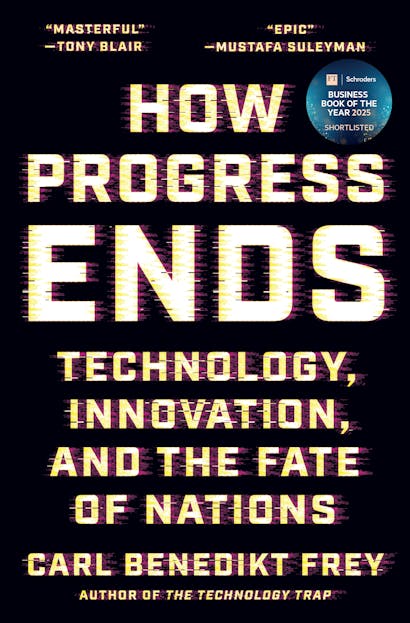
In How Progress Ends, Carl Benedikt Frey challenges the conventional belief that economic and technological progress is inevitable. For most of human history, stagnation was the norm, and even today progress and prosperity in the world鈥檚 largest, most advanced economies鈥攖he United States and China鈥攈ave fallen short of expectations. To appreciate why we cannot depend on any AI-fueled great leap forward, Frey offers a remarkable and fascinating journey across the globe, spanning the past 1,000 years, to explain why some societies flourish and others fail in the wake of rapid technological change.
By examining key historical moments鈥攆rom the rise of the steam engine to the dawn of AI鈥擣rey shows why technological shifts have shaped, and sometimes destabilized, entire civilizations. He explores why some leading technological powers of the past鈥攕uch as Song China, the Dutch Republic, and Victorian Britain鈥攗ltimately lost their innovative edge, why some modern nations such as Japan had periods of rapid growth followed by stagnation, and why planned economies like the Soviet Union collapsed after brief surges of progress. Frey uncovers a recurring tension in history: while decentralization fosters the exploration of new technologies, bureaucracy is crucial for scaling them. When institutions fail to adapt to technological change, stagnation inevitably follows. Only by carefully balancing decentralization and bureaucracy can nations innovate and grow over the long term鈥攆indings that have worrying implications for the United States, Europe, China, and other economies today.
Through a rich narrative that weaves together history, economics, and technology, How Progress Ends reveals that managing the future requires us to draw the right lessons from the past.
Carl Benedikt Frey is the Dieter Schwarz Associate Professor of AI and Work at the Oxford Internet Institute and Oxford Martin Citi Fellow at the Oxford Martin School, both at the University of Oxford. He is also a fellow at Mansfield College, the Institute for New Economic Thinking at Oxford, and Lund University鈥檚 Department of Economic History. His books include The Technology Trap: Capital, Labor, and Power in the Age of Automation (快色直播).
Leo Bader is a senior at Wesleyan University studying political theory and history. His interests include European history and political ideology; civil-military relations and strategic studies; and intellectual history.