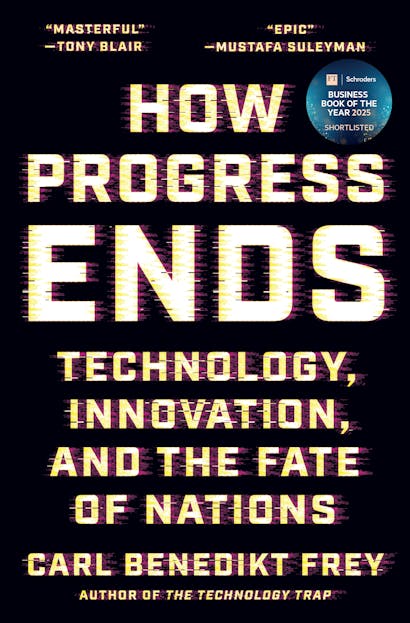
"In How Progress Ends, Carl Benedikt Frey offers a detailed and compelling account of how entrepreneurial, institutional and cultural forces have shaped periods of technological advance and stagnation across the world. In doing so, Frey, an economist and economic historian, draws timely lessons for today’s policymakers as the race for supremacy in artificial intelligence and green technology continues. . . . The present moment underscores the relevance of Frey’s writing. Business dynamism appears to be fading across much of the advanced world. . . . How Progress Ends is, therefore, an essential warning for the new era."鈥擳ej Parikh, Financial Times
"In How Progress Ends, Frey investigates the historical relationship between social structure and economic growth. His sweep is wide, stretching from the Western Zhou dynasty . . . to the European Union today. Both free marketeers and die-hard central planners may find that his conclusions challenge their view of the world. . . . [His] historical analysis has more than a little relevance to today."鈥擬arc Levinson, Wall Street Journal
"[Frey] is a world-leading expert on the sources and consequences of technological progress. In this important book, he analyses the . . . impact of artificial intelligence and, more broadly, the prospects for future economic growth."鈥擬artin Wolf, Financial Times
"Compelling. . . . A thoughtful, deeply informed study, How Progress Ends is both a historical journey and a warning. It challenges readers to recognize that progress is not self-sustaining and that the choices we make now will determine whether innovation continues or quietly fades away."鈥擬argaret Linak, Science
"Can we take for granted that AI will usher in a new era of growth and save us from stagnation? A little less than 40 years after Fukuyama (1992) declared the end of history, Frey steps into the breach on this question with a meaty tome reminding us that history is very much alive. . . . When the Berlin Wall fell, it seemed obvious to many that capitalism鈥檚 defeat of communism would usher in a new world order of technological progress in which peace and prosperity would prevail. Instead, that peace has proven fragile, that progress fleeting. Frey鈥檚 book offers a persuasive and well-written reminder that this is not an exception to history but rather the norm."鈥擠avid Robinson, Journal of Economic Literature
"It is tempting to assume that progress will always continue. How Progress Ends offers a sobering lesson: great leaps forward often grind to a halt when institutions fail to adapt."鈥擝ernard Marr, Forbes
"We are living in a golden age of big books on economic history. I would add Carl Benedikt Frey's, How Progress Ends: Technology, Innovation and the Fate of Nations, to the list of must reads."鈥�Adrian Wooldridge
"Compelling."鈥擜drian Wooldridge, Bloomberg
"On a giant macroeconomic and historical scale . . . [How Progress Ends] has huge lessons . . . for both the US and China. . . . it’s a heavyweight book that gives you a grand historical perspective on the key question of how to guarantee growth and continued technological advance."鈥擜ndrew Hill, Five 快色直播
"Progress isn’t a straight line. Frey traces a millennium of innovation to show the tension between the decentralization that can spur new technologies and the bureaucracy crucial to scaling them. Countries and institutions — from Britain to China — can either stifle change or scale it, getting the balance right matters now."鈥擳unde Olanrewaju CBE, Bloomberg
"With a nuanced study of the past thousand years of technological and economic development that has reshaped societies (and what slows innovation down), an economic historian considers the dichotomies between decentralized dynamism, centralized coordination and scaling to nurture technological progress."鈥擭athalie Atkinson, Globe & Mail
"[A] sweeping survey of a millennium of global economic growth and stagnation with an eye toward charting possible technological futures."鈥擝arry Eichengreen, Foreign Affairs
"[Frey's] broad yet deep survey of technology ranges across many nations and centuries, and pokes insightfully into myriad subjects, from Carolingian feudalism to patent law. The result is an incisive and stimulating consideration of a critical issue."鈥�Publishers Weekly
"A fascinating quasi-historical economic examination of why somesocieties flourish and others flounder amidst innovation."鈥�Library Journal
"This is a highly readable tour de force on technology and development. . . . Along the way Frey offers many anecdotes and insights that bring his subject matter to life."鈥擪evin Gardiner, Society of Professional Economists
"Progress is fragile. According to Carl Benedikt Frey, it requires a delicate sequence of innovation and efficient application. This explains why the world is now threatened by low growth. Vested interests dampen the US’s ability to leverage its decentralised economy for innovation, while greater centralisation in China puts their dynamism at risk. . . . Explaining something as complex as the success of economies through the neat lens of institutional and technological structure is a tall order. Frey does so with rigour."鈥擯hil Bell, LSE Review of 快色直播
"Frey demonstrates a commanding grasp of literatures ranging from Song dynasty statecraft to postwar industrial policy to the organizational sociology of Silicon Valley. . . . How Progress Ends is a wide-ranging synthesis that will interest economic historians, development economists, and scholars of innovation. Frey writes accessibly without sacrificing nuance and does not suppress complexity to shoehorn cases into a grand narrative. The book is a serious attempt to integrate disparate growth episodes into a coherent account and provides a useful framework for thinking about how progress happens and why it sometimes stalls."鈥擯edro Aldighieri, EH.Net
"The book contains an immense wealth of information on technological progress in large economies and their crucial transformative periods. . . . Frey’s style is clear and concise, his message is clear, and his topic urgent. The book is meticulously researched and masterfully presented."鈥擩osip Lu膷ev, Croatian Political Science Review
"How Progress Ends is a chronological explication of how certain nations interacted, culturally and economically, with technological change. . . . Recommended."鈥�Choice
"A unique and exhaustive history of human progress and its possible decline…. [Frey] marches authoritatively from the high courts of China’s Western Zhou Dynasty (1046–771 B.C.) through the Roman and British Empires, scrutinizing industrial revolutions along the way from Germany, Spain, and Poland to Japan, Hong Kong, and Taiwan…. Central to this analysis is Frey’s deeply informed and contrarian view of China. Even under the Chinese Communist Party (CCP), he argues, China may well harbor freer markets in the key technologies of the future than does the increasingly nationalist, bureaucratic, and mercantilist West… [How Progress Ends] scintillates with the surprising insights of genuine originality and historical truth."鈥擥eorge Gilder, Claremont Review of 快色直播
"In How Progress Ends, Carl Benedikt Frey demonstrates how different institutional systems alternately enable and constrain technological progress. The author successfully balances analytical precision with empirical breadth in a way that allows both specialized and general audiences to draw meaningful lessons, not only for understanding the historical dynamics of innovation but also for engaging critically with the stakes of contemporary technological change. . . . the book's concluding chapter stands out as a particularly powerful message for anyone taking progress and the future it will unleash seriously. Public sentiment towards technology, Frey contends, is as crucial—if not more so—as having appropriate institutional conditions in place."鈥擱iccardo Bosticco, International Affairs
"Using an ultra-wide-angle lens . . . [Frey] conducts a masterly sweep across two millennia to ask why progress starts and why it stops. . . . Frey works his thesis through an impressive range of cases: from Chinese mandarins to European guilds, Prussia’s “visible hand”, Soviet planning, postwar Japan and the American ascendancy. He shows how, while the British kicked off the Industrial Revolution in the eighteenth century, assisted by an environment of decentralization, weakened guilds and an ascendant merchant class, it was highly centralized Prussia that, a century later, most profitably exploited the new technologies. The author’s account of the Soviet Union, building on the work of scholars such as Chris Miller, is exemplary. . . . [A] magnificently informative book."鈥擯hilip Zelikow, Times Literary Supplement
"In impressive historical detail and breadth, Frey offers due caution against so-called Whig history, showing how economic and technological innovation often precede socioeconomic stagnation and failure.. . . . Technological innovation occurs in fits and starts. Observed progress can be learned from and replicated, and observed failures avoided. AI and associated technologies might indeed speed economic and social development considerably, fueling real progress. Alternatively, they might yield a set of known and hidden costs, broadly construed to include rights violations, that swamp the benefits. What a blessing it is then, as I would put it, to have someone like Frey to turn to for insightful assessment of currently unpredictable, civilization-shaping developments in the years to come."鈥擥regory J. Robson, Independent Review
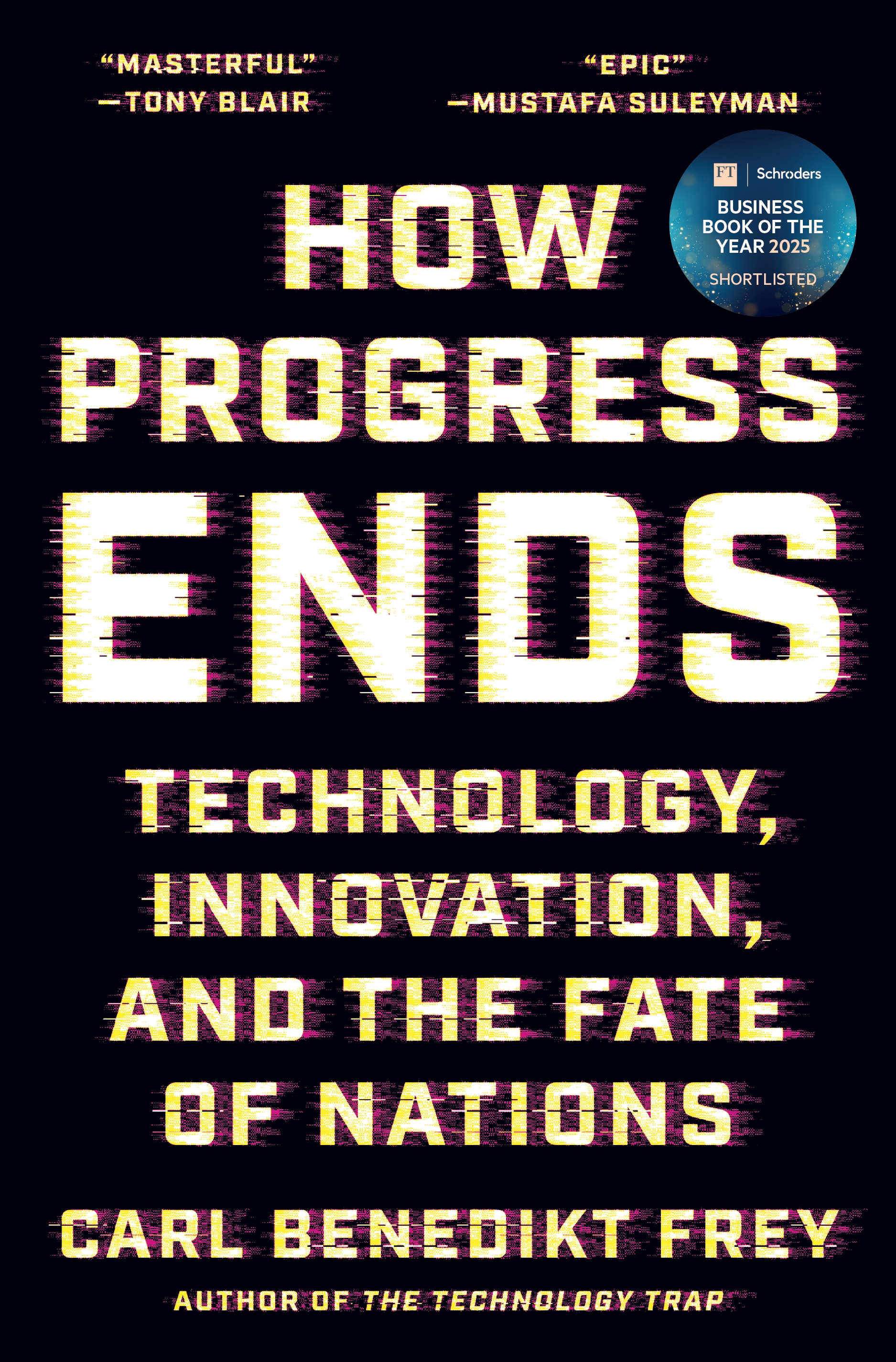
“In How Progress Ends, Carl Benedikt Frey gives a bold answer to one of history’s—and humanity’s—most essential questions: what drives technology and innovation? Epic in scope but packed with rigorous detail, it looks at what creates and reverses societal gains, asks how we should best manage the pursuit of new technologies, and hints at what, in the midst of an AI revolution, happens next. One of the key thinkers in the field, Frey delivers a grand, urgent must-read for anyone who cares about our past, present, and future.”—Mustafa Suleyman, CEO of Microsoft AI
“Debates about AI fluctuate between hopes that it will bring us boundless capabilities and riches and fears that it will reduce us to servitude or worse. But in How Progress Ends, Carl Benedikt Frey shows that the real question is how human creativity and innovation will adapt to the age of powerful AI. I can’t imagine a better place to find answers than this far-ranging, intelligent book, which reminds us that human institutions and culture have always been critical to innovation and progress.”—Daron Acemoglu, Nobel Prize–winning economist and coauthor of Power and Progress: Our Thousand-Year Struggle Over Technology and Prosperity
“Frey masterfully reveals why some nations thrive while others stumble in periods of technological upheaval. At a time when AI reshapes our world, this book offers vital lessons for political leaders seeking to harness innovation while avoiding the institutional traps that have derailed progress throughout history.”—Tony Blair, Executive Chairman of the Tony Blair Institute and former Prime Minister of Britain and Northern Ireland
"How Progress Ends is a deeply researched effort to come to grips with one of the most interesting questions in economic history: what drove innovation and economic growth in the past, and can it be sustained? In the best traditions of giants such as Joseph Schumpeter and Mancur Olson, Frey provides a thoughtful and erudite analysis that nobody interested in these questions can ignore."—Joel Mokyr, author of A Culture of Growth: The Origins of the Modern Economy
“Progress is often thought of as a succession of technologies, but major new inventions from the steam engine to generative AI disrupt societies before they deliver improved living standards. How Progress Ends is a fascinating account of the way culture and institutions interact with new technologies, concluding that conditions in the United States and China today point to a future of stagnation despite their dominance at the AI frontier.”—Diane Coyle, author of The Measure of Progress: Counting What Really Matters
“Why do some eras and countries experience rapid technological advances while others stagnate? In How Progress Ends, Carl Benedikt Frey draws on examples as diverse as Tsarist Russia, Mao’s China, and America’s AI boom to show how economic institutions promote or prevent technological progress, and how vested interests and monopolies mobilize to block change. Essential reading for anyone looking to understand the drivers of technological progress.”—Chris Miller, New York Times bestselling author of Chip War: The Fight for the World’s Most Critical Technology
“How Progress Ends, by Carl Benedikt Frey, is a deeply engaging, well-written look at what actually drives progress, and why great, innovative nations end up stagnating. It’s a fascinating story of innovation, national ambition, and yes, failure. . . . The result is a powerful, and for many, surprising warning that both the U.S. and China are edging towards the same kind of stagnation. Ultimately, the book’s brilliance . . . adds a crucial, nuanced dimension to our understanding of progress. It’s not just the tech, it’s the culture you build around it. This is a must-read for this new age of industrial policy.”—Mohamed El-Erian, Financial Times & Schroders Business Book of the Year 2025 Ceremony