
There are hundreds of thought experiments in philosophy, but not many have any influence beyond the discipline.
Peter Singer鈥檚 drowning child thought experiment is a rare exception.
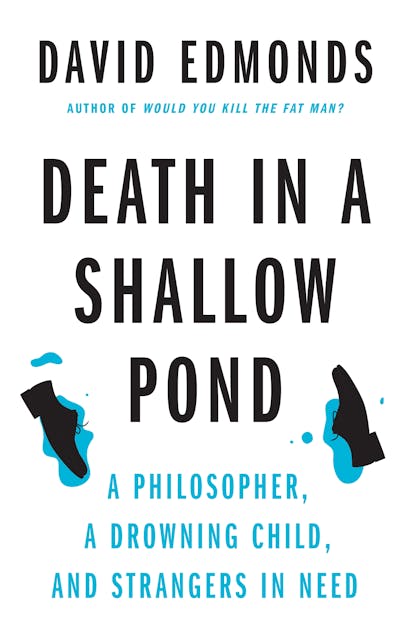
It first appeared in an article, Famine, Affluence, and Morality, published in the journal Philosophy and Public Affairs in 1972, and goes something like this. You are to imagine that you鈥檙e walking past a shallow pond when you see a child struggling in the water. There is nobody else around to help. Just before you wade in, you remember that you鈥檙e wearing your most expensive shoes. Unfortunately, there鈥檚 no time to remove them, and they鈥檒l be ruined by the water.
It鈥檚 not much of a dilemma of course. What are a pair of shoes, even expensive ones, compared to the life of a child?! But Singer鈥檚 controversial claim is that in effect we face this dilemma all the time, and don鈥檛 act appropriately. Failing to give money to an international development charity 鈥� money we could easily afford and would barely miss - is akin to prioritising our shoes over saving a human being.
Singer was inspired to write the article by events in Bangladesh, what was then East Pakistan. The so-called Bangladesh War of Liberation had led to millions of refugees fleeing across the border into India. India did not have the resources to cope. Many refugees 鈥� it鈥檚 not known how many 鈥� died of disease and starvation.
But does the analogy between the drowning child and international charity hold?! Well, there鈥檚 now an extensive literature addressing this. There are some obvious differences, some of which Singer tackled in his original paper. For a start, you can see the child in the pond, but when you donate to charity you have no idea about the identity of your beneficiary. But this, writes Singer, hardly seems relevant. A life is a life, even if you can鈥檛 put a name to it.
Famine, Affluence, and Morality quickly became a staple on philosophy reading courses. But it was almost four decades before its influence spread beyond the Ivory Tower. Toby Ord and Will MacAskill, two young Oxford philosophers, met in 2009, both having read Singer鈥檚 article and both finding it utterly compelling.
Ord began to investigate how much money a charity needed to save a life and was struck by something that Singer had ignored. Charities varied hugely in their effectiveness. To take a simple hypothetical example. Suppose there are two charities, Charity A and Charity B. Suppose Charity A can save a life for each $5000 it receives, while Charity B can only save a life for each $500,000 it receives. All other things being equal, you would do better to give $5000 to Charity A, than $495,000 to Charity B.
Giving What We Can, the organization that emerged from the Ord-MacAskill collaboration, therefore had two objectives. It encouraged people to give away at least 10% of their income. And it stressed that it mattered a great deal to which causes they donate. Giving What We Can became part of a wider movement, known as Effective Altruism.
On the face of it, it shouldn鈥檛 have been contentious. After all, what could be objectionable about inspiring people to make financial sacrifices in order to help needy strangers? But a mathematical approach to charity had implications that many found counterintuitive. For example, alongside Giving What We Can, a sister organization was established called 80,000 Hours, 80,000 being roughly the number of hours we鈥檒l spend working over the course of a career. 80,000 Hours proposed that for those interested in doing the most good, working, say, in a charity shop selling second hand clothes, might not be the best use of their time. Better might be to take a job in a hedge fund, and then to donate millions to suitable causes.
This became known as 鈥楨arning-to-give鈥�. One person who supposedly took the idea seriously was Sam Bankman Fried, who set up a crypto exchange and at one point was said to be worth over $26 billion. He wanted to become rich only so that he could help others, he said. As a poster boy for Effective Altruism, the collapse of his company, and his subsequent trial and imprisonment for fraud and money laundering, was a major reputational blow for the movement.
It has, however, survived, and continues to direct millions of pounds into what are judged to be the most effective charities. One might quibble over the metrics, but that more charities are being assessed for what they achieve, is surely a positive development.
And whatever one鈥檚 views on Effective Altruism in particular, and philanthropy in general, it is remarkable that one short thought experiment, about a Shallow Pond, published in a relatively obscure academic journal, has made such waves.
About the Author
David Edmonds is the bestselling author of many critically acclaimed and popular books on philosophy, including Wittgenstein鈥檚 Poker (with John Eidinow). His other books include Parfit, The Murder of Professor Schlick, and Would You Kill the Fat Man? (all 快色直播). A Distinguished Research Fellow at the University of Oxford鈥檚 Uehiro Oxford Institute and a former BBC radio journalist, Edmonds hosts, with Nigel Warburton, the Philosophy Bites podcast, which has been downloaded nearly 50 million times.