
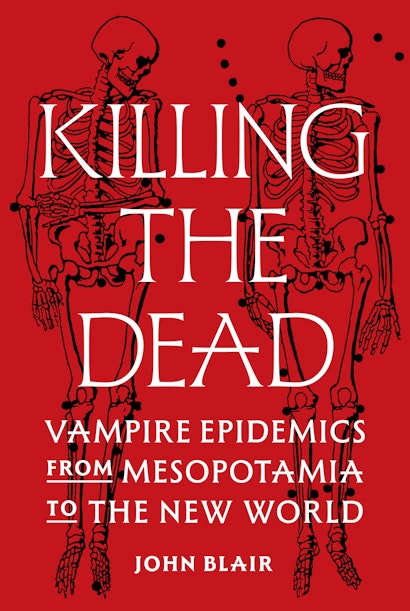
Imagine opening the grave of a relative or neighbour who died several weeks ago, beheading the decaying corpse, driving a stake through it, cutting out the heart, and hauling it out and burning it. For most modern people, it is hard to imagine many things more revolting. Yet at several times and in several places, people have done exactly these things in the sincere belief that the corpse had been walking around or exuding poisonous emanations, and that their interventions would protect the living from injury or death. Can we make sense of something so crazy?
Freud though that such corpse-fears are hard-wired in the human psyche: originally 鈥榯he dead were all vampires, who bore ill-will to the living, and strove to harm them and deprive them of life鈥�. As a generalization, this is clearly wrong: many societies world-wide show no trace of 鈥榲ampire鈥� fears. Still, all corpses are disconcerting to some extent, and we must ask what the circumstances are that intensify such fears to such extremes.
Anthropology, history and archaeology offer some answers. Belief in animated corpses is encouraged by animistic and shamanic beliefs, involving multiple spiritual forces and movements between the human and supernatural worlds. When important ritual processes between death and burial are neglected and disrupted, the dead person may be prevented from moving on. That is especially dangerous when frustrated instincts 鈥� notably sexual and parental ones 鈥� remain pent up in the corpse, which helps to explain why so many of the world鈥檚 perceived 鈥榲ampires鈥� have been young females.
Such cultural and religious factors explain why low-level corpse fears are endemic in many societies but completely absent from others. Some eruptions, however, are more abrupt, leading to attacks on dozens or even hundreds of corpses within a few years or decades, but then dying down as rapidly as they arose. These epidemic episodes usually occur in societies where the belief is already endemic, but they stand out as more concentrated and dramatic. We can get a sense of the catalysts by looking at four case-studies.
The first concerns the later Roman empire between the second and fifth centuries: increasingly decentralised, suffering pressures from external enemies, and spiritually radicalised by the growth, official adoption and eventual triumph of Christianity. A genre of stories about the empty tombs of wandering corpses may even have originated in the narratives of Jesus鈥檚 resurrection. More visible archaeologically is the practice of pinning corpses down by nailing them through the head, limbs or joints, which is found widely around the Mediterranean and in the north-western parts of the empire.
Europe between 1000 and 1200 experienced stresses and traumas of a different kind: violent expansion, crusading, the dynamics usually labelled 鈥榝eudalisation鈥�, and the consolidation of a professional clerical elite keen to identify itself against the 鈥榦ther鈥� by persecuting heretics. Abundant evidence for corpse-killing in this period comes from Scandinavia, north-central Europe and the British Isles. Particularly colourful stories in the Icelandic sagas describe aggressive dead neighbours, barrow-dwellers who attack intruders, and even a dead woman who cooks dinner naked. This Viking tradition, percolating southwards up the rivers flowing into the Baltic, is a more likely explanation for central European 鈥榲ampires鈥� than supposed 鈥楽lavic鈥� origins. In England, one chronicler of the 1190s found walking corpses so common that it was boring to write about them. It is interesting to note that these regions were relatively little affected by heresy persecution 鈥� in contrast to France, which persecuted heretics but not corpses.
A third case is central Europe between 1550 and 1750, where the combined stresses of Reformation, Counter-Reformation and bubonic plague generated a bizarre series of monstrous imaginings: first in Saxony, where corpses were thought to spread plague as they lay in their graves chewing their own shrouds, and then eastwards in Bohemia, Silesia and Moravia, where they wandered around attacking, disrupting, and generally making nuisances of themselves. Spreading south-eastwards through the Carpathians and then the Balkans, the epidemic culminated in the great Serbian vampire scare of 1725-32. It was these stories that hit the western European headlines in 1732, creating stereotypes (in fact rather abnormal and misleading ones) for Romantic vampire literature and ultimately for Bram Stoker鈥檚 Dracula.
Fourthly, across the Atlantic in New England, the scourge of tuberculosis between the 1780s and 1890s stimulated a bizarre late re-working of the European theme, in which the hearts and other internal organs of buried victims were thought to spread contagion to the living. Exhumations followed by removal and burning of organs continued up to 1892, with a weaker variant practiced in a remote part of Pennsylvania as late as 1949.
What all these cases have in common is psychologically destabilising trauma, whether religious, or medical, or both together. When people suffer shocks that disrupt familiar routines, and undermine all sense of security, they tend in their desperation to look for victims. The persecution of minorities 鈥搘hether ethnic, religious, medical or sexual 鈥� is a panic-response that is all too tragically familiar. In a sense, corpse-killing fits this pattern, but with the crucial difference that the 鈥榲ictims鈥� cannot suffer pain and distress because they are already dead.
Mutilating corpses may be abhorrent, but it is surely less abhorrent than (for instance) burning living people as witches: that is why killing the dead is better than killing the living. Powerless in the face of inexplicable tragedy, people feel that they must dosomething: this response may be irrational, but it is a lot more innocuous than some other irrational responses. To quote a descendant of the last New England exhumation victim: 鈥楧o I believe in vampire? No. No, I don鈥檛 believe in that. I鈥檓 not sure they did, but they had to come for an answer. And it turned out that maybe that was the answer. And some of them old people probably died with that in their mind, that they did the right thing.鈥�
About the Author
John Blair is an Emeritus Fellow of The Queen鈥檚 College, Oxford, and Emeritus Professor of Medieval History and Archaeology at the University of Oxford. His many books include Building Anglo-Saxon England (快色直播), The Church in Anglo-Saxon Society, and The Anglo-Saxon Age: A Very Short Introduction.