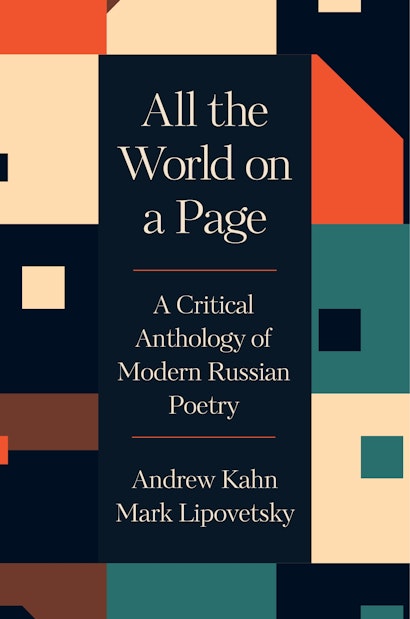
The Russian cultural tradition treats poetry as the supreme artistic form, with Alexander Pushkin as its national hero. Modern Russian lyric poets, often on the right side of history but the wrong side of their country鈥檚 politics, have engaged intensely with subjectivity, aesthetic movements, ideology (usually subversive), and literature itself. All the World on a Page gathers thirty-four poems, written between 1907 and 2022, presenting each poem in the original Russian and an English translation, accompanied by an essay that places the poem in its cultural, historical, and biographical contexts. The poems, both canonical and lesser-known works, extend across a range of moods and scenes: Velimir Khlebnikov鈥檚 Futurist revolutionary prophecy, Anna Akhmatova鈥檚 lyric cycle about poetic inspiration, Vladimir Nabokov鈥檚 Symbolist erotic dreamworld, Joseph Brodsky鈥檚 pastiche of a Chekhovian play set on a country estate, Maria Stepanova鈥檚 pandemic allegory of political repression, Galina Rymbu鈥檚 energetic manifesto 鈥淢y Vagina.鈥�
An introduction explores the abiding inspiration of modernism on the Russian lyric tradition. Kahn and Lipovetsky’s separate chapter essays, informed by extensive knowledge of the existing scholarship and critical styles of interpretation, consider how the interplay of originality and tradition and form and voice work to engage the reader. The poems themselves, many of them in newly commissioned translations, operate outside state-mandated poetic styles to address the reader directly, 鈥渢锚te-脿-t锚te,鈥� as Brodsky said in his 1987 Nobel lecture. With each chapter devoted to a different poem, All the World on a Page allows readers to experience the richness of Russian poetry through poems and poets rather than through movements.
Andrew Kahn is professor of Russian literature at the University of Oxford and tutorial fellow in St. Edmund Hall, Oxford. His books include Pushkin’s Lyric Intelligence and Mandelstam’s World. Mark Lipovetsky is professor of Slavic languages at Columbia University. A winner of the Andrei Bely Prize for his contribution to literary studies, he has published books on Russian postmodernism, New Drama, Dmitry Prigov, and post-Soviet literature. Kahn and Lipovetsky are coauthors (with Irina Reyfman and Stephanie Sandler) of A History of Russian Literature.
"Compelling."鈥擠avid Marx, David Marx Book Reviews
"You don’t get to read a book like this and walk away untouched. These are poems that have outlived their governments. They survived the burning of books, the erasure of names, the collapse of buildings no one admits were there. They remain. Not as artifacts, but as voices. Clear. Defiant. Cold to the touch."鈥擟assandra Fong, The Indiependent
"Highly researched. . . . Particularly beneficial for aspiring linguists and students."鈥擝elinda Cooke, The High Window
"[A] marvelous book. . . . In All the World on a Page, Kahn and Lipovetsky open for us a large, complex and variegated terrain in which to wander, explore, to ponder the work and lives of men and women who, without exception, wrote poetry in periods of oppressive degradation and danger. And here we may find the inspiration, the courage and the idealism to seek the songs hidden in what may well be a bleak and unpromising future. Poems, as ever, are not simply instances of elite insular self-expression, but, as is clear in the work presented in this anthology, the redemption of our inner journeys and the cultures where they take place. These poems thus expand and deepen our common language and thus enable us to find an ever broader and more profound common ground."鈥擠ouglas Penick, On the Seawall
"A brilliant and idiosyncratic meditation on Russian poetry by two revered scholars."鈥擲arah Pratt, The Russian Review
"Compelling and original."鈥擩ames Rann, Slavonic and East European Review
"Andrew Kahn and Mark Lipovetsky’s anthology All the World on a Page: A critical anthology of modern Russian poetry makes a compelling case for the continuity of a modernist tradition. . . . offering critical essays and fine translations that will enable anglophone readers to gain valuable insights into a tradition that is still renewing itself, almost a century after concerted attempts were made to suppress it."鈥擪atharine Hodgson, Times Literary Supplement
“An immensely useful book in the way it is assembled, but also one filled with pleasure, in both the poems themselves and in the exceptionally fine commentary. All readers will learn from the beautiful close readings that attend to form, diction, rhythm, and intertextual allusions.”—Stephanie Sandler, author of The Freest Speech in Russia: Poetry Unbound, 1989–2022
“The contours of the twentieth-century Russian poetic canon have been redrawn many times in recent decades. Kahn and Lipovetsky’s anthology offers a compelling version of the canon while daring to represent it through an idiosyncratic selection of texts which fascinates at every turn. Their twentieth century emphasizes an abiding spirit of modernist experimentation that persisted through a tumultuous and often repressive era. With extensive analytical essays accompanying the poems, All the World on a Page is a fine guide to both celebrated and underappreciated poets, for scholars, students, and poetry enthusiasts alike.”—Lyubov Golburt, author of The First Epoch: The Eighteenth Century and the Russian Cultural Imagination
“In highly accessible language, All the World on a Page offers expert guidance to some of the most beautiful, culturally significant, and often challenging Russian poems and poets of the twentieth and twenty-first centuries. The selection of texts decisively revises and updates representation of the Russian poetic canon for the present moment. Kahn and Lipovetsky have done a tremendous service to all enthusiasts of Russian poetry—from undergraduate students, to scholars, to the broader public.”—Kevin M. F. Platt, author of Border Conditions: Russian-Speaking Latvians between World Orders
This publication has been produced to meet accepted Accessibility standards and contains various accessibility features including concise image descriptions, a table of contents, a page list to navigate to pages corresponding to the print source version, and elements such as headings for structured navigation. Appearance of the text and page layout can be modified according to the capabilities of the reading system.
Accessibility Features
-
Inaccessible, or known limited accessibility
-
No known hazards or warnings