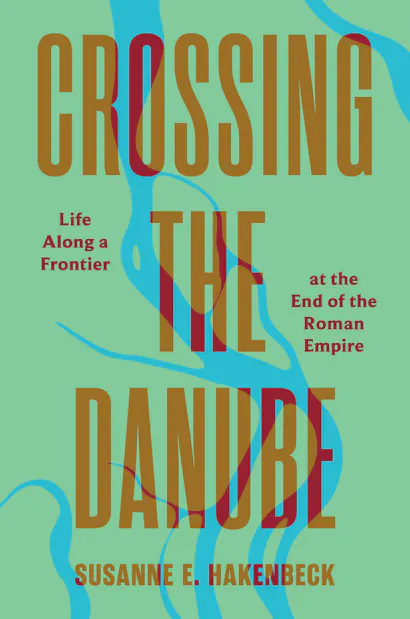
Crossing the Danube offers a new account of the peoples who lived along Europe鈥檚 greatest river鈥攖he nearly 2,000-mile-long Danube鈥攄uring the dramatic centuries leading up to the end of the Roman Empire in the West. Written sources of this period are dominated by accounts of Rome鈥檚 struggle against the 鈥渂arbarians鈥� along the Danube, which marked the border between the empire and the lands beyond, and the crossing of the river by Gothic refugees escaping the Huns in 376 CE was long seen as a catalyst of Rome鈥檚 fall. But, as Susanne Hakenbeck shows, that is not the whole story. The Danube was not only a political boundary, but a living landscape. Using archaeological evidence, she traces four tumultuous centuries along the river through the material world of the people who lived there.
Crossing the Danube describes how ordinary people and local elites navigated, exploited, and ultimately transformed the Roman frontier. It tells how generations of interactions鈥攖hrough diplomacy, trading, raiding, and recruitment into the Roman army鈥攂ound the empire and the people beyond the frontier together. By the fifth century, former 鈥渂arbarians鈥� embraced the trappings of Roman imperial power and moved toward full political participation. In doing so, the people from beyond the Danube ended up fracturing the empire.
Sweeping in scope yet rich in detail, Crossing the Danube overturns longstanding myths about the role of the so-called barbarians in Rome鈥檚 collapse.
Susanne Hakenbeck is associate professor of archaeology at the University of Cambridge.
“Susanne Hakenbeck has an exceptional gift for bringing archaeological evidence to life. In this beautifully written narrative, she shows how the Danube made history as a Roman frontier, how people along it were affected by war and peace, how they lived and loved, and how nature changed around them.”—Walter Pohl, author of The Avars: A Steppe Empire in Central Europe, 567–822
“Hakenbeck has composed a masterful tribute to the Danube and the men, women, and children who lived and died alongside its unpredictable flow in late antiquity. Her nuanced study of the archaeological, isotopic, and historical evidence of these frontier regions offers long-awaited insight into Roman and non-Roman military, economic, cultural, and religious life.”—Bonnie Effros, author of Uncovering the Germanic Past: Merovingian Archaeology in France, 1830–1914
“This erudite, comprehensive, and elegantly written Danubian voyage follows Europe’s great river and the peoples who lived along its banks, sailed its waters, and most importantly crossed and recrossed its shores. Drawing on an extraordinary range of evidence, Hakenbeck illuminates the distinctive ecological, political, and social worlds of the Danube and its tributaries across the centuries. The result is a richly textured and compelling reinterpretation of the Danube frontier and of the transformations that reshaped both the Roman and the post-Roman worlds.”—Patrick J. Geary, author of The Myth of Nations: The Medieval Origins of Europe
“Compellingly written with an archaeologist’s expertise, this book extends beyond the hallowed rise-and-fall narrative of the empire. Hakenbeck offers a new and important account that allows us to see commonalities and exchanges through a lens in which the Roman gaze and the imperial intermediary are not omnipresent.”—Michael Kulikowski, author of The Tragedy of Empire: From Constantine to the Destruction of Roman Italy
“This is a beautiful book with a truly original perspective on the changes from the ancient Roman to the post-Roman world along the Danube. Exhibiting an impressive command of archaeological sources, Hakenbeck offers insightful microhistories along and across the river to demonstrate the broad connections that these places represent.”—Helmut Reimitz, author of History, Frankish Identity, and the Framing of Western Ethnicity, 550–850
This publication has been produced to meet accepted Accessibility standards and contains various accessibility features including concise image descriptions, a table of contents, a page list to navigate to pages corresponding to the print source version, and elements such as headings for structured navigation. Appearance of the text and page layout can be modified according to the capabilities of the reading system.
Accessibility Features
-
WCAG v2.2
-
WCAG level AA
-
Table of contents navigation
-
Single logical reading order
-
Short alternative textual descriptions
-
Print-equivalent page numbering
-
Landmark navigation
-
Index navigation
-
Epub Accessibility Specification 1.1
-
ARIA roles provided
-
All non-decorative content supports reading without sight
-
No known hazards or warnings