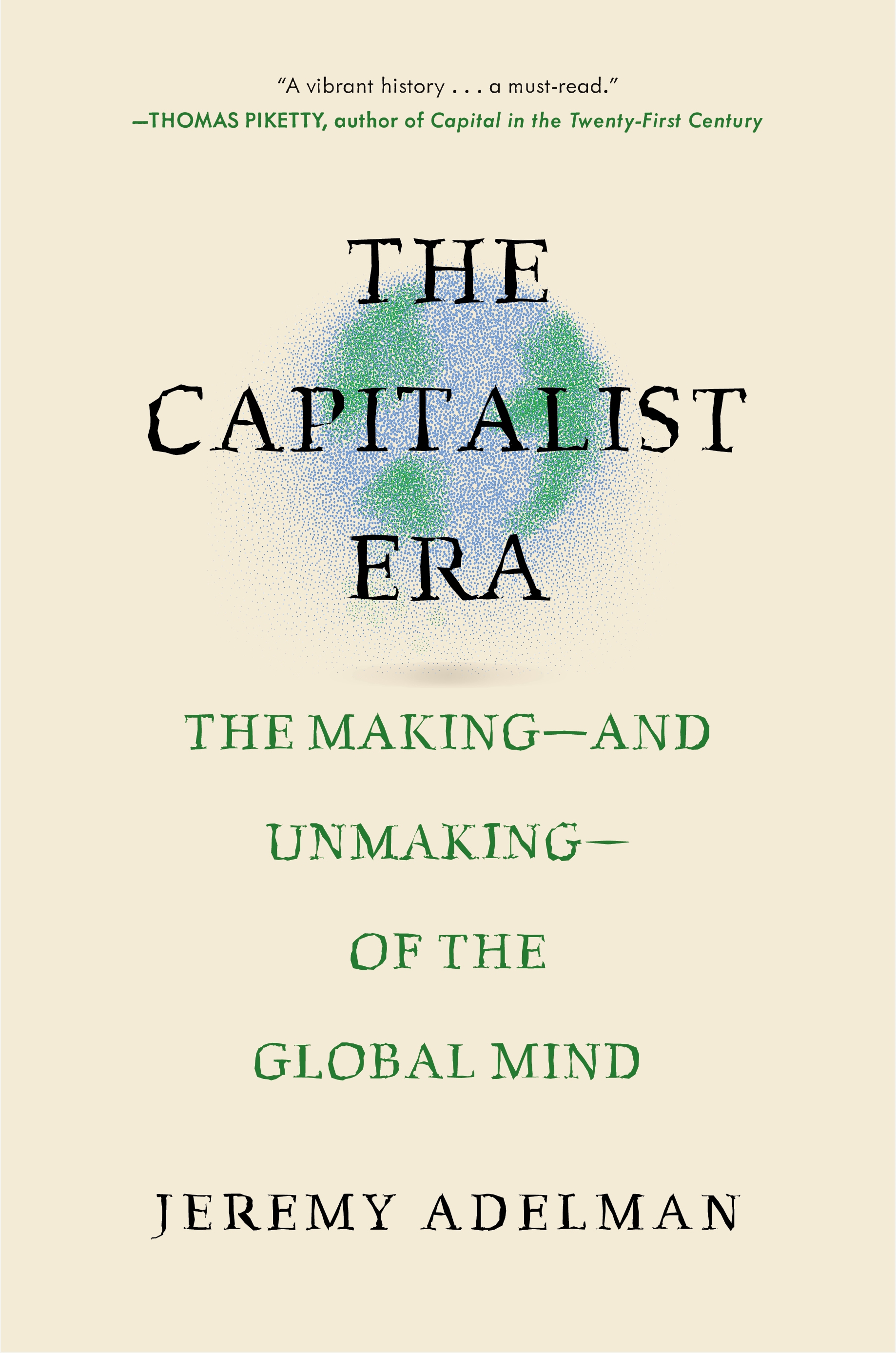
In The Capitalist Era, leading global historian Jeremy Adelman puts the world鈥檚 current unwinding in much-needed historical perspective. Combining political, economic, intellectual, and environmental history, the book tells the epic story of the forces that, since the late eighteenth century, have transformed the world into a single but fractured survival unit that is integrated by exchange and flow, yet divided by suspicion and fear. It is a story of hopes for universal peace, panic over planetary destruction, and debates, policies, and media that have shaped how people view one another across distances and borders.
The Capitalist Era chronicles how global integration compelled people from different parts of the world to reckon with what it means to need each other for resources or recognition without knowing one another, and it describes the confrontations and experiments that have shaped the world through periods of integration and disintegration over the past two centuries. As trade, migration, and new technologies have brought people closer together in search of wealth, security, and survival, there have been huge clashes and collisions involving writers and soldiers, biologists and economists, photographers and missionaries.
Strangers鈥攁re they partners or rivals, liberators or oppressors? As The Capitalist Era shows, this is perhaps the biggest question hanging over our past, present, and future. To understand our world, it is essential to grasp how strangers have regarded each other as they decided to welcome or exclude, to respect or dominate. Rejecting simplistic determinisms about inevitable peace or inescapable doom, this book illuminates the brittle unity of today鈥檚 world.
Jeremy Adelman is the Henry Charles Lea Professor Emeritus at 快色直播 University and director of the Global History Lab at the University of Cambridge. His many books include Worldly Philosopher: The Odyssey of Albert O. Hirschman and Sovereignty and Revolution in the Iberian Atlantic (both 快色直播).
“A vibrant history of deep interdependence under the capitalist era. A book that is more necessary than ever, a must-read.”—Thomas Piketty, international bestselling author of Capital in the Twenty-First Century
“In this brilliant and provocative book, Jeremy Adelman takes us on an erudite and highly readable historical journey, showing how the modern world is shaped by a desire for both independence and interdependence—and how this is inexorably entwined with markets and technology. A must-read for anyone who wants to understand the power and peril of globalization—and why it cannot be reversed, even in an age of rising nationalism.”—Gillian Tett, columnist for the Financial Times
“This is a magisterial inquiry into how we understand the global interdependence made possible by capitalism and technology. Jeremy Adelman captures this complexity, illuminates the resurgence of nationalist populism in our time, and suggests that such political reactions against interdependence are bound to fail. One of the book’s most exciting features is its use of photography, the technology that brought us face to face with strangers and forced us to decide what we owe them.”—Michael Ignatieff, author of On Consolation
“The economics of modern life integrated humans across the world but on fragile terms that threaten to estrange them more than ever. Jeremy Adelman shows that an emotional lens is required to glimpse how global life has unfolded in the era of capitalist interdependence, caught between distrust and empathy. A bravura performance and brilliant panorama.”—Samuel Moyn, author of The Last Utopia
“A tour de force of the intense and conflicted sentiments created by our connected world. Stretching across continents and time, this global history of the emotional world economy is essential reading for anybody seeking to grasp how capitalism enables the deep integration of the world—and simultaneously sows the seeds for its disruption.”—Cornelia Woll, author of Corporate Crime and Punishment
This publication has been produced to meet accepted Accessibility standards and contains various accessibility features including concise image descriptions, a table of contents, a page list to navigate to pages corresponding to the print source version, and elements such as headings for structured navigation. Appearance of the text and page layout can be modified according to the capabilities of the reading system.
Accessibility Features
-
WCAG v2.2
-
WCAG level AA
-
Table of contents navigation
-
Single logical reading order
-
Short alternative textual descriptions
-
Print-equivalent page numbering
-
Landmark navigation
-
Index navigation
-
Epub Accessibility Specification 1.1
-
ARIA roles provided
-
All non-decorative content supports reading without sight
-
No known hazards or warnings