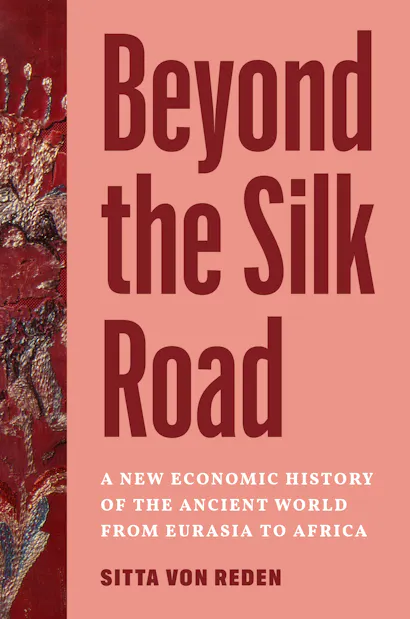
Beyond the Silk Road presents a new economic history of ancient empires from East Asia to the Mediterranean and North Africa during a period of intense empire building, transformation, and interaction. Leaving behind the obsolete idea of an ancient Silk Road, the book reveals how transimperial exchange was shaped by special social and political networks, frontier societies, and inner-imperial economic developments involving a wide range of people鈥攊ncluding kings, emperors, diplomats, soldiers, pastoralists, and traders. What emerges is a new explanation of why, for example, we find Chinese silk in Palmyra, Egyptian glass goblets in Afghanistan, and Roman coin pendants in Thailand.
Through a detailed examination of a wide variety of evidence about economic behavior in different parts of Afroeurasia from 300 BCE to 300 CE, Sitta von Reden shows that the relationships between imperial centers and their frontiers had a greater effect than trade routes in determining the directions and flows of long-distance exchange. She demonstrates the critical role of frontier zones by introducing some of the most important ones: the Nabataean kingdom of northern Arabia, Barygaza in northwestern India, Sogdiana under the Kangju, and the Eastern Desert of Egypt.
Based on a decade of collaborative research using new approaches to archaeological, monetary, and textual sources in many different languages, Beyond the Silk Road puts ancient economies in a new global perspective.
Sitta von Reden is professor of ancient history at the University of Freiburg. She is the author of Money in Classical Antiquity and Money in Ptolemaic Egypt and the editor of The Cambridge Companion to the Ancient Greek Economy and the Handbook of Ancient Afro-Eurasian Economies.
"A sweeping, meticulously supported case for dynamic interimperial interdependence."鈥�Kirkus Reviews
“Disposing of the modern myth of a Silk Road, Sitta von Reden explains how empires, frontiers, and far-flung networks tied ancient Afroeurasia together. A model of how to advance cross-cultural history, her bold synthesis shows how diverse economies interacted long before modern globalization.”—Walter Scheidel, author of What Is Ancient History?
“A tour de force, Beyond the Silk Road presents an essential framework for premodern global economic history—one in which trade and the social networks that sustained it take their proper place. Sitta von Reden treats Eurasian climate and environment as the fundamental drivers of state formation, demography, and movement, and shows frontier zones to be engines of regional economies rather than marginal zones. This book sets the standard for the next generation of work across the many disciplines it touches.”—J. G. Manning, author of The Open Sea: The Economic Life of the Ancient Mediterranean World from the Iron Age to the Rise of Rome
“Beyond the Silk Road underscores the heterogeneity of peoples and livelihoods in the ancient world, revealing an interconnectedness ramified into a kaleidoscope of polities, economies, and societies of different scales and ecologies. A splendid book, endlessly rich in intimate details, that rewrites the history of globalization.”—Richard von Glahn, author of The Economic History of China: From Antiquity to the Nineteenth Century
“In every respect an impressive book, a monument of scholarship that will stand for decades, Beyond the Silk Road successfully delivers the first integrated economic history of the Afroeurasian world in antiquity.”—Peter Fibiger Bang, author of The Roman Empire and World History
“Decisively breaking with the single romantic image of the Silk Road, Sitta von Reden builds a new economic history of Afroeurasia—empire by empire, network by network, frontier zone by frontier zone, grounded in an exceptional command of archaeological, textual, and comparative evidence. Erudite, capacious, and bracingly revisionist, this remarkable book will reshape how we understand the ancient world economy.”—S枚ren Stark, Institute for the Study of the Ancient World
This publication has been produced to meet accepted Accessibility standards and contains various accessibility features including concise image descriptions, a table of contents, a page list to navigate to pages corresponding to the print source version, and elements such as headings for structured navigation. Appearance of the text and page layout can be modified according to the capabilities of the reading system.
Accessibility Features
-
WCAG v2.2
-
WCAG level AA
-
Table of contents navigation
-
Single logical reading order
-
Short alternative textual descriptions
-
Print-equivalent page numbering
-
Landmark navigation
-
Index navigation
-
Epub Accessibility Specification 1.1
-
ARIA roles provided
-
All non-decorative content supports reading without sight
-
No known hazards or warnings