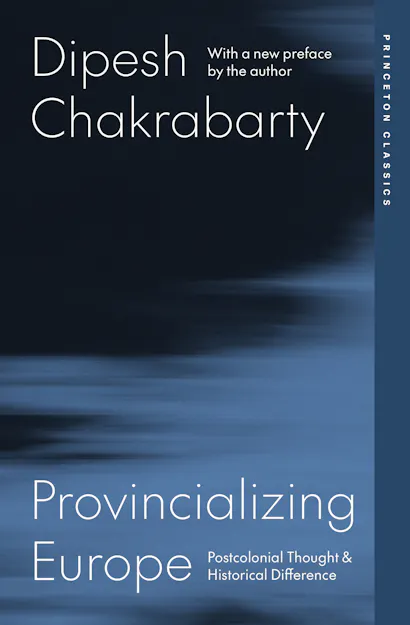
Can European thought be dislodged from the center of the practice of history in a non-European place? What problems arise when we translate cultural practices into the categories of social science? In this landmark book, Dipesh Chakrabarty examines how postcolonial thinking impacts on the social sciences. Through a series of linked essays, he explores the problems of thought that present themselves when we think of a place such as India through the categories of modern European social science and history. Now with a new preface by the author, Provincializing Europe globalizes European thought by exploring how it may be renewed both for and from the margins.
Dipesh Chakrabarty is the Lawrence A. Kimpton Distinguished Service Professor of History at the University of Chicago. His books include The Climate of History in a Planetary Age and Rethinking Working-Class History: Bengal 1890–1940 (快色直播).
"Chakrabarty's work gives us a richer, more penetrating language to deal with modernity and the colonial encounter. . . . It is the ambiguity of Chakabarty's own position as both a critic and archivist of modernity that gives his study its poetic undertow and its intelligent irresponsibility."鈥擜mit Chaudhuri, London Review of 快色直播
"The great value of this book lies in Chakrabarty's exceptional ability to bring to light what constantly gets glossed over and forgotten when we can only speak the standard languages of the academy. To do this requires the kind of bilingual consciousness which can bring into illuminating relation Adam Smith and Tagore. Chakrabarty makes you regret that so few are capable of doing this with a high degree of eloquence and insight."鈥擟harles Taylor, IWM Newsletter
"This masterful re-examination of rationality, universality, and difference in the postcolonial world should prove inspiring for serious historians of all lands."鈥擜lice Ballard, Theory and Society
"The idea of provincializing Europe has been around for some time, but mostly as an insight waiting for elaboration. In this book, Dipesh Chakrabarty develops the idea into a project informed massively by fact and brilliantly by theory. A work of exemplary scholarship, it is a call to raise the level of current debates about modernity and the colonial experience and reexamine our approach to histories and cultures on both sides of the colonial divide. A formidable challenge."—Ranajit Guha
"Chakrabarty offers a fundamental rethinking of the most important and misunderstood of all historical categories—time itself. Never facile, always willing to confront the most intractable dilemmas, Chakrabarty forces us to reconsider our deepest historicizing impulses. His work is must reading for anyone with an interest in the future of historical studies."—Lynn Hunt, University of California, Los Angeles
Accessibility Features
-
Inaccessible, or known limited accessibility
-
No known hazards or warnings