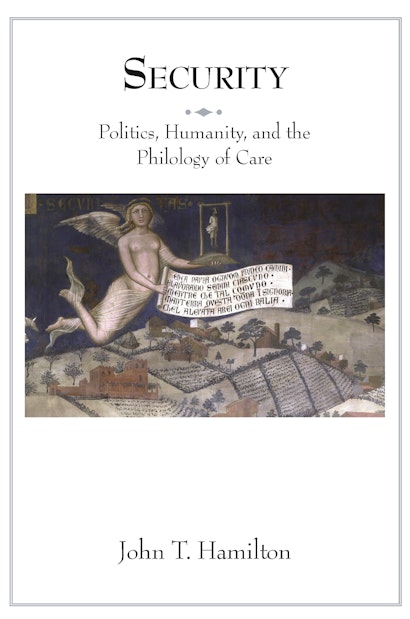
From national security and social security to homeland and cyber-security, 鈥渟ecurity鈥� has become one of the most overused words in culture and politics today. Yet it also remains one of the most undefined. What exactly are we talking about when we talk about security? In this original and timely book, John Hamilton examines the discursive versatility and semantic vagueness of security both in current and historical usage. Adopting a philological approach, he explores the fundamental ambiguity of this word, which denotes the removal of 鈥渃oncern鈥� or 鈥渃are鈥� and therefore implies a condition that is either carefree or careless. Spanning texts from ancient Greek poetry to Roman Stoicism, from Augustine and Luther to Machiavelli and Hobbes, from Kant and Nietzsche to Heidegger and Carl Schmitt, Hamilton analyzes formulations of security that involve both safety and negligence, confidence and complacency, certitude and ignorance. Does security instill more fear than it assuages? Is a security purchased with freedom or human rights morally viable? How do security projects inform our expectations, desires, and anxieties? And how does the will to security relate to human finitude? Although the book makes clear that security has always been a major preoccupation of humanity, it also suggests that contemporary panics about security and the related desire to achieve perfect safety carry their own very significant risks.
Awards and Recognition
- Named a Harvard University Walter Channing Cabot Fellow for 2014
"[This] is a wonderfully rich volume that makes punctual yet decisive incursions leading to brilliant new readings of canonical texts. . . . Through the cornucopia of its corpus and the generosity of its gesture, Security is above all an invitation to think along, to think further and deeper, to pursue the project of the book on a yet wider corpus. It invites us to practice the philology of care in our approach to books but also to the world."鈥擧all Bjornstad, L'Esprit Cr茅ateur
"[A] masterful meditation."鈥擡llwood Wiggins, Modern Language Quarterly
"贰虫肠别濒濒别苍迟."鈥�Comparative Literature
"John Hamilton's meditation on 'security'鈥攖he word and the thing鈥攔anges, with uncommon erudition, over centuries of thought, from Hyginus's Latin fable on Cura (a marvelous beginning) to Heidegger and Homeland Security. Hamilton's philological skill, intellectual historical imagination, and critical brio fuse in a radiant explication of Goethe's Faust; indeed, the trajectory of his thought is itself Faustian in its appetite and willpower."鈥擲tanley Corngold, author of Franz Kafka: The Ghosts in the Machine
"Broad and deep, learned and incisive, Security traces crisscrossing arcs from Roman securitas, back to Greek asphaleia, up through renaissance allegorization and the major thinkers of the Western tradition until our own times. The paradox of security, a state of lacking care, sets up a double bind between being carefree and carelessness. Hamilton's philological method resists the degradation that comes with a governmental monopolization of security measures and proposes instead a flexible, more humane politics."鈥擬ich猫le Lowrie, University of Chicago
"This is an important and absolutely timely exploration of security in all its intonations, structures, and puzzlements, from the classical world to the present. Hamilton moves with breathtaking ease between different languages, contexts, traditions, and periods, as well as different discourses, including literature, philosophy, anthropology, religion, political theory, painting, and film. Lucid, persuasive, and enlightening, this is a tour de force."鈥擯aul Fleming, Cornell University
"Hamilton brings a vitally humanist and historicist perspective to the complex ideas, fears, risks, and desires that the word 'security' names. With brilliant close readings and fine insights, this is an excellent and refreshingly original study that will interest scholars and students in many fields."鈥擬arc Redfield, Brown University