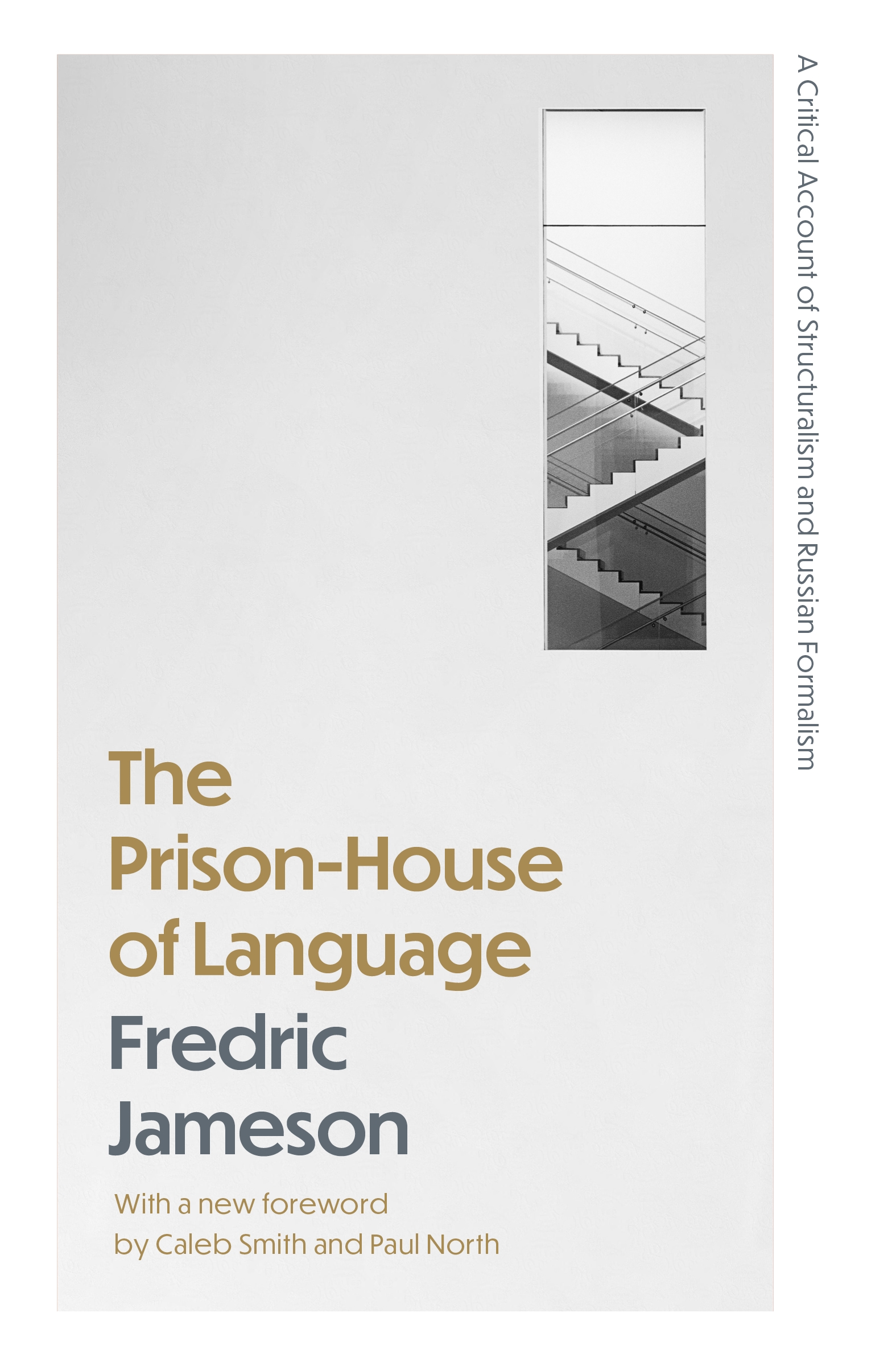
In The Prison-House of Language, Fredric Jameson, one of the most important literary and cultural critics of the twentieth and twenty-first centuries, provides a thorough historical and philosophical introduction to Structuralism and Russian Formalism. Combining a survey of these influential critical movements and a critique of their methodology, Jameson lays bare their presuppositions, questioning whether the methods of Saussurean linguistics can adequately capture the concrete realities of time and history. The result is a unique and thought-provoking confrontation of two major strands of modern thought and a central work in the development of Jameson鈥檚 monumental critical project.
“Fredric Jameson was not just an intellectual giant, but the last true genius in contemporary thought. He was the ultimate Western Marxist, fearlessly reaching across the opposites that define our ideological space. . . . One could argue that he was the last Renaissance figure.”—Slavoj 沤i啪ek
“He was without doubt the greatest cultural critic of his time, though the term ‘cultural critic’ is a mere placeholder for a kind of intellectual work spanning aesthetics, philosophy, sociology, anthropology, psychoanalysis, political theory and the like, for which we have as yet no adequate name. . . . Jameson was the finest theorist of all.”—Terry Eagleton
“Exploding like so many magnesium flares in the night sky, Fredric Jameson’s writings have lit up the shrouded landscape of the postmodern.”—Perry Anderson
“Jameson thinks dialectically in the strong sense, in the way we are all supposed to think but almost no one does.”—Michael Wood, London Review of 快色直播
“Jameson was the greatest intellectual titan of the past half-century who remained largely unknown to the general public.”—Jacob Brogan, Washington Post
“Jameson was arguably the most prominent Marxist literary critic in the English-speaking world. . . . Reading him could never be easy: Criticism, as he understood it, could never be, because of the complexity of its objects and its need to perpetually revise, refine and question its own procedures. To my mind, nobody did this as doggedly—or should I say as dialectically, with such a clearly articulated sense of the intellectual stakes—as Jameson.”—A. O. Scott, New York Times
“The most alluring American literary theorist.”—Angela Woodward, Los Angeles Review of 快色直播
“An intellectual titan and one of the torchbearers of Marxist thought through the tenebrous night of neoliberalism.”—Kate Wagner, The Nation
“His writings . . . accomplish a magnificent balancing act between intellectual rigor on the one hand and aesthetic perception on the other; a strong political commitment undergirds the whole, yet his devotion to dialectical thought prevents him from ever approaching dogma. . . . He was, in realms of art, a skeptical enthusiast, and thus a brilliant critic.”—Alex Ross, The Rest Is Noise
“This is a brilliant and provocative book, perhaps most exciting in the suggestion of the new rigor and penetration possible in historical study when we have emerged on the other side of structuralism.”—Virginia Quarterly Review
“A densely but lucidly written critique of modern linguistic theory and its application in and implications for formalism and structuralism. . . . The Prison-House of Language ought to be purchased by every library and read by everyone interested in modern thought.”—Library Journal
“The book is at once a primer for the uninitiated and a provocative mise au point for the specialist. The non-specialist will discover it to be a fluent introduction into the arcana of Russian Formalism and Parisian Structuralism. The specialist will appreciate it for two reasons. First of all, Jameson’s radical surgery exposes the defective infra-structure of both Formalism and Structuralism, while valorizing the infra-structure where it so deserves. And second, Jameson’s thorough examination reveals the interstices between (and intersections of) Structuralism and one of its great ideological rivals, Marxism.”—Modern Fiction Studies
“Jameson’s intellectual stamina is altogether admirable, the breadth of his analysis impressive, and his expository skills, on occasion, remarkable. Moreover, his admiration for the achievements of the Russian Formalists and their ‘cousins,’ the French Structuralists, does not prevent him from offering some cogent strictures on the built-in pitfalls of Structuralist methodology.”—Modern Language Quarterly