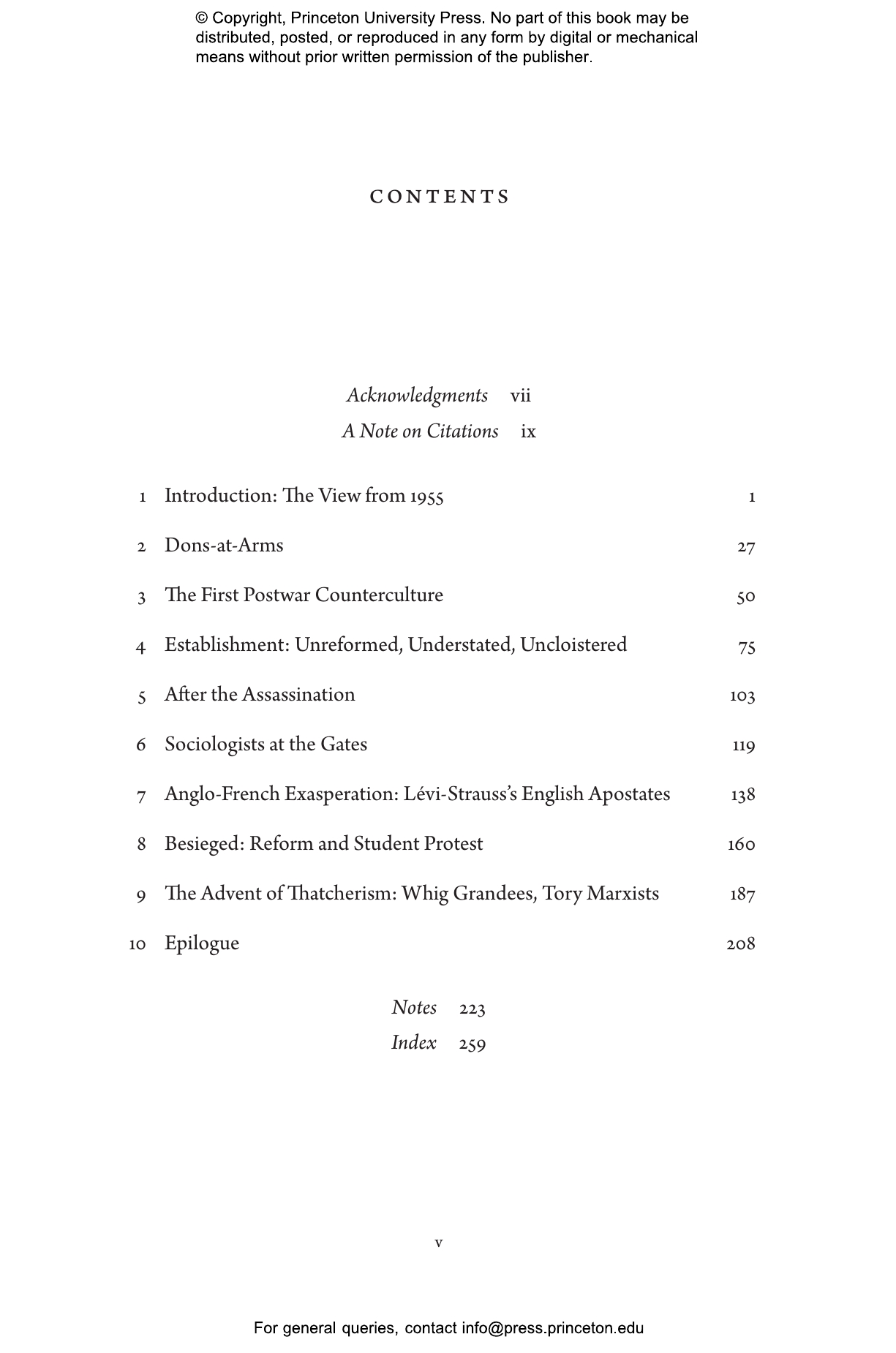
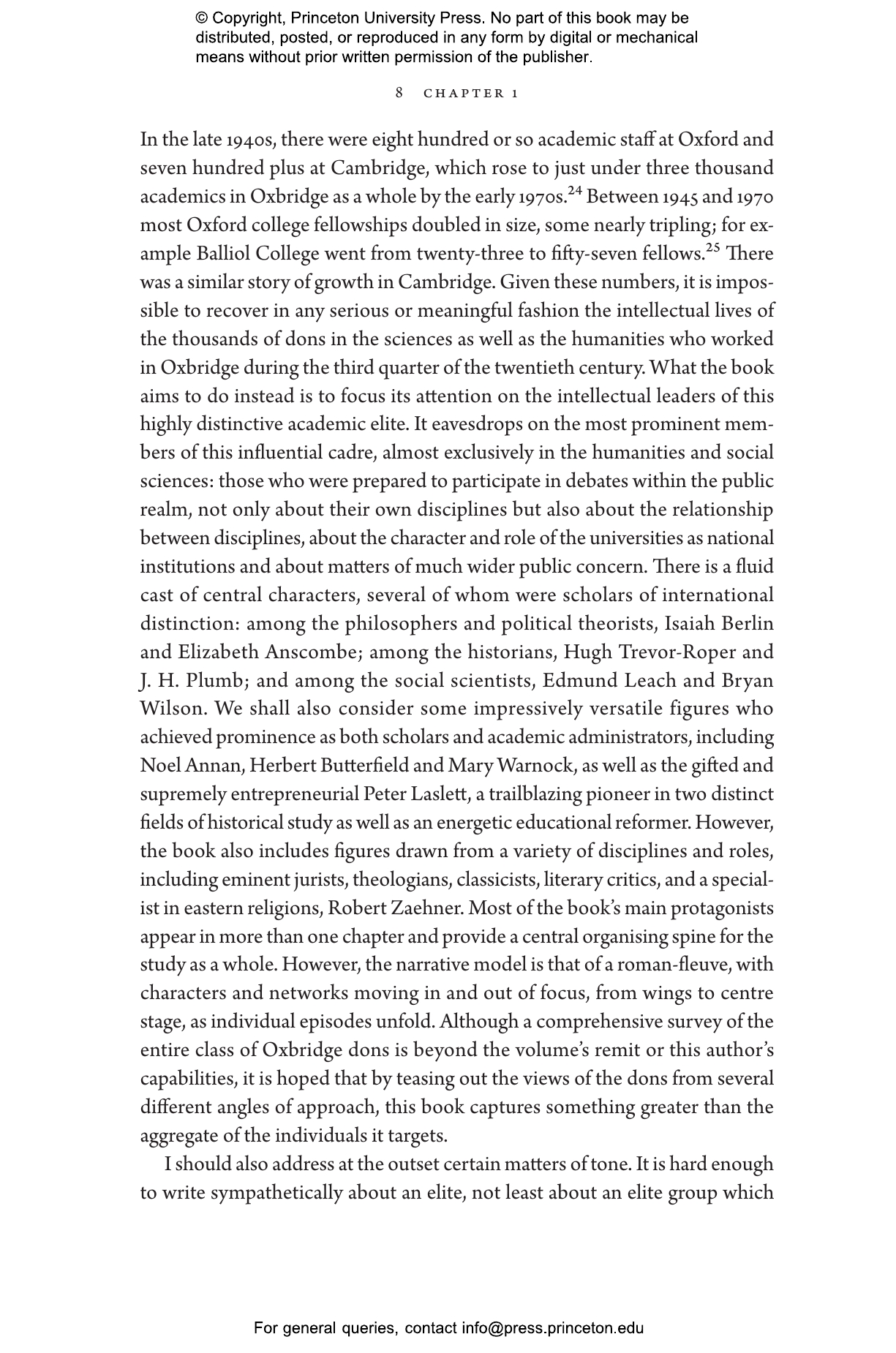
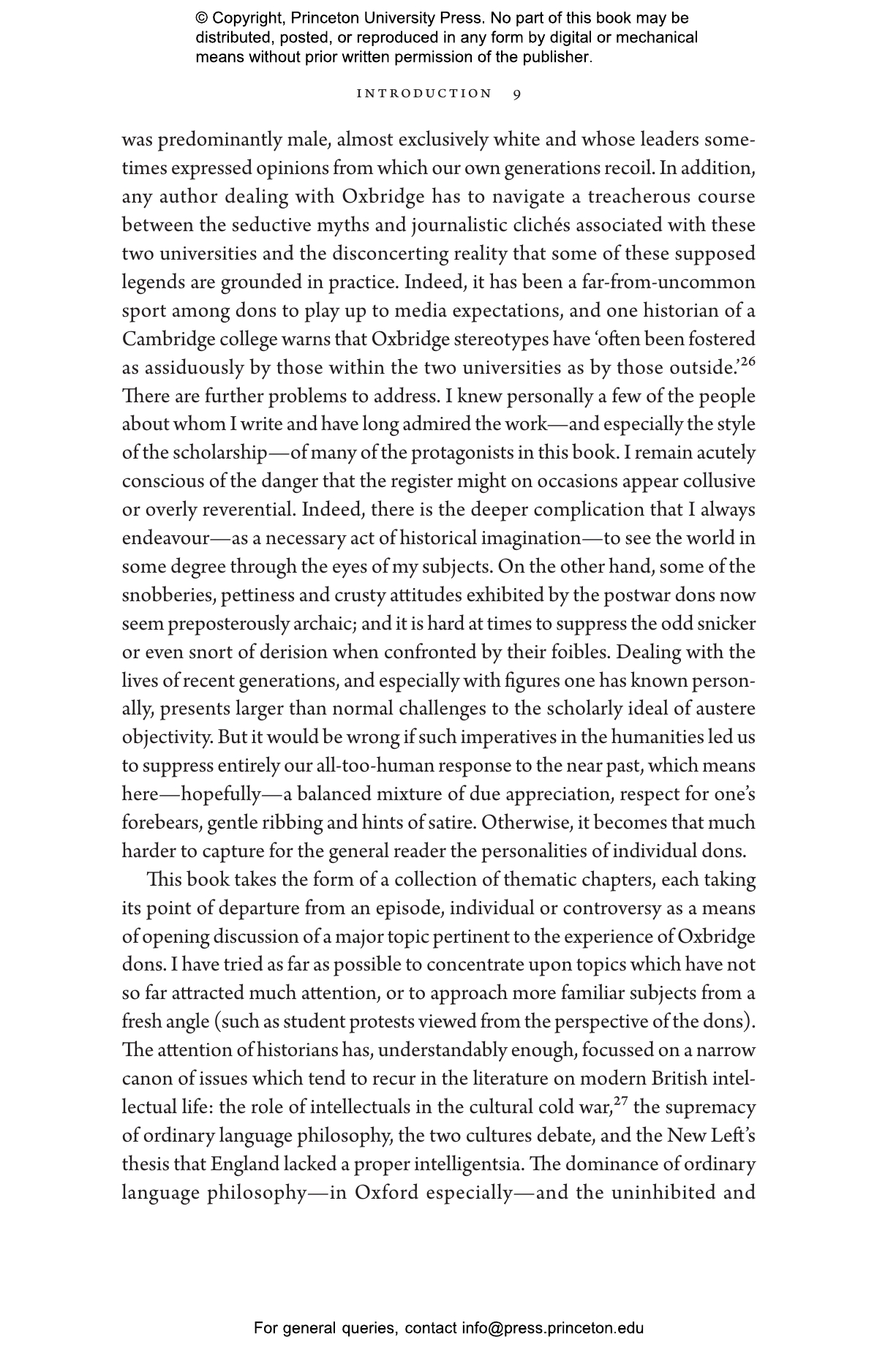
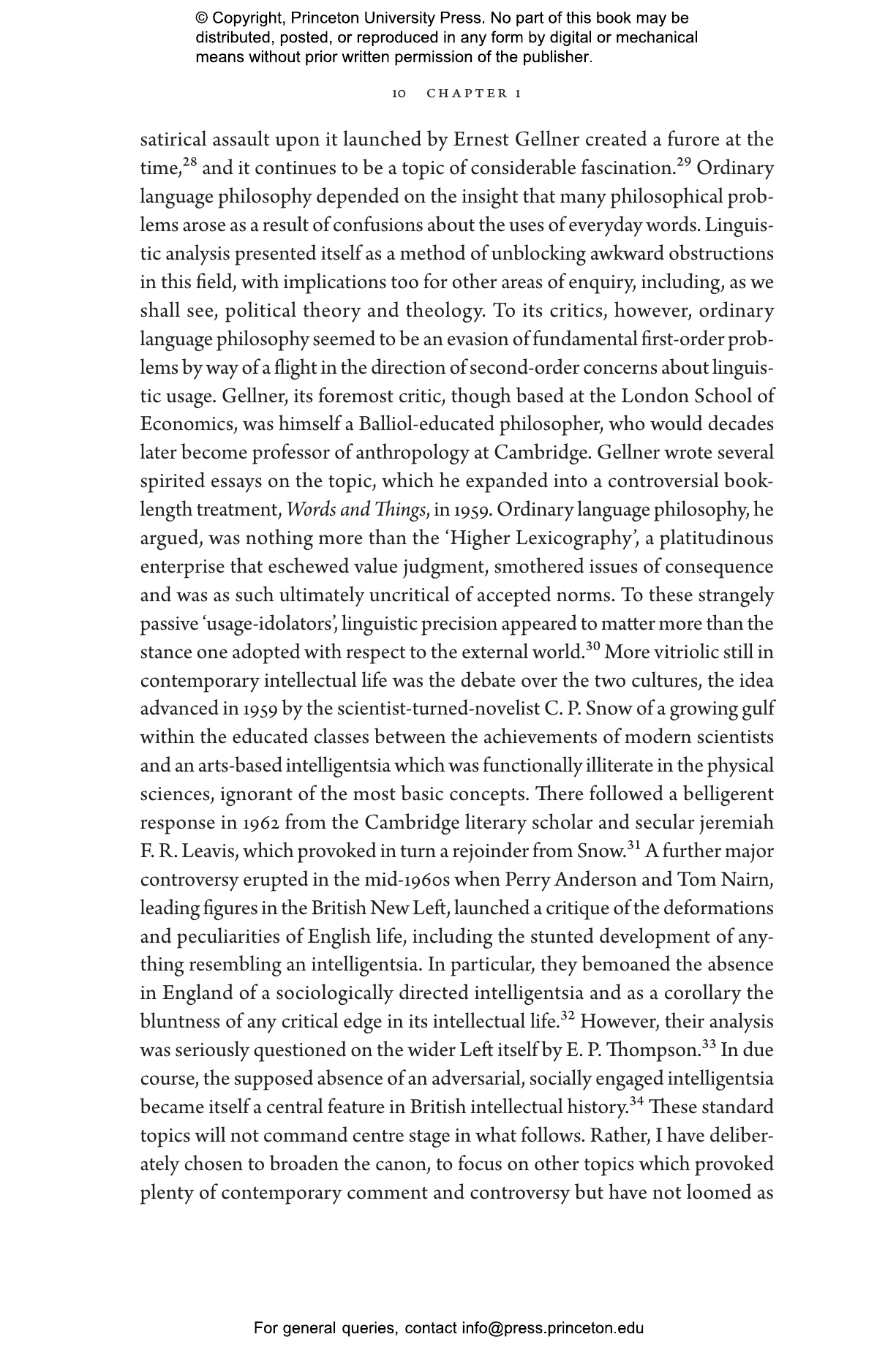
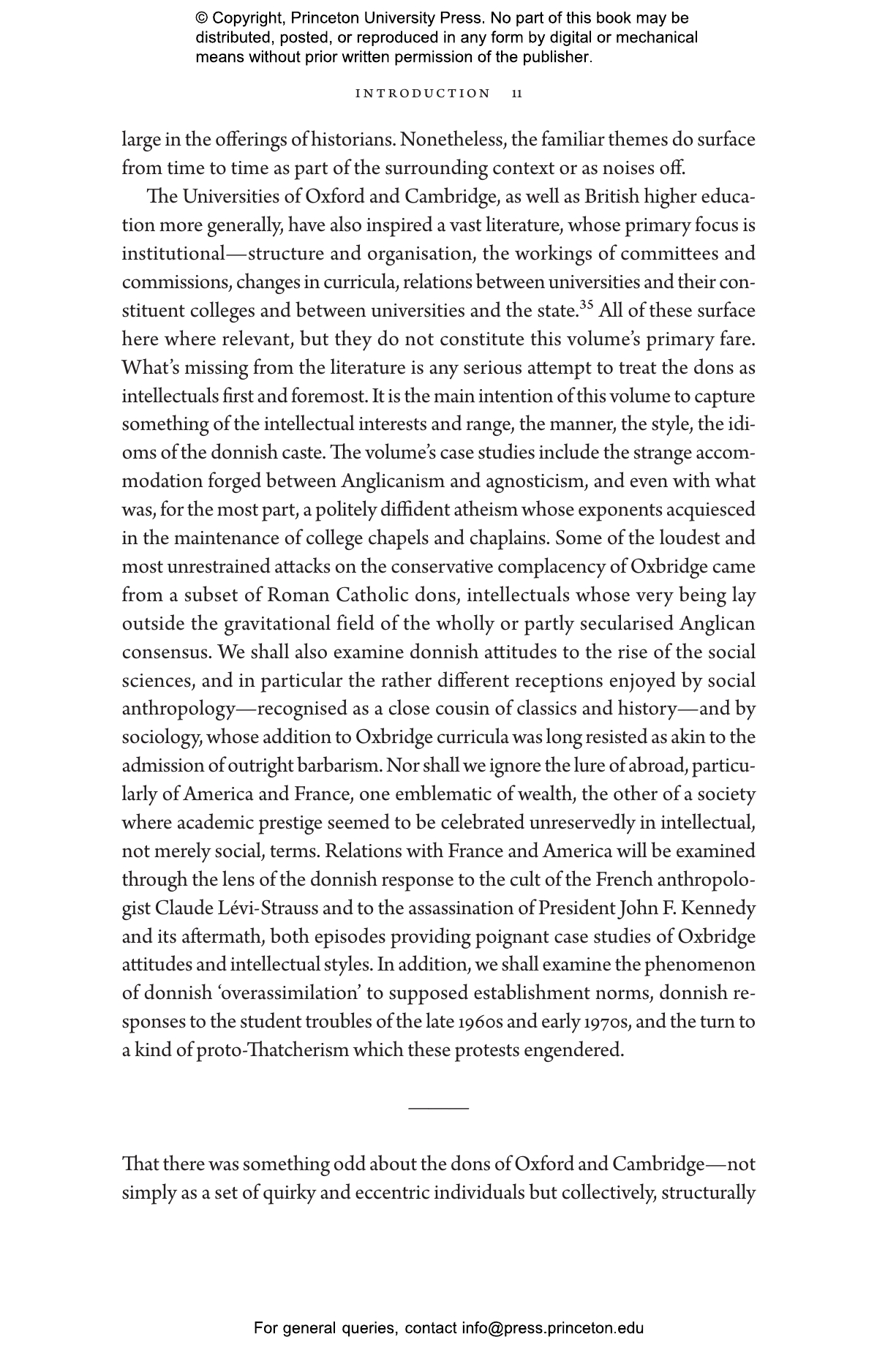
After World War II, the academics of Oxford and Cambridge鈥攖he dons鈥攆ormed an unusual kind of university-based, establishment-connected intelligentsia. Unlike intellectuals in other countries, often anti-establishment outsiders, the dons of Oxbridge enjoyed secure and even cosy connections with those in power. In Twilight of the Dons, Colin Kidd examines the golden age of Britain鈥檚 Oxford- and Cambridge-based intellectual elites鈥攁nd how their influence waned when Oxbridge鈥檚 links to the establishment began to fray. Kidd explores a series of episodes and themes that range from the dons鈥� confrontations with student protesters in the 1960s to their reaction to the rise of Thatcherism in the 1980s. The cast of characters includes many of twentieth-century Britain鈥檚 most famous intellectuals鈥擡lizabeth Anscombe, Isaiah Berlin, Edmund Leach, J. H. Plumb and Hugh Trevor-Roper, to name just a few.
Kidd describes the multiple important roles played by dons in World War II, the countercultural force of convert Catholicism and the strange phenomenon of Tory Marxism. He examines the dons鈥� attitudes towards America and France鈥攁s seen in their engagement in the debates over the Kennedy assassination and the awkward reception of L茅vi-Strauss鈥檚 anthropology. When Oxbridge came under assault, it was first by a modernising, technocratic Left in the early 1960s, then by student radicals in the late 1960s and finally by the Thatcherite Right鈥攊n whose rise, Kidd shows, some dons were complicit. As deference to Oxbridge intelligentsia declined, a reassessment of the place of dons in British public life began.
"A rich history of Britain’s academic leaders and their fall from grace and power."鈥�Kirkus Reviews
"A history of academic life stands and falls by the number and quality of its anecdotes. On this count, Colin Kidd’s Twilight of the Dons unquestionably delivers."鈥擭ikhil Krishnan, Spectator
"Kidd is one of our most brilliant intellectual historians and this book displays all his characteristic qualities: depth of research, command of argument and a seemingly effortless ability to distil complex ideas into stylish prose. Both his general analysis of postwar Oxbridge and the individual essays on particular themes are outstanding works of history as well as a delight to read."鈥擶illiam Whyte, Literary Review
"[A] disparate, nuanced, and fascinating set of essays that amount to more than the sum of their parts. . . . It is among the ironies of history that the ‘golden age’ of Britain’s ancient universities was brought to an end by a Conservative government. And yet, good work is still being done in British academia as this original, thought-provoking book by a fellow of All Souls shows."鈥擳im Bouverie, Air Mail
"The book’s relevance reaches far beyond the hallowed halls of Britain’s storied universities."鈥擬arie Le Conte, Foreign Policy
"This elegant and entertaining book is both a scrutiny of and lament for a world we have lost."鈥擡amon Duffy, The London Standard
"[A] searching new account of Oxbridge intellectual life."鈥擠avid Shribman, Globe and Mail
"[Twilight of the Dons] charts the fortunes of the intellectual leaders at Oxbridge during their golden age in the postwar period in glorious detail. . . . Despite having fewer glamorous dons, the reputation of Oxbridge endures, doubtlessly helped by its enchanting history, so brilliantly portrayed by Kidd in this entertaining book."鈥擬ax Skj枚nsberg, Law & Liberty
"Minutely researched, Twilight of the Dons breaks new ground in showing how their golden age was a by-product of their part in the Second World War."鈥擩ohn Gray, New Statesman
"Colin Kidd’s intriguing new history of Oxbridge intellectual life, Twilight of the Dons, explains the snub not as a powerful display of academic censure, but as the death throes of a declining cultural force."鈥擳ristram Hunt, Financial Times
"Stylish, erudite. . . . [and] enlivened by flashes of humour."鈥擱ichard Vinen, Times Literary Supplement
“This is a brilliant book, based on remarkable archival scholarship and 铿乴led with astonishing episodes.”—Emma Rothschild, author of An Infinite History: The Story of a Family in France over Three Centuries
“Like an owl taking flight ‘when the shadows of night are gathering’, Colin Kidd, one of our greatest and most versatile historians, takes a deep dive into a curious world: the manners, styles, idioms and blind spots of the postwar dons of Oxbridge. The result is a sparkling achievement, written with as much zest and verve as sharp insight, and arriving at just the right time, offering a historical mirror to the debate over the state of British universities.”—Maksymilian Del Mar, author of Neil MacCormick: A Life in Politics, Philosophy, and Law
“Twilight of the Dons is vintage Colin Kidd—a gripping account of the rise and fall of an Oxbridge intellectual clerisy which formed part of the ‘establishment' and shaped society for a generation. Combining lucid analysis and captivating narrative, the book examines a fascinating aspect of the British postwar settlement.”—Richard Bourke, author of Hegel’s World Revolutions
“Twilight of the Dons is sharper than most campus novels and more acute than any other autopsy of donnish decline. With a historian’s sensitivity to structure and a raconteur’s ear for an anecdote, Colin Kidd transports readers back to a world lost within living memory that endures in academic debate and popular imaginings of Oxbridge.”—David Armitage, Harvard University
This publication has been produced to meet accepted Accessibility standards and contains various accessibility features including a table of contents, a page list to navigate to pages corresponding to the print source version, and elements such as headings for structured navigation. Appearance of the text and page layout can be modified according to the capabilities of the reading system.
Accessibility Features
-
WCAG v2.2
-
WCAG level AA
-
Table of contents navigation
-
Print-equivalent page numbering
-
Next / Previous structural navigation
-
Landmark navigation
-
Index navigation
-
Epub Accessibility Specification 1.1
-
ARIA roles provided
-
All non-decorative content supports reading without sight
-
No known hazards or warnings